Opening that account isn't the same experience as opening one back home, though. US banks apply specific rules to non-resident-owned entities, and the process has more moving parts than a straightforward domestic application.
This guide covers the entity and EIN prerequisites, the exact steps involved, the document checklist banks ask for, how to choose between a traditional bank and a fintech platform, and the mistakes UAE founders make most often.
TL;DR
- Register a US entity and get an EIN before any bank will review your application
- Traditional banks often need an in-person visit; fintechs and neobanks support fully remote opening
- Ready docs—formation certificate, EIN letter, ID, and ownership details—speed up approval most
- A cross-border advisor like VJM Global helps UAE businesses complete each step correctly the first time
How to Open a Business Bank Account in the USA as a UAE Company
Each step below builds on the one before it. Skip the EIN, for example, and your bank application gets rejected automatically. No exceptions.
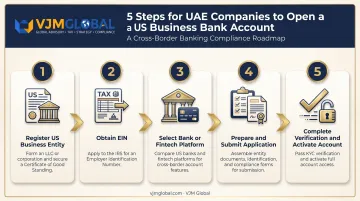
Step 1: Register a US Business Entity
Banks require a formally registered LLC or C-Corp in a US state before they'll even look at an application. There's no path around this — a UAE company operating without a registered US entity has no legal identity for a US bank to open an account against.
Delaware and Wyoming are popular choices among foreign founders, though Nevada, Texas, Florida, and California also see plenty of formations. Each state requires a registered agent with a physical street address in that state, regardless of where the actual owners live. Wyoming is explicit that a P.O. box or virtual mailbox doesn't satisfy this requirement.
A quick cost comparison:
| Factor | Delaware | Wyoming |
|---|---|---|
| Registered agent | Required, physical DE address | Required, physical WY address (no P.O. boxes) |
| Annual LLC tax | Up to $400 | $60 minimum |
| Formation fee | Varies by filing speed | $100 |
| Known for | Established corporate law system | Lower ongoing costs |
Delaware's edge is its long-standing corporate law infrastructure and specialized Court of Chancery. Wyoming's appeal is lower statutory costs and a formation form that doesn't require you to list members or managers publicly.
Choosing the right entity type and state matters more than it first appears. It shapes your tax filings and your banking options down the line. A firm experienced in cross-border formation, such as VJM Global, helps UAE founders avoid a structure that seems workable at formation but complicates account opening later.
Step 2: Obtain an EIN (Employer Identification Number)
The EIN from the IRS functions like a US tax ID for your company. It's non-negotiable — no US bank will open a business account without one.
Here's the part many UAE founders don't expect: if your company's responsible party doesn't have a US Social Security Number, you can still apply. You simply enter "foreign" on line 7b of Form SS-4, and apply by phone, fax, or mail instead of the online portal, which is restricted to applicants with a US address.
- By fax: Generally processed within 4 business days, according to IRS instructions for Form SS-4
- By mail: Around 4 weeks, and the IRS recommends applying 4-5 weeks before you actually need the EIN
- By phone: International applicants can call the IRS directly, though this line is only for foreign applicants and keeps specific hours
A delay here pushes back everything else. Get this step moving as early as possible.
Step 3: Select a Bank or Fintech Platform Suited to Non-Resident Owners
Not every US bank accepts applications from companies that are 100% foreign-owned with no US-resident officer. Some traditional banks will consider it case by case; others don't publish clear policies either way.
Mercury, for instance, explicitly states that founders don't need to be US citizens or residents, provided the business is US-registered, has a genuine US or foreign operating address, and isn't in an excluded industry like MSBs or cannabis. Relay publishes similar language for non-US-resident owners.
Before applying anywhere, check two things:
- Does the bank or platform accept 100% foreign-owned entities in writing?
- Does it require an in-branch visit, or can a signatory complete everything remotely?
Traditional banks like Chase, Bank of America, and Wells Fargo often support foreign-owned businesses too, but their public documentation is less explicit, and more complex ownership structures frequently get routed to a branch appointment.
Step 4: Prepare and Submit the Application
Once you've picked a provider, gather everything before you start the application. Going back and forth over missing documents is the single most common cause of delay at this stage.
Most applications require:
- Entity formation documents and EIN confirmation
- Identity proof for beneficial owners and signatories
- A short business description or expected transaction volume
That last item catches people off guard. Banks and fintechs want to understand what your company actually does and roughly how much money will move through the account before they approve anything.
Step 5: Complete Verification and Activate the Account
This is the KYC/AML review stage, where the bank checks beneficial owners against sanctions lists and watchlists. Under federal beneficial ownership rules, banks must verify every individual owning 25% or more of the company, plus one person with significant control.
Review times vary by provider. Some fintechs report reviewing most applications within 1-2 business days, while others can take longer if additional documents are requested. Once approved, you'll receive:
- Routing and account numbers
- A business debit card
- Online banking access to start operations immediately
Documents and Eligibility Requirements for UAE Applicants
Incomplete or inconsistent documentation is the top reason UAE-owned applications get delayed or declined. Get this checklist right before you apply anywhere.
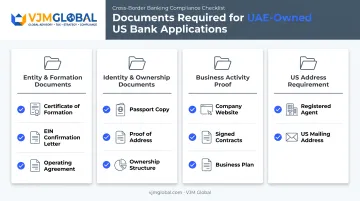
Entity and Formation Documents
- Certificate of Formation or Incorporation
- EIN confirmation letter (CP 575) from the IRS
- Operating Agreement (LLC) or Bylaws (C-Corp)
Identity and Ownership Documents
- Passport copies for every beneficial owner and signatory
- Proof of UAE residential address, such as a recent utility bill or Emirates ID
- Ownership breakdown showing each beneficial owner's percentage stake
Business Activity Proof
Banks want evidence you're running a real operating business, not a shell entity parked for tax purposes. Useful supporting documents include:
- A live company website
- Signed client contracts or invoices
- A short business plan covering what you sell and who buys it
US Address and Registered Agent Requirement
A US mailing or registered agent address is generally required, since banks can't domicile an account to a UAE address. A registered agent address meets state formation rules, but banks often still ask for a genuine operating address. The two are not automatically interchangeable.
Key Factors That Affect Bank Approval and Account Type
Approval odds and account features vary based on a handful of variables you actually control.
- Physical presence: Many large US banks still require a signatory to visit a branch in person for foreign-owned accounts. Choosing a bank without this requirement can save weeks for UAE founders who can't easily travel.
- Entity type (LLC vs. C-Corp): Banks assess LLCs and C-Corps differently for tax reporting and ownership transparency. The wrong structure can complicate later US tax filings and compliance reviews.
- Industry risk: Crypto, trading, and certain e-commerce models often trigger enhanced due diligence, longer verification, and more document requests.
- Source of funds and ownership: Banks verify where initial deposits come from and confirm every beneficial owner. Unclear or undisclosed ownership remains a leading cause of outright rejection, not just delay.
Common Mistakes UAE Businesses Make When Opening a US Bank Account
Most rejected or stalled applications trace back to a handful of avoidable mistakes:
- Applying too early — before the EIN or entity registration is fully finalized
- Using a UAE address — when the bank requires a US registered agent or mailing address
- Underestimating KYC timelines — foreign-owned entity reviews often run longer than planned and delay operational go-live
- Choosing a bank by brand alone — without first confirming it accepts non-resident, 100% foreign-owned applicants
Traditional Banks vs. Fintech Alternatives for UAE-Owned Businesses
The right choice depends on whether your business prioritizes an in-person banking relationship or fast, remote account access.
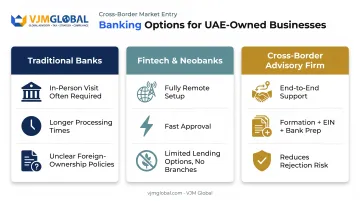
Traditional US Banks
Traditional banks suit companies that want to build long-term US credit history, apply for loans, or need trade-finance support.
Common trade-offs:
- In-person visit often required
- Longer processing for foreign-owned applicants
- Unclear public policies on 100% non-resident ownership
Fintech and Neobank Platforms
Fintech and neobank platforms suit UAE founders who need a fast, fully remote account to start receiving US client payments. Several platforms publish explicit policies that accept non-US-resident owners.
Common trade-offs:
- Fewer in-person services
- Limited lending options
- No physical branches
Working With a Cross-Border Advisory Firm
A cross-border advisory firm suits teams that want formation, EIN, and bank-readiness handled together instead of juggling multiple providers.
VJM Global supports UAE companies through this process end to end: entity type and state selection, formation filing, registered agent appointment, EIN application, and bank-application prep.
A service fee applies, but it cuts the risk of rejected applications and repeated document resubmissions that cost more time than the fee itself.
Frequently Asked Questions
Can a non-resident open a business bank account in the USA?
Yes. Non-residents can open a US business account once they have a registered US entity and an EIN, though document and verification requirements are stricter than for US residents.
Do I need to travel to the US to open a business bank account?
Some traditional banks require an in-person visit from a signatory. Several fintech platforms, by contrast, allow UAE founders to complete the entire process online.
How long does it take for a UAE company to get a US business bank account?
There's no fixed timeline, but entity formation and EIN issuance often take longer than the bank application itself. Plan extra time for document requests and KYC review.
Do I need a US address to open a business bank account?
Generally, yes. A US registered agent or mailing address is typically required, since banks can't domicile the account to a UAE address.
Can an LLC owned entirely by a UAE company open a US bank account?
Yes, fully foreign-owned LLCs can open accounts, provided the entity documents, EIN, and beneficial ownership details are complete and consistent.
What is the biggest reason US bank applications get rejected for foreign-owned companies?
Incomplete or inconsistent documentation is the top rejection trigger. Unclear ownership structures and unverifiable source of funds rank close behind—getting these right matters more than which bank you choose.