
Introduction
More UAE entrepreneurs are eyeing US expansion than ever. The UAE recently committed to a 10-year, $1.4 trillion US investment framework, a clear sign the two economies are locking in closer ties.
Most UAE business owners assume getting a "US business license" means filling out one application, the way a DED or free zone trade license works back home. It doesn't work that way.
The US runs on a layered system: state-level entity registration, a federal tax ID from the IRS, and separate permits depending on your industry and location. There's no single office that hands you one license covering everything.
This guide breaks down what a US business license actually involves and the exact steps a UAE company needs to follow. You'll get the documents required, what changes your requirements, and the mistakes that trip up most first-time applicants.
Key Takeaways
- The US has no single national business license: you need state registration, an IRS EIN, and activity-specific permits
- A UAE trade license, mainland or free zone, has zero legal standing in the US
- State and entity choice (Delaware vs. Wyoming, LLC vs. C-Corp) directly changes costs and tax exposure
- UAE documents typically need translation, notarization, and MOFAIC attestation before US authorities accept them
- Cross-border compliance mismatches are the biggest cause of delays for UAE founders entering the US
US Business Licenses Explained: How They Differ From a UAE Trade License
When Americans say "business license," they're rarely talking about one document. It's shorthand for three separate compliance layers:
- State entity formation or registration: creating your LLC or corporation with a Secretary of State
- Federal EIN: your tax ID from the IRS, required for banking and tax filing
- Activity and location permits: separate approvals tied to what you do and where you do it
The Small Business Administration confirms this directly: most small businesses need a combination of federal and state licenses or permits, with exact requirements depending on your industry, state, county, and city.
Here's the part that surprises UAE founders most: your existing trade license doesn't transfer. A DED mainland license or a DIFC/ADGM free zone license carries no jurisdictional weight in Florida, Delaware, or anywhere else in the US. It simply isn't recognized.
That leaves two realistic paths:
- Form a new US LLC or corporation: the usual route for a US-facing business, investors, or a US brand built from scratch
- Foreign-qualify your existing UAE entity: register that company to transact in a specific state when it must keep its identity for contracts or banking
Most UAE founders choose the first option. It's cleaner, easier for US banks and investors to understand, and skips repeated proof that your UAE entity remains in good standing.
How to Get a Business License in the USA as a UAE Company: Step-by-Step
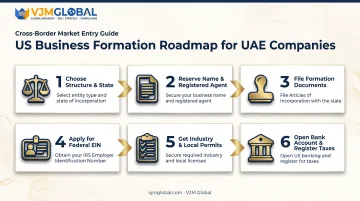
Step 1: Choose Your Business Structure and State of Incorporation
Your first decision shapes everything downstream: taxes, paperwork, and how investors view your company.
LLC vs. C-Corp:
- LLC: pass-through taxation, simpler annual compliance, popular with founders running the business themselves
- C-Corp: double taxation at the corporate and dividend levels, but the structure VCs expect if you're raising US funding
Why Delaware and Wyoming dominate: Delaware offers legal predictability that investors trust, backed by a specialized business court system. Formation starts at $109 for a corporation and $110 for an LLC, though corporations owe an annual franchise tax with a $175 minimum and LLCs pay a flat $400 annual tax.
Wyoming, by contrast, charges a $100 LLC filing fee and a modest annual report fee starting at $60 for smaller entities — no franchise tax calculation to worry about. It's the go-to for founders prioritizing low ongoing costs over investor familiarity.
Step 2: Reserve a Business Name and Appoint a Registered Agent
Before filing anything, check name availability in two places:
- The Secretary of State database for your chosen state
- The USPTO trademark database, to avoid federal trademark conflicts down the line
Since your UAE company has no US address, appointing a registered agent licensed in your incorporation state is a legal requirement, not optional. This agent receives legal and tax correspondence on your behalf and must maintain a physical address in that state.
Step 3: File Formation Documents with the State
You create the legal entity by filing Articles of Organization (LLC) or Articles of Incorporation (Corporation) with the Secretary of State.
A few things to watch:
- Any UAE-issued supporting documents may need notarization or attestation before the state accepts them
- Filing fees and processing times vary widely — Wyoming caps mailed reviews at 15 business days, while Delaware offers paid expedited options ranging from same-day to one-hour service
- Always check the specific state's current fee schedule before filing, since these numbers change
Step 4: Apply for a Federal EIN from the IRS
Your EIN is roughly the US equivalent of your UAE Tax Registration Number. You need it to open a bank account, file taxes, and hire.
If you don't have a US Social Security Number, you can't use the instant online EIN system. Apply via Form SS-4 by fax, mail, or phone as an international applicant.
According to IRS instructions for Form SS-4, fax applications typically produce an EIN within 4 business days, while mailed applications take roughly 4 weeks. The IRS recommends submitting SS-4 at least 4-5 weeks before you need the EIN. Plan accordingly.
Step 5: Apply for Industry-Specific and Local Business Permits
State registration and an EIN don't automatically clear you to operate. Depending on your business activity, you may need:
- Federal licenses for regulated activities like import/export or financial services
- State permits tied to your industry, checked through the state's Department of Revenue
- Local permits for things like food service, retail signage, or zoning compliance
Before you launch, map required permits against your NAICS activity and the city or county where you'll operate, then confirm federal overlays if you touch import/export or financial services.
Step 6: Open a US Business Bank Account and Register for State Taxes
Many major US banks still require in-person verification for non-resident business owners, though some providers now offer remote setup for founders who can't travel immediately. Expect to provide passport identification and formation documents regardless of the route.
Once your entity is active, register for applicable state sales tax or franchise tax obligations. This step gets missed often, and unpaid state tax obligations accumulate until they surface as a bigger problem.
What You Need Before Applying: Documents and Requirements for UAE Applicants
UAE applicants face one extra layer that non-UAE founders don't: document authentication. Here's what typically gets requested.
Core identification:
- Passport copies of all directors, shareholders, and ultimate beneficial owners
- A company extract or Certificate of Good Standing from your UAE licensing authority, where applicable
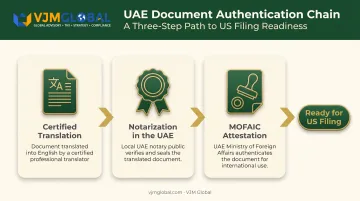
Emirates ID authentication chain: Most founders underestimate this step. A UAE-issued Emirates ID generally needs to be:
- Translated by a certified translator
- Notarized within the UAE
- Attested by the UAE Ministry of Foreign Affairs (MOFAIC)
Once that chain is done, the document is typically ready for US filing.
US address requirement: A UAE-only address can't satisfy state incorporation rules — you need a US registered address or agent. VJM Global’s New York office gives UAE clients a US base for this requirement during formation.
Other essentials:
- EIN applications without a US SSN take longer — build the fax/mail timeline into your launch plan
- Regulated activities (finance, healthcare, food service) often need a business plan or activity description with your application
Key Factors That Affect Your US License Requirements
Not every UAE company faces the same checklist. Requirements shift based on where, what, and how you operate.
State of Incorporation
| Factor | Delaware | Wyoming |
|---|---|---|
| LLC filing fee | $110 | $100 |
| Annual cost | $400 flat tax | ~$60 minimum |
| Investor familiarity | High | Moderate |
| Franchise tax complexity | Yes (share-based) | No |
Delaware suits founders planning to raise US venture capital. Wyoming suits founders prioritizing lower long-term costs with no immediate funding plans.
Business Activity or Industry
Regulated sectors trigger extra licensing layers beyond basic state registration:
- Food and beverage — local health permits
- Financial services — federal and state regulatory approval
- Healthcare — professional licensing boards
- Real estate — state broker or agency licensing
Missing one of these can delay your launch or trigger fines, even after your entity is fully incorporated.
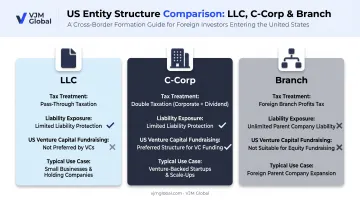
Entity Structure (LLC vs. C-Corp vs. Branch)
Your structure determines tax treatment, liability, and your ability to raise US capital:
- LLC — flexible pass-through taxation; fits most operating businesses
- C-Corp — standard choice when you plan to raise US venture capital
- Branch — extends the UAE parent directly and can create US tax and liability exposure
Switching later, such as from LLC to C-Corp, usually means costly re-registration rather than a simple amendment.
Physical Presence and Economic Nexus
Selling into a state can create tax obligations even without an office there. California's economic nexus threshold sits at $500,000 in sales, while New York applies $500,000 plus more than 100 transactions. Cross that line in multiple states, and you may need multi-state sales tax registration on top of your original state filing.
Common Mistakes UAE Companies Make When Applying for a US License
UAE companies hit the same avoidable snags when applying for a US license. Watch for these:
- Defaulting to Delaware without weighing alternatives. Generic advice says "always incorporate in Delaware." That ignores your customer base, tax exposure, and industry rules. Wyoming or another state might fit better.
- Underestimating document authentication timelines. Translation, notarization, and MOFAIC attestation for UAE documents routinely delay EIN applications and bank setup by weeks, not days.
- Assuming incorporation equals full compliance. Approved Articles of Organization are not the finish line. Industry-specific and municipal permits still need separate applications.
- Treating entity formation and tax planning as unrelated projects. There is no comprehensive US-UAE income tax treaty, so double taxation and income sourcing work differently than under treaty protection. Map foreign tax credits and state nexus up front—advisors such as VJM Global do this with UAE founders before gaps turn into penalties.
Frequently Asked Questions
Does a UAE license work in the USA?
No. A UAE trade license, whether mainland or free zone, has no legal recognition in the US. A UAE company must incorporate a new US entity or foreign-qualify its existing one to operate legally.
What is a business license in the USA?
A US business license is typically a mix of state entity registration, an IRS EIN, and any federal, state, or local permits tied to your specific activity.
How do I verify a UAE company license?
Identify the specific licensing authority, whether a DED, free zone, DIFC, or ADGM, and search that authority's own online portal using the trade license number.
Can a UAE company own 100% of a US LLC?
Yes. Most US states allow 100% foreign ownership of an LLC or corporation, with no residency or citizenship requirement, unlike some UAE mainland sector restrictions.
How long does it take for a UAE company to get a US business license?
State filing can take anywhere from same-day to a few weeks, while EIN processing for non-residents adds roughly 4 business days by fax or 4 weeks by mail. UAE document attestation is usually the biggest bottleneck.
Do I need a US visa to own a business in the USA as a UAE resident?
No. Owning a US company doesn't require a visa. However, physically working in the US or drawing a salary there may trigger separate immigration requirements —review those rules first.