UAE founders entering the US face a genuinely different rulebook. There's no single national business registry, no US-UAE tax treaty to lean on, and foreign-owned entities routinely hit friction when opening bank accounts or proving beneficial ownership. Add a 50-state patchwork of tax and employment rules, and it's easy to see why so many promising expansions stall in year one.
This guide walks through the realistic entry routes available to UAE businesses, how to choose the right entity and state, what the IRS actually expects from foreign-owned entities, and the mistakes that trip up even well-funded founders.
Key Takeaways
- Choose US entry via entity setup, EOR, distributors, or e-commerce based on capital and risk tolerance.
- Entity type and state choice drive tax outcomes for non-resident owners, including withholding and IRS reporting.
- With no comprehensive US-UAE tax treaty, Form 5472 compliance and structure matter from day one.
- Cross-border specialists cut compliance risk and speed formation for UAE-origin businesses.
Why the US Market Is a Strategic Opportunity for UAE Businesses
US consumer spending accounts for more than two-thirds of the entire economy, and it kept growing at roughly a 2.3% annualized rate even through a period of elevated interest rates, according to Reuters' 2024 coverage of US GDP data. That's the scale UAE businesses are tapping into.
The bilateral relationship is already substantial. Total US-UAE goods trade hit $34.4 billion in 2024, per US Census Bureau figures, with the US running a trade surplus of nearly $19.6 billion. Inbound investment into the US is strong as well: FDI inflows reached $225 billion in 2024, up 10% year-over-year.

UAE businesses aren't just watching from the sidelines. Diversification away from oil-linked and purely regional trade is accelerating, particularly in:
- E-commerce and D2C consumer brands
- Trading and import-export operations
- F&B franchising
- Technology and SaaS
- Real estate investment and development
Structural Advantages UAE Companies Already Have
UAE-origin companies enter with a few built-in edges most foreign entrants don't have:
- The AED's peg to the US dollar (AED 3.6725 per USD, maintained by the Central Bank of the UAE) removes currency risk that trips up competitors from floating-rate economies
- UAE free zone structures have already familiarized founders with formal corporate governance
- The English-language business environment eliminates the translation layer that slows entrants from non-English markets
None of that removes the compliance burden, but it does shorten the learning curve.
US Market Entry Strategies for UAE Companies
There's no single "correct" way to enter the US. Think of it as a spectrum: low commitment and low control on one end, full ownership and full control on the other. Most successful UAE entrants don't pick one lane and stay there. They start lean, then layer on more commitment as demand proves out.
Direct US Entity Establishment (LLC or C-Corp)
This is the highest-commitment route: forming an LLC or C-Corporation under a US state's laws. It suits UAE companies with proven US demand or active fundraising plans, since investors and larger US customers generally expect a domestic legal entity.
The trade-off is complexity. You're now navigating federal and state regulations simultaneously, plus:
- Opening a US business bank account as a foreign-owned entity
- Obtaining an EIN from the IRS
- Meeting state-specific annual filing requirements
None of these steps are impossible to handle remotely, but they move faster with advisors who have formed foreign-owned US entities before. VJM Global supports UAE companies through US entity formation, EIN registration, and ongoing state compliance.
Employer of Record (EOR) for Market Testing
An EOR lets a UAE company hire US-based staff or test a market segment without incorporating anything. You can recruit in the US without directly employing workers there.
You still need to watch for unintended tax or permanent-establishment exposure from the arrangement. For UAE SMEs, this is usually the lowest-risk starting point.
You validate product-market fit (do Americans actually want this, at this price, through this channel) before committing capital to entity formation, banking setup, and ongoing state compliance.
Distributor, Reseller, and Trading Partnerships
UAE trading houses and import-export businesses are often already comfortable operating through intermediaries. Extending that model to the US, using distributors or resellers, is a natural fit.
It's faster and cheaper than building direct infrastructure. The trade-off: you give up meaningful control over branding, pricing, and the customer relationship itself. That can matter a lot if your long-term plan involves a direct-to-consumer brand.
E-Commerce and Digital-First Entry
UAE consumer brands can test US demand through Amazon US, Shopify storefronts, and digital payment rails, often with far lower upfront investment than any physical presence route.
One caveat that catches people off guard: selling into the US digitally doesn't exempt you from sales tax nexus rules. Since the Supreme Court's Wayfair decision, states can require tax collection based on economic activity alone, with no warehouse or office required.
Marketplace facilitators like Amazon may collect on your behalf in some states. That does not automatically clear you of registration or filing obligations elsewhere.
Choosing the Right Business Structure and State for US Market Entry
Get this decision wrong and you'll spend the next few years untangling it. Get it right early, and everything downstream (banking, taxes, fundraising) moves more smoothly.
LLC vs. C-Corporation for Non-Resident Owners
For a foreign, non-resident owner, the two structures behave very differently:
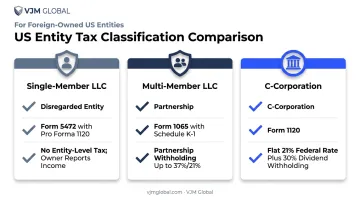
- Single-member LLC: Defaults to "disregarded entity" status federally. You still file Form 5472 with a pro forma Form 1120 for reportable related-party transactions, including capital contributions.
- Multi-member LLC: Defaults to partnership taxation. Withholding on income allocable to foreign partners runs as high as 37% (non-corporate) or 21% (corporate).
- C-Corporation: Files Form 1120 at a flat 21% federal rate, regardless of profitability. Dividends to a nonresident owner generally face 30% withholding, with no US-UAE treaty rate available.
Most UAE founders raising outside capital or planning eventual acquisition lean toward a C-Corp. Those keeping things simple and founder-owned often start with an LLC.
Delaware vs. Your Operating State
Delaware remains the default for a reason: more than two-thirds of Fortune 500 companies are incorporated there, according to the state's own 2024 annual report. Its corporate law is well understood by US investors and lawyers alike.
That said, Delaware isn't automatically the right call. If your UAE company will run physical trading operations, warehousing, or retail presence concentrated in one state, incorporating in that operating state directly can simplify tax filings and cut out an unnecessary layer of registration.
Banking, EIN, and Ongoing Compliance
This is where a lot of UAE founders get stuck. US banks apply strict customer due diligence rules, requiring identification and verification of any beneficial owner holding 25% or more of the entity, plus at least one controlling individual.
Documentation standards for non-US directors tend to be more extensive than for domestic founders. EIN acquisition adds its own timeline: foreign applicants without a US address can't use the IRS online tool. The fax route generally takes about four business days; mail can stretch to four weeks.
Every state also requires a registered agent (a person or service with a physical in-state address to receive legal and official documents) before formation paperwork can be filed. Once formed, most states expect annual reports and franchise tax payments.
Delaware, for example, charges a flat $300 annual tax for LLCs, while corporations pay a minimum franchise tax starting around $175, depending on the calculation method used.
This multi-month grind often catches foreign founders off guard. VJM Global's US entity formation service handles state selection, EIN acquisition, and registered agent setup end-to-end for UAE clients. That support typically compresses a process that otherwise drags out over months of back-and-forth with unfamiliar state and federal systems.
Tax, Compliance, and Regulatory Considerations for UAE Companies
There's no comprehensive tax treaty between the US and UAE. The UAE simply doesn't appear on the IRS's current list of income tax treaty partners. That single fact shapes almost everything downstream for a UAE-owned US entity.
IRS Reporting Obligations
Foreign-owned US entities face specific, non-negotiable filing requirements:
- Form 5472 with a pro forma Form 1120, even when the entity owes no US income tax
- Related-party transaction detail (intercompany loans, capital contributions, and service fees)
- Supporting books and records that substantiate every amount reported on those forms
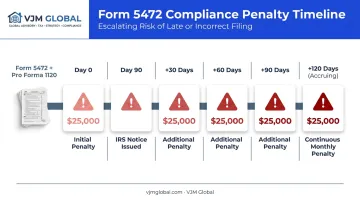
The penalty exposure here is steep: an initial failure to file correctly or on time carries a $25,000 penalty, and if the failure continues more than 90 days after IRS notice, another $25,000 applies for each 30-day period that follows. This isn't a filing you want to treat as optional paperwork.
Sales Tax Nexus and Franchise Tax
Physical presence isn't the trigger it used to be. Economic nexus rules mean a UAE company can owe sales tax registration and collection duties in a state purely from transaction volume or revenue, with no office or warehouse involved. Thresholds vary by state and change over time, so this needs checking state-by-state, not assumed as a flat national rule.
Franchise tax is a separate state-level cost. Several states charge a privilege or franchise tax on entities formed or doing business there—Delaware, Texas, and California among the common examples. Minimum taxes and annual report fees can apply even in low- or no-revenue years, so build them into state selection and your ongoing budget.
Employment Law the Moment You Hire
Whether you hire directly or through an EOR, US employment law kicks in immediately:
- Federal income tax and Social Security/Medicare withholding
- Employer-side FUTA and state unemployment insurance contributions
- Forms 941, 940, and W-2 filings
- State-specific requirements like workers' compensation and disability insurance
The GAAP vs. IFRS Reporting Gap
Most UAE businesses report under IFRS. US entities operate under US GAAP, and the two frameworks diverge in ways that matter to lenders and investors. IFRS permits certain impairment reversals that GAAP prohibits, for instance, and inventory valuation methods differ.
For a UAE parent company needing consolidated reporting across both markets, this gap is more than academic. VJM Global's CPAs and Chartered Accountants work across both standards, producing GAAP-compliant filings for US stakeholders while keeping IFRS reporting intact for UAE-based investors or lenders.
Avoiding Common Mistakes and Building a Practical Entry Roadmap
Two mistakes account for most of the pain UAE founders experience in their first year of US operations.
Mistake one: assuming UAE practices transfer directly. Banking relationships, negotiation norms, and even standard payment terms work differently in the US. A UAE business's established free zone banking relationship carries zero weight with a US institution running its own KYC process from scratch.
Mistake two: hiring or signing contracts before compliance infrastructure exists. Bringing on US staff or signing a lease before you have an EIN, registered agent, and payroll setup in place creates liability gaps that are expensive to unwind later.
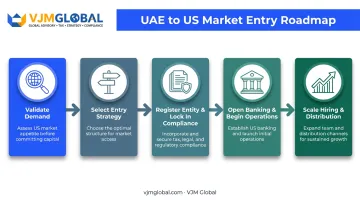
A more reliable sequence looks like this:
- Validate demand — through EOR-based hiring, distributor deals, or e-commerce, before committing capital.
- Select an entry strategy — matched to your capital, timeline, and control preferences.
- Register the entity and lock in compliance infrastructure — EIN and registered agent in place before any hiring or contracting.
- Open banking and begin operations — with documentation prepared for foreign-owner scrutiny.
- Scale hiring and distribution — including payroll setup, once the compliance foundation is proven—not before.
Frequently Asked Questions
What are the main market entry strategies for UAE companies entering the USA?
The four core routes are direct entity formation (LLC or C-Corp), Employer of Record hiring, distributor or trading partnerships, and digital-first e-commerce entry. Most UAE companies start with a lower-commitment route and scale up as demand is validated.
How do I register a UAE company in the US?
Choose an entity type and state, appoint a registered agent, file your formation documents, obtain an EIN from the IRS, and open a US business bank account. Foreign-owned entities typically face additional documentation requirements at the banking stage.
Is there a tax treaty between the US and UAE?
No. The UAE doesn't appear on the IRS's list of income tax treaty partners, so UAE-owned US entities need careful planning around IRS filings and potential double taxation exposure rather than relying on treaty relief.
What is the fastest way for a UAE business to test the US market?
Employer of Record hiring or e-commerce entry through platforms like Amazon US typically allow market testing within weeks, without the time or cost of full entity formation.
Which US state is best for a UAE company to incorporate in?
Delaware suits most UAE companies seeking investor credibility, given its established corporate law and familiarity to US investors. Companies with physical US operations concentrated in one state may benefit from incorporating there instead.
Can a UAE business owner get a visa to run their US company?
Visa eligibility depends on individual circumstances and is entirely separate from entity registration. Consult an immigration specialist alongside your entity formation process. Forming a US company does not grant work authorization on its own.