Introduction
UAE entrepreneurs are looking west more than ever. The U.S. Census Bureau recorded 5,671,836 business applications in 2025 alone. That volume shows how strongly the American market still draws founders from everywhere, including the Gulf.
Here's the catch most UAE founders miss. In the UAE, you register a trade name through your emirate's Department of Economic Development or a free zone authority. In the US, there's no equivalent single desk. Naming rules, required suffixes, and restricted words all shift depending on which state you pick.
This guide breaks down the US naming system, what is allowed and what is not, a step-by-step registration path, and the extra steps UAE-based founders need to plan for.
Key Takeaways
- No single US registry exists for business names; every state sets its own rules.
- A name can require up to four separate registrations: entity name, trademark, DBA, and domain.
- States require names to be "distinguishable" and, for LLCs and corporations, to carry a specific suffix.
- You don't need a US Social Security Number, but you do need a registered agent with a physical US address.
- Choosing the right name, state, and structure up front prevents costly renaming later.
Understanding the US Business Name System: What UAE Entrepreneurs Need to Know
The US runs 50 separate state registries plus one for Washington, DC — not one federal system. A name that's free in Delaware could already belong to someone else in New York, and there's no central lookup that checks both at once.
If that sounds chaotic compared to home, think of it like the UAE's own setup: each emirate's DED runs its own name approvals, and on top of that sit 40+ free zone authorities, each with its own rules. The US just spreads that same logic across 50 states instead of seven emirates.
Four Ways a Business Name Gets Protected
A single business name in the US can actually touch four completely separate registrations:
- Entity name – your legal identity, registered with a state's Secretary of State
- Trademark – federal protection through the USPTO, covering how your brand is used commercially
- DBA (fictitious name) – a local filing required in some states when you trade under a name different from your legal entity name
- Domain name – your web address, registered through any domain registrar
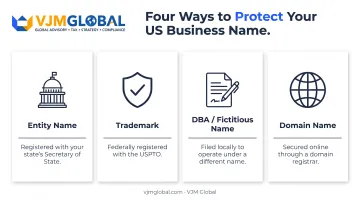
Most small businesses end up using the same name across all four. Aligning all four is smart practice, though the law does not require it.
Before running any name search, decide your business structure. An LLC needs a different suffix than a C-corporation, and that choice also shapes your tax treatment down the line.
Where you form the entity matters next. Delaware and Wyoming come up often for foreign founders. Delaware calls itself a leading domicile for US and international entities and reported over 2.28 million active business entities in 2025. Wyoming, meanwhile, keeps its LLC and corporation filing fees at a flat $100. Neither state requires you to live there.
VJM Global works with UAE clients to weigh these factors, plus tax exposure and target-market fit, before the name search even starts.
US Business Naming Rules and Requirements: What's Allowed and What's Not
Every state applies a "distinguishability" test. Your proposed name can't be identical, or confusingly close, to a name already on file with that state's Secretary of State. California, for example, checks this against its own database of registered entity names. It explicitly warns that its online search is preliminary, not a final approval, and doesn't cover trademarks at all.
Suffixes Aren't Optional
Skip the required suffix and your filing gets rejected. Common examples:
- LLCs: "LLC" or "Limited Liability Company"
- Corporations: "Inc.," "Corporation," "Incorporated," or "Limited" (varies by state)
New York, for instance, requires corporation names to include "Incorporated," "Corporation," or "Limited," or an approved abbreviation. Exact wording differs state to state, so check the specific filing office before you file.
Restricted and Regulated Words
Certain words trigger extra scrutiny or require regulator sign-off first. New York's Department of Financial Services, for example, requires consent for banking terms like Bank, Finance, Loan, and Mortgage, and insurance terms like Insurance, Assurance, and Underwriter.
Getting that consent doesn't reserve the name or license the activity. It's a separate hurdle entirely.
This isn't so different from UAE rules restricting words like "Insurance" or "Finance" without Central Bank approval — the logic is the same, just administered by a different regulator on each side.
Names implying government affiliation are banned outright, nationwide, regardless of state. Think "Treasury," "FBI," or "State Department." No state will approve these.
Regulated professions add another layer. If you're forming a business in law, medicine, or financial advisory, expect state board approval before your name is finalized.
The Federal Trademark Check Is Separate
State approval only confirms your name is available in that state. It says nothing about trademark conflicts. The USPTO retired its old TESS tool in November 2023 and replaced it with a new search system. Running a comprehensive clearance search through USPTO's database checks for names that are confusingly similar, not just identical, across related goods and services.
Step-by-Step: How to Register Your Business Name in the USA from the UAE
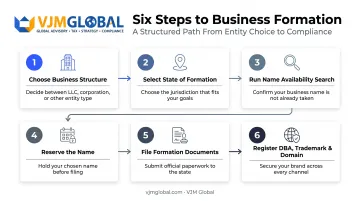
Choose your business structure. An LLC and a C-corporation carry different naming suffixes and create different tax outcomes for a nonresident owner. Get this decision right before anything else.
Select your state of formation. Base this on your target market, tax exposure, and filing costs, not just where you happen to have physical ties. Delaware and Wyoming are common picks for exactly this reason.
Run a name availability search. Use the chosen state's Secretary of State portal to check for exact matches and phonetically similar names. Treat the result as a starting point, not a guarantee.
Reserve the name, if needed. Most states let you hold a name for a fee before filing. Delaware offers a 120-day reservation for $75; New York offers 60 days for $20. Confirm the timeline and fee for your state before you pay.
File your formation documents. File Articles of Organization (LLC) or Articles of Incorporation (corporation) through a registered agent. UAE-based founders need one—every state requires an in-state physical address for legal correspondence.
Register a DBA and secure your brand. If you'll operate publicly under a name different from your legal entity name, file a DBA. Then submit a trademark application with the USPTO and secure a matching domain to round out your brand protection.
Special Considerations for UAE-Based Founders
UAE-based founders face a few requirements that sit outside pure name selection. Handle them early so they don't stall your US filing.
Registered agent (required in every state). Every US state needs a registered agent with a physical in-state address to receive legal documents. A UAE-based founder can't fill this role personally. VJM Global's cross-border entity formation service arranges the registered agent in the same engagement as your EIN filing and US tax compliance work, including FBAR and FATCA reporting where applicable.
EIN without an SSN. You don't need a US Social Security Number to get an Employer Identification Number. On IRS Form SS-4, nonresident applicants without an SSN or ITIN enter "foreign" on the relevant line. Apply by phone, fax, or mail; the IRS recommends starting four to five weeks before you need the EIN.
Document authentication, not apostille. The UAE is not a member of the Hague Apostille Convention. UAE-issued documents used in US filings typically need a formal legalization chain through the UAE Ministry of Foreign Affairs and the relevant US embassy or consulate, not a simple apostille stamp. Plan extra lead time for this step.
Expanding to a second state. Your registered name isn't automatically protected in other states. Run the name search again where you expand. If the name is taken, you'll use an alternate name when you foreign-qualify to do business in that jurisdiction.
Common Naming Mistakes to Avoid
A compliant state filing doesn't mean you're in the clear everywhere else. Watch for these three traps:
- Skipping the federal trademark check. A name can clear your state's Secretary of State search and still trigger a trademark dispute later. State approval and federal trademark clearance are separate processes.
- Ignoring domain and social handle availability. Filing your entity name before confirming matching domains and social handles creates a mismatched brand identity online.
- Picking a name that's too geography-specific. A name tied to one city or region can box you in later if you expand into other states or product lines.
Frequently Asked Questions
Can a foreigner register a business in the USA?
Yes. UAE citizens and other nonresidents can form an LLC or corporation in any US state without citizenship, residency, or a visa. You will need a registered agent and an EIN.
Do I need a US address to register a business name in the USA?
No personal US address is required. However, a registered agent with a physical in-state address is mandatory for receiving legal and government correspondence.
Can I use the same business name in every US state?
Not automatically. Name approval is state-specific, so the same name must be checked and registered separately as a foreign entity in each additional state where you operate.
What business name suffixes are required for LLCs and corporations in the USA?
LLCs typically need "LLC" or "Limited Liability Company." Corporations typically need "Inc.," "Corporation," or "Incorporated." Exact wording varies by state, and omitting the suffix causes rejection.
How do I check if a business name is available in the USA?
Search your chosen state's Secretary of State online name-search tool first. Then run a separate check against the USPTO trademark database, since the two systems don't cross-reference each other.
Do I need a Social Security Number to register a business name in the USA?
No. Nonresidents can obtain an EIN using IRS Form SS-4 by entering "foreign" where an SSN would normally go.