This guide breaks down Singapore's audit exemption framework: who qualifies, how group structures affect eligibility, what financial obligations stay in place, and what ACRA's 2026 review could mean for your business.
TLDR: Key Takeaways on Singapore Audit Exemption
- Audit exemption is automatic — qualifying companies do not need to apply; eligibility is determined by the criteria alone
- Private companies qualify by meeting 2 of 3 thresholds (revenue ≤ S$10M, assets ≤ S$10M, ≤50 employees) for two consecutive years
- For group companies, both the individual entity and the consolidated "small group" tests must be satisfied
- Exempt companies still must prepare SFRS-compliant financial statements and file annual returns
- ACRA is reviewing thresholds in 2026 and may raise limits to align with Australia, UK, and New Zealand
What is Audit Exemption in Singapore?
Under Section 205C of the Singapore Companies Act, all incorporated companies are generally required to have their financial statements audited annually. However, qualifying "small companies" are exempt from this obligation, reducing compliance costs without eliminating financial accountability.
What the exemption means:
- Your company does not need to appoint an external auditor
- You are not required to conduct a formal statutory audit
What it does not mean:
- You are not exempt from preparing financial statements
- You must still file financial statements with ACRA as part of your annual return
Historical Context
The current framework replaced a much narrower rule. Before July 1, 2015, only Exempt Private Companies (EPCs) with annual revenue under S$5 million qualified for exemption. The Companies (Amendment) Act 2014 replaced this with a broader "small company" concept, introducing quantitative thresholds across revenue, assets, and headcount — a structure that took effect from July 1, 2015 and opened the exemption to significantly more businesses.
Small Company Audit Exemption Criteria in Singapore
To qualify for audit exemption, your company must meet two core conditions:
- It must be a private company during the financial year in question
- It must satisfy at least 2 out of 3 quantitative thresholds for the immediate past two consecutive financial years
Public companies are not eligible for this exemption, regardless of size.
The Three Quantitative Thresholds
Your company qualifies as a "small company" if it meets at least two of the following criteria:
| Criteria | Threshold |
|---|---|
| Total annual revenue | ≤ S$10 million |
| Total assets | ≤ S$10 million at year-end |
| Full-time employees | ≤ 50 at year-end |
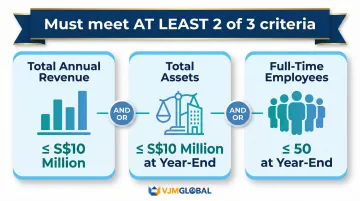
These thresholds must be met across the immediate past two consecutive financial years to maintain exemption status.
Exemption Rules for Newly Incorporated Companies
Companies incorporated less than two years ago follow a simplified assessment:
- They need to meet the qualifying criteria in their current financial year
- They do not need to look back two consecutive years
Example: If your company is in its first financial year, you check the criteria for that year only. If you meet 2 of the 3 thresholds, you qualify for exemption immediately.
Transitional Provisions for Pre-2015 Companies
Companies incorporated before July 1, 2015 had a transitional rule:
- They qualified as a small company if they met the criteria in either the first or second financial year commencing on or after July 1, 2015
- A company that failed to meet the criteria in both years (FY2015 and FY2016) would not qualify
Unlike the old EPC criteria, the current framework places no restrictions on corporate shareholders. Having a corporate shareholder does not disqualify your company from exemption.
Audit Exemption for Group Companies in Singapore
If your company is part of a corporate group, audit exemption becomes more complex. Both the individual company and the entire group must qualify.
What constitutes a "group"?
- A parent company and its subsidiaries
Dual requirement:
- The individual company must qualify as a small company (meet 2 of 3 thresholds)
- The entire group must qualify as a "small group" on a consolidated basis
Meeting only one condition is not enough — both must be satisfied simultaneously.
What Qualifies as a "Small Group"?
A small group must meet at least two of the following three thresholds on a consolidated basis for the immediate past two consecutive financial years:
- Annual revenue ≤ S$10 million
- Total assets ≤ S$10 million
- Employee headcount ≤ 50
Consolidated figures are drawn from:
- The holding company's consolidated financial statements
- All entities under the group, including foreign subsidiaries
Common Misconceptions About Group Exemption
"My subsidiary qualifies individually as a small company, so it's exempt."
- In practice, if the overall group exceeds the consolidated thresholds, the subsidiary must still be audited — even if it individually meets the criteria.
"Our group is a small group, so all subsidiaries are automatically exempt."
- Not quite. If a particular subsidiary does not individually qualify as a small company (fails to meet 2 of 3 thresholds), the exemption does not apply to that subsidiary — even if the group qualifies as a small group.
Foreign Subsidiaries and Group Exemption
When assessing whether a group meets the "small group" criteria, all entities under the group — including those incorporated or based overseas — are counted in the consolidated figures. That said, the audit exemption under Section 205C only applies to Singapore-incorporated companies; foreign subsidiaries remain subject to the audit requirements of their own jurisdictions.
How to Maintain or Lose Your Audit Exemption Status
Once qualified, your company continues to be exempt in subsequent financial years unless one of two disqualifying events occurs.
Two Conditions That Cause Loss of Exemption
- The company ceases to be a private company at any point during a financial year
- Example: Converting to a public company
- The company fails to meet at least 2 out of 3 quantitative criteria for two consecutive preceding financial years
Grace Period and the Two-Year Rule
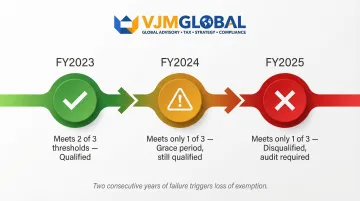
The loss is not immediate. A single bad year does not strip the exemption. The company must fail the criteria for two consecutive years before losing audit exemption status.
Example:
- FY2023: Meets 2 of 3 thresholds (qualified)
- FY2024: Meets only 1 of 3 thresholds (still qualified—grace period)
- FY2025: Meets only 1 of 3 thresholds (now disqualified—two consecutive years of failure)
What Happens When You Lose Exemption?
Once disqualification kicks in, the company must take immediate compliance action:
- Appoint auditors for the relevant financial year
- Recommence statutory audit in compliance with the Companies Act
If your company is operating close to the thresholds, track your financials annually so changes in audit status don't catch you off guard. An unexpected shift to non-exempt status can leave you scrambling to appoint auditors under tight deadlines.
Financial Obligations That Remain After Audit Exemption
Audit exemption does not eliminate your company's fundamental financial obligations. Several requirements remain in place.
Maintaining Proper Accounting Records
Section 199 of the Companies Act requires every company to keep accounting records that:
- Sufficiently explain the transactions and financial position of the company
- Enable the preparation of true and fair financial statements
- Must be retained for at least 5 years
Failure to maintain proper records is a compliance breach, even for exempt companies.
Preparing and Filing Financial Statements
Exempt companies must still:
- Prepare financial statements in compliance with Singapore Financial Reporting Standards (SFRS)
- File them with ACRA as part of their annual return
The financial statements are unaudited — no external auditor reviews them — but they must still give a true and fair view of the company's performance. That responsibility falls entirely on management. For cross-border businesses handling multiple jurisdictions, outsourced accounting support — such as the services VJM Global provides — can help ensure SFRS-compliant statements and accurate filings.
Shareholder Safeguard
Even if your company is exempt, shareholders holding at least 5% of the total issued shares retain the right to require the company to conduct a statutory audit. This provides a check on management and ensures minority shareholders can demand accountability when needed.
ACRA's 2026 Audit Exemption Framework Review
In February 2026, ACRA announced a formal review of Singapore's audit exemption framework, noting that average company asset values and revenues have grown considerably since the S$10 million thresholds were set in 2015.
Why the Review?
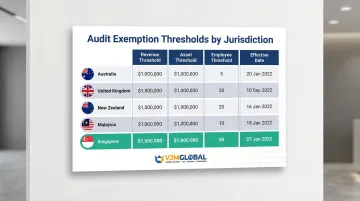
| ACRA observed that comparable jurisdictions including Australia, the UK, New Zealand, and Malaysia have raised their audit exemption thresholds in recent years to account for inflation and economic growth. | Jurisdiction | Revenue Threshold | Asset Threshold | Employee Threshold | Effective Date |
|---|---|---|---|---|---|
| Australia | ≥ A$50 million | ≥ A$25 million | ≥ 100 employees | 1 July 2019 | |
| United Kingdom | ≤ £15 million | ≤ £7.5 million | ≤ 50 employees | 6 April 2025 | |
| New Zealand | > NZ$33 million | > NZ$66 million | N/A | 29 September 2025 | |
| Malaysia | ≤ RM3 million | ≤ RM3 million | ≤ 30 employees | 1 January 2027 |
Key Areas Under Review
ACRA is focusing on two primary areas:
- Raising the total annual revenue and total assets thresholds beyond S$10 million
- Exploring whether subsidiaries in large groups could qualify for exemption under specific conditions, even if the overall group exceeds the consolidated thresholds
Consultation Timeline
Targeted industry consultations commenced in March 2026. Companies can track updates and submit feedback directly through ACRA's official review page.
If thresholds are raised, companies currently sitting just above the S$10 million mark — particularly subsidiaries of larger groups — should reassess their eligibility once final guidelines are published.
Frequently Asked Questions
What is audit exemption in Singapore?
Audit exemption is a provision under Section 205C of the Singapore Companies Act that allows qualifying "small companies" to skip the mandatory annual statutory audit. This reduces compliance costs while still requiring companies to prepare and file SFRS-compliant financial statements.
Is audit mandatory for all companies in Singapore?
Statutory audit is mandatory by default for all Singapore-incorporated companies. However, private companies that qualify as "small companies" (or belong to a "small group") are exempt. Dormant companies may also qualify for a separate exemption under Section 205B.
Which companies qualify for audit exemption in Singapore?
Private companies qualify if they meet at least 2 out of 3 criteria (revenue ≤ S$10M, assets ≤ S$10M, ≤50 employees) for the past two consecutive financial years. Group companies must additionally satisfy the small group consolidated test.
Do companies need to apply for audit exemption in Singapore?
No formal application or approval from ACRA is required—the exemption is automatic once a company meets the qualifying criteria. Companies should, however, assess their eligibility each financial year and maintain documentation supporting their qualifying status.
Does the two-year rule apply to audit exemption in Singapore?
Yes. The two-year rule is central to the framework—a company must meet at least two of the three quantitative criteria for the two immediately preceding consecutive financial years to qualify. Similarly, a company must fail those criteria for two consecutive years before losing the exemption.
Is an internal audit mandatory in Singapore?
Internal audit is not mandatory for all Singapore companies under the Companies Act. It is typically required for SGX-listed companies and certain regulated entities. The audit exemption framework discussed in this article relates specifically to statutory (external) audit requirements.
Preparing SFRS-Compliant Financials Without an Auditor?
Qualifying for audit exemption doesn't eliminate your obligation to produce accurate, SFRS-compliant financial statements. VJM Global's team of CPAs and Chartered Accountants supports foreign companies — including USA, UK, and Australian businesses with Singapore operations — in maintaining compliant books and managing cross-border accounting requirements. With 30+ years of experience across international compliance, we can help you stay on track without unnecessary overhead. Contact us to discuss your requirements.