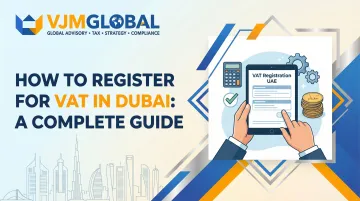
Introduction
Miss your VAT registration deadline in Dubai and the Federal Tax Authority (FTA) can issue penalties of AED 10,000 or more — before you've made a single sale. Get it right, and you recover input tax on business purchases from the start.
For foreign investors, multinational companies, and businesses new to the UAE, navigating the FTA portal without prior UAE tax experience is genuinely tricky.
This guide covers who must register, the exact steps to complete on the FTA portal, required documents, post-registration obligations, and common pitfalls to avoid — so your business stays compliant from your first filing period.
Key Takeaways
- UAE VAT is charged at 5% on most goods and services; registration is managed through the FTA's EmaraTax portal
- Mandatory registration applies when annual taxable supplies exceed AED 375,000; voluntary registration is available from AED 187,500
- Registration requires an FTA account, a completed online form, and supporting documents; the process typically takes 2–3 weeks
- Once registered, you receive a Tax Registration Number (TRN) and must file quarterly VAT returns and issue compliant invoices
- Late registration, filing delays, or submission errors trigger FTA penalties starting at AED 1,000
What Is VAT Registration in Dubai, and Why Does It Matter?
VAT registration is the process by which a business formally enrolls with the UAE Federal Tax Authority to collect, report, and remit Value Added Tax on taxable supplies. The UAE introduced VAT on 1 January 2018 at a standard rate of 5%, governed by Federal Decree-Law No. 8 of 2017.
Once registered, your business receives a Tax Registration Number (TRN)—a unique identifier issued by the FTA that legally authorises you to charge VAT on sales. The TRN also entitles you to reclaim input VAT paid on business purchases, creating a net tax position you report to the FTA each tax period.
Many new business owners confuse registration with compliance. Registration is the one-time enrolment step that gives you your TRN. Compliance covers the ongoing obligations that follow: filing returns, issuing tax invoices, and maintaining records. Both are legally required, and neglecting either can result in financial penalties and business disruptions.
Who Needs to Register for VAT in Dubai?
Understanding whether your business must register is the first critical step. The UAE uses strict revenue thresholds calculated over specific time periods.
Mandatory Registration
You must register if:
- Your taxable supplies and imports exceed AED 375,000 in the previous 12 months, OR
- You reasonably expect to exceed AED 375,000 in the next 30 days
Timeline: You have 30 days from the date you cross the threshold to submit your application.
Non-resident businesses: If your business is located outside the UAE but makes taxable supplies within the UAE, you must register regardless of turnover value—unless another party in the UAE accounts for the VAT under the reverse-charge mechanism.
Voluntary Registration
Businesses with taxable supplies or imports between AED 187,500 and AED 375,000 may register voluntarily.
Why register voluntarily?
- Recover input VAT on business purchases immediately
- Build credibility with B2B clients who require VAT-registered suppliers
- Simplify future compliance when you cross the mandatory threshold
- Avoid retroactive registration issues if your turnover grows faster than anticipated
Exempt and Zero-Rated Categories
Not all business activities trigger VAT registration requirements — and the distinction matters because zero-rated and exempt supplies are counted differently when calculating your threshold.
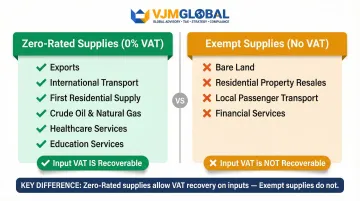
Zero-rated supplies (0% VAT):
- Exports of goods and services
- International transport of passengers and goods
- First supply of residential buildings (within 3 years of completion)
- Crude oil and natural gas
- Specified preventive healthcare and recognised educational services
With zero-rated supplies, you can still recover input VAT on related business purchases — a meaningful cash flow advantage. Exempt supplies work differently.
Exempt supplies (no VAT):
- Bare land
- Residential property sales and leases (subsequent sales)
- Local passenger transport
- Margin-based financial services
Critical difference: You cannot recover input VAT on purchases related to exempt supplies.
Free Zone Businesses
A common misconception: operating in a UAE Free Zone does not automatically exempt your business from VAT registration.
The reality:
- Free zone businesses are treated as onshore for VAT purposes
- You must register if you meet the AED 375,000 threshold
- This applies regardless of whether you trade primarily with other free zone entities
Exception—Designated Zones: The UAE recognises specific "Designated Zones"—fenced geographic areas with strict customs controls that are treated as being outside the UAE for VAT purposes.
In practice:
- Transfers of goods between Designated Zones, or from outside the UAE into a Designated Zone, are generally outside the scope of UAE VAT
- Services provided within a Designated Zone remain subject to standard UAE VAT rules
Check the FTA's Designated Zone Guide to confirm whether your specific free zone location falls under this treatment.
How to Register for VAT in Dubai: Step-by-Step
VAT registration in Dubai is completed entirely online through the FTA's EmaraTax portal at eservices.tax.gov.ae. There is no need to visit an FTA office.
Timeline: The FTA's official processing time is 20 business days from receipt of a completed application. In practice, most approvals arrive within 10–15 business days for straightforward applications. Complex cases — or those with missing documents — can take longer.
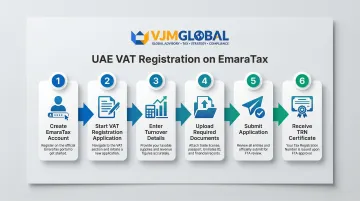
Follow these steps to complete your VAT registration:
Create an EmaraTax account — Go to eservices.tax.gov.ae and register using your Emirates ID or UAE Trade License details. Existing e-Services account holders can migrate their credentials.
Start a new VAT registration application — Log in, select "Register for VAT," and begin filling in your business profile, including legal name, trade license number, and business activity.
Enter your turnover details — Provide your taxable supplies and imports for the past 12 months and projected figures for the next 30 days. This determines whether you qualify for mandatory or voluntary registration.
Upload required documents — Prepare and attach the following before submitting:
- Valid trade license (all pages)
- Emirates ID or passport of the authorized signatory
- Memorandum of Association (MOA) or Articles of Association
- Bank account details (IBAN and bank letter)
- Customs registration number (if applicable)
- Supporting financials showing turnover (bank statements or audited accounts)
Submit the application — Review all entries carefully. Incomplete or inconsistent information is the most common reason for FTA rejection. Once submitted, you will receive a reference number by email.
Receive your VAT registration certificate — Upon approval, the FTA issues a Tax Registration Number (TRN), which must appear on all VAT invoices you issue. You can download your certificate directly from the EmaraTax portal.
Common Reasons for Rejection
The FTA may reject or delay your application if:
- Documents are expired or illegible
- Turnover figures are inconsistent with supporting financials
- The authorized signatory's identity cannot be verified
- The trade license does not cover the declared business activities
Addressing these issues before submission significantly reduces processing time.