Introduction
For UK businesses ready to move into Asia, Singapore consistently comes out at the top of the shortlist — and the numbers back that up. Bilateral trade between the UK and Singapore reached £26.7 billion in 2025, reflecting a commercial relationship that has grown steadily since the UK-Singapore Free Trade Agreement (UKSFTA) entered into force in February 2021.
The appeal comes from a combination of practical factors: Singapore's position as Asia-Pacific's financial hub, a legal system rooted in English common law, and a business environment consistently ranked among the world's most open.
The interest spans both individual UK entrepreneurs seeking a second base and established UK companies pursuing a regional headquarters in Asia. Both groups face the same core questions: how to register, what structure to choose, and what their compliance obligations actually involve.
This guide serves as a practical, end-to-end resource for UK business owners, covering structure selection, the registration process via ACRA (Accounting and Corporate Regulatory Authority), ongoing compliance, and the UK-specific factors that make Singapore a logical expansion choice.
Key Takeaways
- Singapore permits 100% foreign ownership — UK founders keep full control of their company
- Choose a Private Limited Company (Pte Ltd) as a solo founder, or a Subsidiary if registering under an existing UK company
- Appoint at least one locally resident director and use a registered filing agent to submit incorporation documents
- Government fees total S$315 (S$15 name reservation + S$300 registration); full setup typically costs S$800–S$2,000+
- Registration completes in 1–3 business days, with annual compliance obligations ongoing
Why UK Businesses Are Choosing Singapore to Expand
Since Brexit reshaped the UK's trade relationships, Singapore has emerged as one of the most practical footholds for British businesses expanding into Asia. The UKSFTA eliminates tariffs on virtually all Singapore exports to the UK and enhances market access for services. Beyond bilateral trade, Singapore serves as a gateway to ASEAN's 676.6 million population and US$3.8 trillion GDP.
Practical advantages specific to UK businesses include:
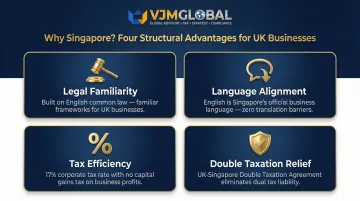
- Legal familiarity – Both countries operate under English common law, reducing legal complexity
- Language alignment – English is Singapore's official business language
- Tax efficiency – Corporate tax is capped at a flat 17% with no capital gains tax
- Double taxation relief – The UK-Singapore Double Taxation Agreement prevents income from being taxed twice
These structural advantages are backed by measurable performance. Singapore consistently ranks in the top 20% globally across all pillars of the World Bank's Business Ready (B-READY) index, scoring 78 points for Regulatory Framework, 75 for Public Services, and 79 for Operational Efficiency — results that reflect how reliably the system actually functions for foreign businesses, not just on paper.
What UK Business Owners Should Know Before Getting Started
Non-Negotiable Requirements
Unlike filing directly with Companies House, UK nationals cannot self-register in Singapore. You must appoint an ACRA-registered filing agent because access to the BizFile+ portal requires Singpass, which is only available to Singapore residents.
At least one director must be ordinarily resident in Singapore—a Singapore citizen, Permanent Resident, or valid pass holder. Most UK founders use a nominee director arrangement at the outset.
Registration can be handled entirely remotely through a professional services provider, so there is no requirement to relocate. That said, if you plan to work in Singapore personally, you will need to apply for the appropriate work pass — such as an Employment Pass or EntrePass — before taking on any director or operational role.
Ongoing Costs
Initial setup costs are often lower than expected, but ongoing annual obligations represent a recurring commitment. Typical annual compliance costs for a Singapore Pte Ltd range from S$2,000 to S$5,000, covering:
- Company secretary fees
- Annual return filing
- Registered address
- Accounting and bookkeeping
- Corporate tax filing
These figures assume standard compliance requirements — costs can rise if your business has complex accounting needs or requires additional filings.
Choosing the Right Business Structure for UK Companies
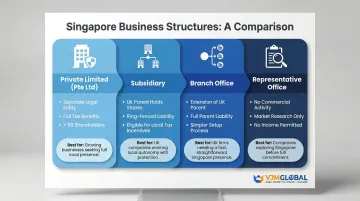
The entity type you choose shapes your tax treatment, liability exposure, administrative burden, and how easily the business can be scaled or wound down later. For UK founders and UK companies, there are four main structures worth considering.
Private Limited Company (Pte Ltd)
A Pte Ltd is the most commonly chosen structure for UK individuals starting fresh in Singapore. Key features:
- Separate legal entity limiting shareholder liability to the amount invested
- Between 1 and 50 shareholders permitted
- Minimum paid-up capital of S$1
- Eligible for Singapore's Startup Tax Exemption Scheme (SUTE): 75% exemption on the first S$100,000 of chargeable income and 50% exemption on the next S$100,000 for the first three consecutive years
Subsidiary Company
UK companies looking to establish a Singapore presence should typically form a subsidiary—a locally incorporated Pte Ltd where the UK parent company holds shares.
As a separate legal entity from the UK parent, the subsidiary ring-fences the parent's assets from any debts or liabilities incurred in Singapore. It is also treated as a Singapore company for tax purposes, making it eligible for local tax benefits and incentives that a branch office cannot access.
Branch Office
A branch office is an extension of the UK parent company rather than a separate entity—meaning the UK parent carries full legal and financial liability for the branch's activities in Singapore.
This is less commonly recommended for most UK businesses but may suit companies that need a simpler operating presence for a defined purpose. The branch must appoint at least one ordinarily resident authorised representative.
Representative Office
A representative office cannot generate income or conduct commercial activities—it exists only for market research and feasibility purposes. It suits UK companies not yet ready to commit to full incorporation but wanting a foothold to assess the Singapore market.
How to Set Up a Business in Singapore from the UK: Step by Step
This section walks through the practical registration process from start to finish, covering what UK nationals and UK companies need to do when setting up remotely. The process below reflects the two most common structures: a Private Limited company (Pte Ltd) for individual founders, and a Subsidiary for UK corporates expanding into Singapore.
Step 1 – Choose Your Structure and Prepare Your Key Details
Decide on entity type based on whether this is a personal venture or a corporate expansion from an existing UK business. Confirm:
- Ownership split
- Intended share capital
- Business activity description (Singapore requires a primary Singapore Standard Industrial Classification (SSIC) code at registration)
Identify who will serve as the local resident director—either a hire, a nominee director sourced through a corporate services provider, or an existing Singapore-based team member. This is a prerequisite before registration can proceed.
Step 2 – Reserve Your Company Name via ACRA BizFile+
The name reservation process through ACRA's BizFile+ portal:
- Fee: S$15
- Reservation period: 120 days
- Name must be unique, not infringe on existing trademarks, and avoid restricted words (such as "bank," "finance," or "media") that require additional regulatory approvals
UK businesses cannot access BizFile+ without a Singpass ID, which is only available to Singapore residents—this is the primary reason a registered filing agent is required. The agent submits all applications on your behalf.
Step 3 – Appoint Your Local Director, Company Secretary, and Registered Address
Before registration can be completed, the company must have:
- At least one locally resident director (ordinarily resident in Singapore)
- A qualified company secretary appointed within 6 months of incorporation
- A Singapore registered office address—P.O. boxes are not accepted, and the address must be accessible during normal business hours
Many UK founders use a corporate services provider that bundles nominee director, company secretary, and registered address as a package—the standard approach for remote UK founders.
Step 4 – Submit the Company Registration Application
Once all prerequisites are in place, the registered filing agent submits the incorporation application via BizFile+ with a government fee of S$300. For standard business activities, ACRA typically approves registrations within 1–3 business days. Once approved, a Unique Entity Number (UEN) is issued and an incorporation notice arrives by email.
The incorporation package includes everything needed to open a bank account and enter into contracts:
- Digital certificate of incorporation
- Company constitution
- Share certificates
- Company's business profile
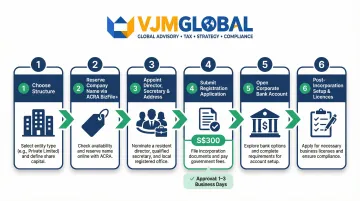
Step 5 – Open a Corporate Bank Account
Key Singapore banks for business accounts include DBS, OCBC, and UOB for traditional banking. Digital-first options such as Aspire, Airwallex, and Wise Business offer remote account opening that does not require physical presence in Singapore—a clear advantage for UK founders who can't easily travel to Singapore.
Documents typically required:
- Certificate of incorporation
- Company constitution
- Board resolution to open the account
- Passports of directors and beneficial owners
- Proof of residential address
DBS and UOB both apply a minimum S$500 account setup fee for foreign-incorporated companies, and some require in-person attendance from at least one director—confirm these requirements before committing to a provider.
Step 6 – Complete Post-Incorporation Setup and Begin Operations
With your company registered and bank account open, the final step is clearing any remaining operational requirements before trading:
- Obtain industry-specific licences or permits – Some regulated sectors (financial services, food and beverage, healthcare) require additional regulatory approvals from MAS, NEA, or MOH before trading. Check the GoBusiness licence finder tool for sector-specific requirements.
- Register for GST – Registration is mandatory if annual taxable turnover exceeds S$1 million. Voluntary registration is available earlier and can be beneficial for companies claiming input tax credits.
Tax, Compliance, and Ongoing Obligations in Singapore
Tax Structure
Singapore's core tax structure offers significant advantages for UK businesses:
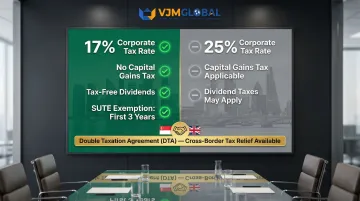
- Corporate income tax: Capped at 17% (compared to the UK's 25% rate for larger companies)
- No capital gains tax: Capital gains are not taxable in Singapore
- Single-tier dividend system: Dividends can be distributed to UK shareholders tax-free
- Double taxation relief: The UK-Singapore Double Taxation Agreement prevents income being taxed in both jurisdictions
Ongoing Compliance Obligations
All Singapore companies must fulfil these requirements:
| Obligation | Deadline | Notes |
|---|---|---|
| Annual Return Filing | Within 7 months of financial year-end | Filed with ACRA for private companies |
| Corporate Tax Return | By 30 November each year | Form C-S/C filed with IRAS |
| Accounting Records | Ongoing | Proper records must be maintained |
| Company Secretary | Continuous | Must remain current and qualified |
| Registered Address | Continuous | Must be accessible during business hours |
Failure to comply carries financial penalties and will affect the company's standing with ACRA.
Outsourcing for Remote Management
For UK businesses managing accounts remotely, outsourcing accounting and compliance to a local professional services firm is the most practical route. Key benefits include:
- Keeps compliance costs predictable with fixed-fee engagements
- Ensures filing deadlines are met without manual tracking
- Frees up UK-based owners to focus on running the business
VJM Global has supported 250+ UK businesses with cross-border compliance and business setup, covering both the initial incorporation process and ongoing obligations in markets outside the UK.
Frequently Asked Questions
Can a foreigner set up a business in Singapore?
Yes, foreigners including UK nationals can set up a company in Singapore and own 100% of it. However, they cannot self-register and must appoint a registered filing agent and a locally resident director.
Can you own a 100% company in Singapore?
Singapore allows full 100% foreign ownership across most industries, meaning a UK individual or UK company can own the entire share capital of a Singapore-registered entity without requiring a local partner.
What are the requirements to register a company in Singapore?
Core requirements include minimum S$1 paid-up capital, at least one shareholder (maximum 50), at least one ordinarily resident director, a qualified company secretary, and a Singapore registered address.
How much does it cost to set up a business in Singapore?
Government fees are S$15 for name reservation plus S$300 for registration. Total costs including professional services (nominee director, company secretary, registered address, filing agent) typically range from S$800–S$2,000+ for the first year.
Is Singapore the best for starting a business as a foreigner?
Singapore ranks near the top for good reason: full foreign ownership, low corporate tax, a common law legal system, and a transparent regulatory environment. That said, the best jurisdiction depends on which market you actually want to reach and operate in.
How much money is required to start a business in Singapore?
The legal minimum paid-up capital is just S$1, but realistic startup costs — covering registration, professional services, and operating capital — vary significantly by business type and sector.