Introduction
Singapore consistently ranks as Asia's most business-friendly jurisdiction. It holds the #1 spot in the World Bank's Business Ready 2025 report and attracts 22.2% of India's total Outward Direct Investment (ODI). For Indian entrepreneurs — SaaS founders, export-oriented manufacturers, and NRIs — the appeal is straightforward: a 17% flat corporate tax rate, zero capital gains tax, and the India-Singapore DTAA that prevents income from being taxed twice.
The incorporation process itself is streamlined. But Indian founders face compliance layers that often catch them off guard:
- No Singpass access means you can't file directly through ACRA's Bizfile+ portal
- A nominee director ordinarily resident in Singapore is mandatory
- FEMA ODI rules apply to Indian residents — file Form ODI late and penalties start at INR 7,500
Here's what you need to know before you start.
Key Takeaways
- Register a Singapore company 100% remotely through a Corporate Service Provider (CSP) filing via ACRA's Bizfile+ portal
- Choose a Private Limited Company (Pte. Ltd.) for limited liability, 100% foreign ownership, and startup tax exemptions
- Core requirements: one Singapore-resident director, local registered address, company secretary, and SGD 1 paid-up capital
- Indian residents must comply with FEMA's ODI rules, including filing Form FC with the RBI before or after remitting funds
- Registration completes in 1–3 business days and costs SGD 315–1,500+ depending on services chosen
Why Indian Entrepreneurs Register Companies in Singapore
Strategic Tax and Treaty Advantages
Singapore's 17% flat corporate tax rate applies uniformly to local and foreign companies, with no capital gains tax on asset sales or foreign exchange gains. Qualifying new startups also benefit from IRAS startup exemptions: 75% off the first SGD 100,000 of chargeable income and 50% off the next SGD 100,000, for the first three consecutive Years of Assessment.
That combination keeps more cash in the business during the years when runway matters most.
The India-Singapore DTAA prevents double taxation on business profits, dividends, and interest. Dividends paid from Singapore to India are capped at 10% withholding tax (for beneficial owners holding at least 25% of shares) or 15% otherwise.
One caveat worth noting: the Multilateral Instrument (MLI) now applies a Principal Purpose Test. If the primary reason for structuring through Singapore is to access treaty benefits, those benefits may be denied. Substance requirements matter.
Operational and Market Access Benefits
The tax advantages are only part of the picture. Singapore also gives Indian founders access to global banking infrastructure, credibility with international clients, and a direct gateway to Southeast Asian markets.
Export-oriented businesses benefit from payment gateways and merchant accounts that are often unavailable or heavily restricted for Indian-incorporated entities. For SaaS businesses billing US or EU clients, a Singapore entity removes friction in contracting, invoicing, and collections.
Foreign venture capital investors often prefer Singapore holding structures due to cleaner exit options and well-established legal frameworks for shareholder agreements and convertible instruments.
Specific Use Cases Where Singapore Makes Sense
- SaaS and digital product businesses billing international clients who expect OECD-jurisdiction invoicing
- Export-oriented manufacturers needing a regional headquarters for Southeast Asia operations
- Indian founders targeting Singapore's startup ecosystem for funding and accelerator programs
- NRIs structuring cross-border investments cleanly without triggering complex Indian residential tax obligations

What You Need Before Registering: India-Side and Singapore-Side Requirements
Preparation is where most Indian founders stall. India-side FEMA compliance and Singapore-side prerequisites must be addressed simultaneously. Missing either one can delay or invalidate your incorporation.
Documents Required from India
Indian nationals must prepare:
- Valid passport (primary identification for ACRA and bank KYC)
- Overseas address proof (utility bill, lease agreement, or bank statement showing non-India address)
- Indian bank account details (for FEMA remittance documentation)
- Corporate shareholders must also provide: Certificate of Incorporation, MOA/AOA, and a board resolution authorizing the overseas investment
Most documents will need to be notarized and apostilled for Singapore use, particularly for bank account opening and nominee director agreements.
Singapore-Side Requirements
Singapore law mandates four requirements for every Private Limited Company:
- Locally resident director — must be a Singapore Citizen, Permanent Resident, Employment Pass, or EntrePass holder. Indian founders without Singapore residency typically appoint a professional nominee director through their Corporate Service Provider (CSP).
- Qualified company secretary — must be Singapore-resident and appointed within six months of incorporation. Missing this deadline triggers fines up to SGD 1,000.
- Physical registered office address — must be open to the public for at least three hours during normal business hours. P.O. boxes are not accepted.
- Paid-up capital of at least SGD 1 — can be increased at any time after incorporation.
India-Side FEMA/ODI Compliance
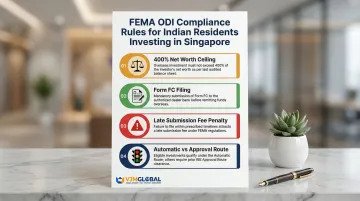
Indian residents making an overseas direct investment fall under FEMA's Overseas Investment Rules, 2022. Four rules apply directly:
- 400% net worth ceiling — total financial commitment across all foreign entities (equity, debt, guarantees) cannot exceed 400% of your Indian entity's net worth per the last audited balance sheet
- Form FC filing — submit to your Authorized Dealer (AD) bank before or at the time of remitting funds to Singapore; this generates a Unique Identification Number (UIN) from RBI
- Late Submission Fee (LSF) — missing the Form FC deadline attracts a penalty of INR 7,500 plus 0.025% of the remitted amount per year of delay
- Automatic vs. approval route — investments within the 400% ceiling proceed automatically; those exceeding it require prior RBI approval
Critical: Many Indian founders incorporate the Singapore company first and remit funds without filing Form FC, creating FEMA exposure. Working with a firm experienced in both Indian FEMA compliance and Singapore incorporation — such as VJM Global, which handles cross-border structuring for Indian businesses — ensures both sets of obligations are met before funds move.
How to Register a Company in Singapore from India: Step-by-Step
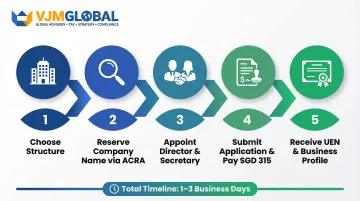
Step 1: Choose Your Business Structure
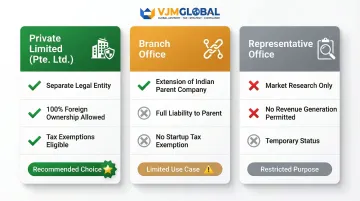
Private Limited Company (Pte. Ltd.) is the optimal choice for most Indian founders:
- Limited liability ring-fences personal assets from business debts
- 100% foreign ownership permitted with no local shareholder requirement
- Access to startup tax exemptions (75% exemption on first SGD 100,000 of chargeable income for three years)
- Separate legal entity protecting the Indian parent from Singapore liabilities
Branch Office is an extension of the Indian parent company:
- Not a separate legal entity, meaning the Indian parent is fully liable for Singapore operations
- Excluded from IRAS's Start-up Tax Exemption scheme
- Suitable only for established Indian companies expanding temporarily into Singapore for market exploration
Representative Office is for market research only and cannot conduct revenue-generating activities.
For liability protection and tax efficiency, incorporate a Pte. Ltd.
Step 2: Reserve Your Company Name via ACRA Bizfile+
The process is straightforward:
- Check name availability on ACRA's Bizfile+ portal
- Pay SGD 15 name reservation fee
- Receive a 120-day window to complete registration
Naming rules to know:
- No identical or similar names to existing entities
- Restricted words (e.g., "bank," "finance," "university") require regulatory approval and trigger referral authority reviews delaying approval by 14–60 days
- Choose a unique business name free of regulated industry terms to avoid delays
Critical limitation for Indians: Without Singpass, you cannot access Bizfile+ directly. You must engage a registered Corporate Service Provider (CSP) to file on your behalf — this applies to all subsequent filings as well.
Step 3: Appoint a Nominee Director and Company Secretary
Indian founders who are not Singapore residents cannot self-direct without a local co-director. A professional nominee director service (offered by CSPs) is the standard route.
Nominee Director
Key points:
- Nominee directors do not interfere in business operations
- Sign a nominee agreement clearly limiting the nominee's role and authority
- Typical nominee fees range from SGD 500–1,200 annually
- The nominee remains on the ACRA register as an official director with statutory obligations
Company Secretary
The secretary must be a Singapore resident and cannot be left vacant for more than six months. The CSP typically provides this service as part of their package (SGD 300–600 annually).
Step 4: Submit Your Registration Application and Pay Fees
Your CSP submits the following via Bizfile+:
- Company name reservation reference
- Company constitution (Articles of Association)
- Details of shareholders and directors (names, addresses, ID numbers)
- Registered office address
- Share capital structure (number of shares, par value, paid-up amount)
- Business activity codes (SSIC codes)
Government fees:
- SGD 15 (name reservation) + SGD 300 (incorporation) = SGD 315 total
- CSP service fees: SGD 500–1,200+ (typically includes nominee director, registered address, and company secretary for the first year)
Approval timeline:
- Standard applications: 1 hour to 3 business days
- Referral authority applications: 14–60 days (if restricted words are used)
Once approved, ACRA issues a Unique Entity Number (UEN) and a free Business Profile, confirming your company is legally registered.
Step 5: Open a Singapore Corporate Bank Account
Traditional Banks (DBS, OCBC, UOB)
- Typically require in-person signing by key directors
- Foreign-owned companies must be assisted by a Relationship Manager
- Expect requests for proof of business activity, source of funds, and beneficial ownership declarations
Digital/Fintech Banks (Airwallex, Aspire, Wise Business)
- 100% remote account opening for Singapore companies owned by non-residents
- Digital KYC process using passport, proof of address, and ACRA BizFile documents
- Faster approval (3–7 days vs. 2–4 weeks for traditional banks)
- Lower or no minimum balance requirements
Required documents for digital banks:
- ACRA BizFile and Business Profile
- UEN certificate
- Company constitution
- Director and shareholder passport copies
- Proof of residential address
- Ownership structure chart
- Source of wealth declaration (if applicable)
Post-Registration Compliance Requirements in Singapore
Ongoing Filing Deadlines
| Filing Requirement | Authority | Deadline |
|---|---|---|
| Estimated Chargeable Income (ECI) | IRAS | Within 3 months from financial year-end |
| Annual Return | ACRA | Within 7 months from financial year-end |
| Corporate Tax Return (Form C/C-S) | IRAS | November 30 each year |
Maximizing Singapore's Startup Tax Exemption
Qualifying new startup companies receive:
- 75% exemption on the first SGD 100,000 of normal chargeable income
- 50% exemption on the next SGD 100,000
- Valid for the first 3 consecutive Years of Assessment
Eligibility criteria:
- Incorporated in Singapore
- Tax resident in Singapore
- Maximum 20 individual shareholders (no corporate shareholders holding more than 10%)
After the exemption period, the 17% flat corporate tax rate applies.
India-Side Ongoing Obligations
Indian founders with a Singapore company must comply with:
- Annual Performance Report (APR) filed with the RBI through the AD bank by December 31 each year
- Disclosure in Indian personal/corporate tax returns of foreign income and assets
- ODI reporting updates if there are changes in shareholding or financial commitments
Missing these filings triggers Late Submission Fees starting at ₹7,500 and can restrict future financial commitments abroad. A cross-border advisory firm like VJM Global, which handles dual India-international compliance, can help ensure none of these deadlines slip through.
Common Mistakes Indians Make When Registering a Company in Singapore
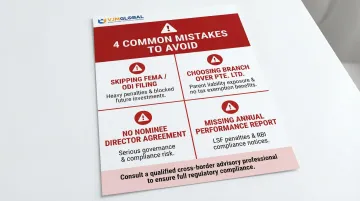
These four errors come up repeatedly — and each one carries real financial or legal consequences.
Skipping FEMA/ODI compliance: Many Indian founders remit funds to their Singapore entity without first filing Form FC with the RBI. This triggers FEMA penalties and can block future outbound investments. File Form FC before or immediately after remittance to secure your UIN.
Choosing the wrong structure: Registering a Branch Office instead of a Pte. Ltd. may seem simpler, but it ties the Indian parent company's liability to Singapore operations. It also disqualifies the entity from Singapore's Start-up Tax Exemption, which is available only to private limited companies.
Underestimating nominee director responsibilities: A nominee director without a formal agreement creates governance risk. A clear nominee agreement should define the scope of authority and explicitly limit involvement in business decisions.
Ignoring the Annual Performance Report: Indian residents must file an APR with the RBI by December 31 each year — even after incorporation is complete. Missing this deadline triggers Late Submission Fees (LSF) and formal compliance notices from the RBI.
Frequently Asked Questions
Can a foreigner register a company in Singapore?
Yes, foreigners including Indian nationals can register a Singapore company. However, they cannot file directly via Bizfile+ without Singpass and must engage a registered Corporate Service Provider (CSP) to submit the application on their behalf, along with appointing at least one locally resident director.
Can you own 100% of a company in Singapore?
Yes, Singapore allows 100% foreign ownership of a Private Limited Company with no requirement for a local shareholder. Indian founders can retain full control, though a local resident director (not shareholder) is still mandatory.
What is the minimum paid-up capital to register a private limited company in Singapore?
The minimum paid-up capital is just SGD 1. This can be increased anytime post-incorporation and does not affect the company's credibility or legal standing.
How much does it cost to register a company in Singapore?
Government fees total SGD 315 (SGD 15 name reservation + SGD 300 incorporation). CSP fees typically range from SGD 500–1,500, depending on services included — nominee director, registered address, and company secretary for the first year.
How long does it take to register a company in Singapore?
Most Private Limited Company registrations are approved within 1 hour to 1 business day after submission via Bizfile+. However, complex applications or those requiring referral to government authorities (for example, restricted words in the company name) can take 14–60 days.
How do I register a private limited company in Singapore?
Engage a Corporate Service Provider (CSP) to reserve your company name on ACRA Bizfile+, appoint a local resident director and company secretary, and prepare the company constitution. Submit the incorporation application with the SGD 315 government fee — the entire process can be completed remotely from India.