Introduction
Singapore entrepreneurs increasingly look to the US as their next market, drawn by access to American consumers, venture capital, and global credibility. The NVCA's model documents reflect what most US investors expect: a Delaware C-Corporation. Foreign founders can register one without visiting the US, holding a visa, or having citizenship.
Yet the process involves multiple steps—entity selection, state filing, EIN acquisition, and banking—each with nonresident-specific nuances. Mistakes in choosing the wrong entity structure, skipping critical tax filings like Form 5472, or underestimating EIN timelines can cause costly delays and penalties exceeding $25,000.
Key Takeaways
- Singapore residents can fully own US LLCs or C-Corporations without citizenship, visas, or physical travel
- LLC offers flexible pass-through taxation; C-Corp is preferred for venture capital (S-Corps unavailable to nonresidents)
- A registered agent with a US physical address is legally mandatory for all nonresident-owned entities
- Getting an EIN takes 4 business days to 4+ weeks via fax or mail — online filing is not available to nonresidents
- Traditional banks require in-person visits; fintech platforms (Mercury, Relay, Brex) support remote account opening
- Foreign-owned US entities carry mandatory IRS filing obligations — missing them triggers penalties up to $25,000 per violation
Business Structures Available to Singapore Nonresidents
There are no citizenship or residency requirements to own a US company. Singapore passport holders can be sole owners of US LLCs or C-Corporations, managing operations from abroad.
Limited Liability Company (LLC)
An LLC offers personal liability protection with pass-through taxation by default, meaning profits flow directly to owners who report them on personal tax returns. This structure is simpler and more cost-effective for small businesses, solo founders, and service-based companies operating from Singapore.
One tax implication nonresidents frequently miss: the IRS treats a Singapore-based single-member LLC as a "foreign-owned disregarded entity." This triggers mandatory Form 5472 and pro forma Form 1120 filing requirements. Failure to file carries a minimum $25,000 penalty per violation, with additional $25,000 penalties every 30 days after IRS notification.
C-Corporation
A C-Corporation is a separate tax-paying entity, preferred by founders seeking US venture capital or institutional investment. It supports multiple share classes and unlimited shareholders regardless of nationality, making it the standard structure for VC-backed startups.
The trade-off is double taxation. C-Corps pay corporate tax at 21%, and dividends distributed to shareholders face a second layer of tax. The US and Singapore do not have a comprehensive income tax treaty, so Singaporean residents cannot claim reduced withholding rates. The default statutory rate under IRC §1441 is 30%.
Key considerations:
- Total tax burden: 21% corporate + 30% dividend withholding = effective 45.7% combined rate on distributed profits
- Retained earnings remain taxed only at corporate level until distributed
- Consult a cross-border tax advisor to model total tax impact versus LLC pass-through taxation
Why S-Corps Are Off the Table for Singapore Founders
Of the three common US structures, only LLC and C-Corp are available to nonresidents. S-Corporation status requires all shareholders to be US citizens or resident aliens. Under Internal Revenue Code §1361(b), an S-Corp cannot "have a nonresident alien as a shareholder." Singapore nonresidents are categorically ineligible for S-Corp status.
How to Register a US Company from Singapore: Step-by-Step
Step 1: Choose Your Registration State
All US companies are formed at the state level, not federally. Popular choices for nonresidents:
Delaware:
- Investor-familiar corporate law via Court of Chancery
- Fast processing and predictable jurisprudence
- Recommended for C-Corps seeking venture capital
- Formation fee: $109 (C-Corp), $110 (LLC)
- Annual fees: $225 minimum (C-Corp), $300 flat tax (LLC)
Wyoming:
- Low fees and strong privacy protections
- No state income tax
- Recommended for LLCs held by solo Singapore founders
- Formation fee: $100
- Annual fee: $60 minimum license tax
- Strong charging order protections for asset protection
Nevada:
- No state income tax (though Commerce Tax applies on gross revenue over $4M)
- Strong privacy laws
- Not recommended due to high annual fees: $650 (C-Corp), $350 (LLC)

Step 2: Reserve and Verify Your Business Name
Search state business name database:
- Delaware Division of Corporations
- Wyoming Secretary of State Business Center
- Nevada Secretary of State SilverFlume
Requirements:
- Name must be distinguishable from existing entities in your chosen state
- Check USPTO Trademark Search to avoid federal trademark conflicts
- Include required legal suffix: "LLC," "L.L.C.," "Limited Liability Company" (for LLCs) or "Inc.," "Corp.," "Corporation" (for C-Corps)
Step 3: Appoint a US Registered Agent
Every state requires a registered agent with a physical street address (not P.O. Box) in the state of formation to receive legal notices and government documents on your behalf. Since Singapore founders lack a US address, you must use a professional registered agent service.
Costs: $50–$300 annually, depending on state and service provider Requirements: Agent must be available during normal business hours at the registered address
Step 4: File Formation Documents with the State
For LLCs:
- File Articles of Organization (or Certificate of Formation) with Secretary of State
- Required information: company name, registered agent details, member/manager structure
- Prepare Operating Agreement (not filed but legally recommended) to define ownership structure, profit distribution, and management responsibilities
For C-Corps:
- File Articles of Incorporation specifying authorized shares and initial directors
- Prepare Bylaws (internal document, not filed) governing board procedures
- Draft initial board resolutions approving officers, share issuances, and banking arrangements
Without an Operating Agreement (LLC) or Bylaws (C-Corp), ownership disputes, banking issues, and investor concerns become difficult to resolve legally. Banks and investors typically require these documents during due diligence.
Step 5: Apply for an Employer Identification Number (EIN)
An EIN is a 9-digit IRS tax ID (equivalent to a business Social Security Number) required for:
- Opening US bank accounts
- Filing tax returns
- Hiring employees or contractors
- Processing payments
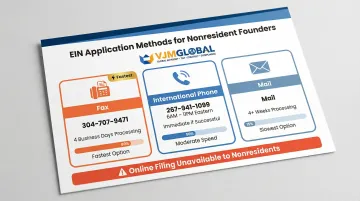
One critical limitation applies to nonresidents: Singapore founders without a US Social Security Number cannot apply online. You must submit IRS Form SS-4 by:
- Fax: 304-707-9471 (typically 4 business days processing)
- International phone: 267-941-1099 (6:00 AM to 11:00 PM Eastern time)
- Mail: (4+ weeks processing time)
Important: On line 7b of Form SS-4, enter "Foreign" or "N/A" when designating the responsible party, since you lack an SSN or ITIN.
Build 1-4 weeks into your launch timeline — the EIN is a hard prerequisite for opening a US bank account.
Step 6: Open a US Business Bank Account
Traditional US banks (Chase, Bank of America, Wells Fargo) require in-person visits and physical US address proof — and most won't open accounts for nonresident-owned entities.
Fintech alternatives for nonresident founders:
| Platform | Remote Opening | Key Requirements |
|---|---|---|
| Mercury | Yes | US entity, EIN, passport, physical operating address (no P.O. boxes or registered agent addresses only) |
| Relay | Yes | US entity, EIN, passport, physical personal address, US operating presence |
| Brex | Yes | US entity, EIN, US operations, physical US address |
Required documentation:
- Filed formation documents (Certificate of Incorporation/Organization)
- IRS-issued EIN confirmation letter (CP-575 or 147c)
- Valid passport for all beneficial owners (25%+ ownership)
- Proof of physical residential address (utility bill, bank statement)
- Physical business operating address (separate from registered agent)
Step 7: Register for Applicable State Taxes and Licenses
After EIN issuance, register for state-level obligations:
State tax accounts:
- Sales tax registration (if selling taxable goods/services subject to state sales tax)
- Employer withholding tax registration (if hiring US-based employees)
- Franchise or gross receipts tax registration where applicable (e.g., Delaware franchise tax, Nevada commerce tax)
Requirements vary by state and business type, so confirm obligations with your registered state's revenue department before your first operating month.