Introduction
Forming an LLC gives business owners a real layer of personal liability protection — but that protection has a vulnerability most new founders overlook. Mixing personal and business finances can pierce the corporate veil, exposing your personal assets to business debts and legal judgments. A dedicated business bank account is what keeps that protection intact.
LLC owners in 2026 have more banking options than ever — traditional banks, fintech platforms, and hybrid solutions, each with different fee structures, interest rates, integrations, and account requirements. The challenge isn't finding an account. It's finding the right one for your situation, whether you're a solo freelancer, a scaling eCommerce operation, or a non-US founder establishing a US entity.
This guide cuts through the noise: five best bank accounts for LLCs in 2026, what to look for when comparing options, and the mistakes owners commonly make when choosing.
TL;DR
- A dedicated business bank account protects your LLC's liability shield and simplifies tax reporting
- Mercury suits startups and tech-forward LLCs
- Chase serves traditional businesses needing in-person branch access
- Relay fits LLCs that need structured cash management across multiple accounts
- Novo works for digital-first solopreneurs with low transaction volume
- Bluevine rewards LLCs that maintain healthy cash reserves with competitive APY
- Key criteria: FDIC coverage, monthly fees, APY, accounting integrations, and scalability
- Non-US founders should verify EIN and passport requirements before applying, as not all platforms accept applicants without a US Social Security Number
Why LLCs Need a Dedicated Business Bank Account
An LLC is a legally distinct entity from its owner. The moment you pay a personal expense from your business account — or deposit business revenue into your personal one — you're commingling funds. Courts have repeatedly cited commingling as grounds for piercing the corporate veil, which eliminates the liability protection the LLC was formed to provide. As the City Bar Justice Center notes, maintaining separate accounts for company and personal assets is one of the clearest ways to preserve that separation.
Beyond legal protection, clean financial records matter at tax time. The IRS closed nearly 500,000 tax-return examinations in FY2025, and accurate books are your first line of defense if your return is selected. Segregated accounts make it far easier to track deductible expenses, accurately calculate quarterly estimated taxes, and produce clean records if the IRS comes knocking.
The credibility gap is real, too. Banks, investors, and vendors treat an LLC without its own account as less established — and that perception affects loan approvals and vendor terms. A dedicated account builds your business credit history and signals that you're operating a legitimate company, not a side project.
Best Bank Accounts for LLCs in 2026
These five accounts were selected based on five criteria:
- Fees — monthly costs and waiver conditions
- FDIC protection — coverage limits and structure
- Yield — APY on checking or savings balances
- Digital tools — integrations, payment features, and ease of use
- LLC fit — which business profile each account serves best
Mercury Business Checking
Mercury is a fintech-powered business account built for startups and tech-forward LLCs. Applications are completed entirely online — ideal for founders who want speed. Mercury does require a passport or government-issued ID along with formation documents and does not accept EIN-only applications without additional identity verification.
Banking services are provided through Choice Financial Group and Column N.A., Members FDIC, with eligible deposits receiving up to $5M in FDIC coverage through Mercury's sweep network.
| Feature | Details |
|---|---|
| Monthly Fee | $0 |
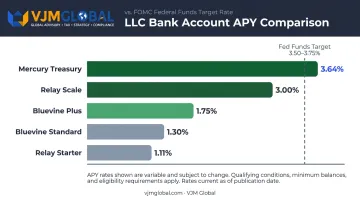
| APY / Yield | Up to 3.64% net yield via Mercury Treasury (qualifying accounts with $250K+ in deposits; variable, not FDIC-insured) |
| Best For | Startups, tech LLCs, and founders comfortable with digital-only banking |
Mercury Treasury is an investment product — not a standard deposit account — so the yield is variable and uninsured. For LLCs holding significant reserves, Mercury Treasury is among the strongest yield options in the no-fee category.
Chase Business Complete Banking
Chase is the largest US bank by assets — $4 trillion+ as of March 2026 — and that scale translates directly into product breadth. LLCs get access to an extensive branch and ATM network, integrated payment processing through QuickAccept (with no-fee same-day deposits for eligible transactions), SBA loans, merchant services, and business credit cards, all under one roof.
This makes Chase particularly well-suited for brick-and-mortar businesses or any LLC that regularly handles cash.
| Feature | Details |
|---|---|
| Monthly Fee | $15 (waivable with $2,000 minimum daily balance or qualifying activity) |
| APY / Yield | Not publicly disclosed for standard checking; savings rates vary by ZIP code |
| Best For | Traditional LLCs needing in-person banking, cash handling, and lending access |
The $15 fee is easy to waive for most active businesses, but verify the waiver conditions match your cash flow patterns before committing.
Relay Business Banking
Relay is designed for business owners who want structure in their cash management. You can open up to 20 individual checking accounts on the Starter plan — well-suited to the Profit First method, where revenue is allocated across dedicated accounts for taxes, operating expenses, and profit.
Banking is provided through Thread Bank, Member FDIC, with up to $3M in FDIC coverage via Thread's IntraFi sweep network.
| Feature | Details |
|---|---|
| Monthly Fee | $0 (Starter); $30 (Grow); $90–$120 (Scale) |
| APY / Yield | 1.11% (Starter savings) · 1.75% (Grow) · 3.00% (Scale) — rates as of May 2026, variable |
| Best For | LLCs using structured cash management or managing multiple budget pools |
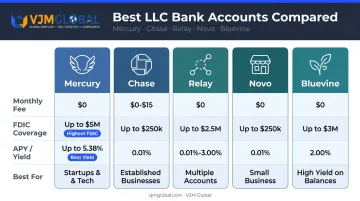
QuickBooks Online and Xero integrations are included across all plans. The 3% APY is only available on the Scale plan; Starter savings yield 1.11% — still competitive for a free account.
Novo Business Banking
Novo targets freelancers, solopreneurs, and early-stage LLCs who want frictionless digital banking. There's no monthly fee, no minimum balance, no transaction limit, and ATM fee reimbursements up to $7 per month for domestic and international withdrawals.
The platform's integrations are a standout: native connections to Stripe, Square, QuickBooks, and Xero make it practical for LLCs operating through digital payment platforms.
| Feature | Details |
|---|---|
| Monthly Fee | $0 |
| APY / Yield | Not publicly disclosed for standard checking |
| Best For | Solo-member LLCs, freelancers, and eCommerce businesses needing simple digital banking |
Novo doesn't offer a high-yield savings component, so it's best suited for LLCs prioritizing simplicity and integration depth over yield on idle balances.
Bluevine Business Checking
Bluevine stands out in the no-fee checking category by offering a competitive APY alongside access to a business line of credit for eligible customers.
Banking services are provided by Coastal Community Bank, Member FDIC, with up to $3M in FDIC coverage through a sweep network.
| Feature | Details |
|---|---|
| Monthly Fee | $0 (Standard); $30 (Plus, waivable with $20K avg. daily balance + $2K/month card spend) |
| APY / Yield | 1.30% APY on balances up to $250K (Standard, with qualifying activity) · 1.75% APY (Plus) |
| Best For | LLCs with significant cash reserves looking to earn yield on operating funds |
The Standard APY requires either $500/month in debit card spend or $2,500/month in deposits — conditions most active LLCs will meet naturally. The line of credit (up to $250,000) has three eligibility requirements: 12+ months in business, $10K+ monthly revenue, and a 625+ FICO score.
Key Features to Look for in an LLC Bank Account
FDIC Insurance and Fund Safety
Standard FDIC coverage protects $250,000 per depositor, per insured institution. Most fintech platforms extend this through sweep programs — distributing funds across multiple FDIC-member partner banks to achieve aggregate coverage of $1M–$5M+.
One caveat: the fintech itself is not FDIC-insured. Pass-through coverage applies only when funds are properly deposited at insured partner banks and recordkeeping requirements are met. LLCs holding significant reserves should confirm exact coverage limits before depositing above the standard threshold.
Fee Structure
The advertised monthly fee is rarely the full picture. Before committing, evaluate:
- Wire transfer fees (domestic and international) — these add up fast for LLCs paying foreign vendors
- ACH fees — some platforms charge per transfer above a monthly threshold
- Transaction limits — accounts with transaction caps become expensive as revenue grows
- Fee waiver conditions — confirm your typical balance or activity pattern actually qualifies
APY and Yield on Idle Balances
With the FOMC maintaining a 3.50%–3.75% federal funds target rate as of June 2026, business accounts offering 1–3% APY represent real value for LLCs holding operating reserves. Even a 1% yield on $50,000 offsets most monthly banking fees within a year.
Accounting Software Integrations
An August 2024 Intuit survey found that business owners and executives averaged 25 hours per week on manual data entry and reconciliation — with 91% reporting a measurable productivity impact. Direct bank-to-accounting sync eliminates most of that overhead. Look for native QuickBooks, Xero, or FreshBooks connections rather than CSV imports.
Scalability and International Functionality
LLCs planning to hire internationally, pay foreign vendors, or serve global customers should evaluate:
- Multi-currency support — essential for paying overseas contractors without conversion delays
- International wire fees — costs vary widely and compound quickly at volume
- Platform scalability — confirm the account can handle growing transaction complexity
This matters especially for non-US founders, where delays in payments or transfers can disrupt day-to-day operations. Once you've identified which features your LLC needs, comparing specific accounts becomes much more straightforward.
How We Chose the Best Bank Accounts for LLCs
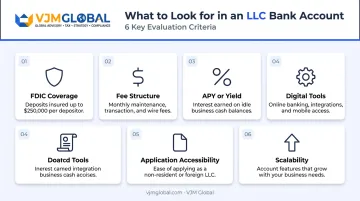
Each account was evaluated on six criteria:
- FDIC coverage — both direct and pass-through via sweep networks
- Fee structure — monthly, transaction, wire, and ACH costs
- APY or yield — on checking and linked savings balances
- Digital tools — invoicing, expense tracking, and accounting integrations
- Application accessibility — EIN requirements, documentation, and ease of setup
- Scalability — transaction limits, multi-account options, credit access
The most common mistakes LLC owners make when choosing a bank:
- Prioritizing brand recognition over actual fee structure
- Overlooking international wire fees until they get the first invoice
- Choosing accounts with transaction caps that restrict growth
- Applying to banks that require a US SSN without confirming eligibility first
No single account is right for every LLC. A solo consultant running a service business has fundamentally different needs than a multi-member eCommerce company or a foreign national establishing a US entity for the first time. Each recommendation below is mapped to a specific use case, so you can identify the right fit without wading through options that don't apply to you.
Conclusion
The right business bank account for your LLC comes down to fit: does the fee structure, yield, and integration stack match how your business actually moves money? If you're a low-volume sole-member LLC, a fee-free digital account probably beats a full-service bank. If you're scaling with payroll, vendors, and investors, the calculus shifts toward institutions that can grow with you.
Before you can open any of these accounts, your LLC's foundational documents need to be in place: Articles of Organization filed with your state, an EIN issued by the IRS, and an Operating Agreement (required in some states, strongly recommended in all). This paperwork stage is where many founders — especially those new to US entity formation — encounter delays.
For international owners of US LLCs — particularly those managing cross-border transactions, India-linked operations, or multi-jurisdiction compliance — getting the financial foundation right involves more than picking a bank. VJM Global's team of CPAs and accounting professionals works with foreign investors and multinational businesses navigating US compliance, cross-border tax obligations, and accounting setup. Reach out to VJM Global to discuss your situation.
Frequently Asked Questions
Does an LLC need a separate bank account?
No federal law mandates it for single-member LLCs, but mixing personal and business funds risks invalidating your liability protection. Open a dedicated account before your first business transaction to preserve that protection.
Can a non-US resident open a bank account for a US LLC?
Yes, but options are more limited. Fintech platforms like Mercury accept non-US applicants with a passport, EIN document, and formation paperwork. Traditional banks typically require a US Social Security Number or an in-person visit.
What documents are needed to open a bank account for an LLC?
Most banks require Articles of Organization, your IRS-issued EIN document, government-issued photo ID for all authorized signers, and a physical business address. Requirements vary by provider, so confirm the full list before applying.
Can a single-member LLC use a personal bank account?
Yes, but it's a bad idea. Commingling funds puts your personal liability protection at risk and creates significant complications for tax reporting and bookkeeping.
What is the best free business bank account for an LLC?
Mercury, Relay (Starter), Novo, and Bluevine all offer $0 monthly fee accounts. The best fit depends on your needs:
- Mercury or Bluevine — highest yield potential
- Relay — best for multi-account structure
- Novo — simplest for digital-payment-heavy businesses
How long does it take to open a business bank account for an LLC?
Most fintech banks — Mercury, Relay, and Novo — respond within 1–2 business days; Novo can approve same-day with automated verification. Traditional banks like Chase vary widely and may require an in-person visit.