Introduction
The business structure decision is one of the first — and most consequential — legal choices any entrepreneur makes in the US. It shapes how you're taxed, whether your personal assets are at risk, who controls the business, and how easily you can raise capital.
Many first-time founders, and especially foreign entrepreneurs, default to a sole proprietorship simply because it requires no registration. That's a costly oversight. One failed contract dispute or unpaid vendor can put personal savings, property, and accounts directly on the line.
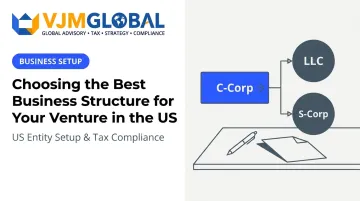
The right structure depends on your risk tolerance, business size, ownership profile, and growth horizon. What works for a solo consultant in Texas looks nothing like what a foreign-owned startup raising venture capital needs. This guide breaks down all six US business structures and the specific factors that determine which one fits your situation.
Key Takeaways
- The US recognizes six primary business structures: Sole Proprietorship, Partnership, LLC, C Corporation, S Corporation, and Nonprofit
- LLCs offer liability protection and pass-through taxation — making them the go-to for most small and mid-sized businesses
- C Corporations are built for venture-backed startups and businesses planning to go public
- S Corporations suit small, US-resident-owned businesses that want liability protection and lower payroll tax exposure
- Foreign nationals can form LLCs and C Corps in the US, but S Corporation ownership is restricted to US residents
- Choosing the wrong structure from the start can trigger tax consequences and costly administrative fixes
What Are US Business Structures and Why Do They Matter?
A business structure — also called a business entity or legal structure — is the formal framework under which a business operates in the United States. It's governed by two parallel systems: state law determines registration and formation requirements, while IRS rules govern federal tax classification.
Some structures exist automatically. The IRS and SBA confirm that a person conducting business without registering another entity is automatically treated as a sole proprietor. Others — LLCs, corporations, limited partnerships — require formal state registration before they exist legally.
Your structure determines:
- Whether your personal assets can be seized to settle business debts
- How business income is taxed — at personal rates, corporate rates, or both
- Who can own the business and in what proportions
- What ongoing paperwork and compliance obligations apply
- How easily the business can attract outside investment
Changing your structure later is possible but complicated. A conversion from LLC to C Corporation may qualify for tax-free treatment under IRC Section 351. However, if liabilities exceed your adjusted basis or other conditions aren't met, that conversion triggers a taxable gain. Restructuring costs — legal fees, tax exposure, refiling — routinely run into thousands of dollars. Getting the structure right from day one is far cheaper than correcting it later.
The 6 Main US Business Structures Explained
The US recognizes six main business structures, each suited to a different profile of owner, risk level, and growth ambition.
Sole Proprietorship
The simplest structure — the owner and business are legally identical, requiring no formal registration. Profits flow directly to the owner's personal return via Schedule C, and setup costs are effectively zero.
The trade-off is severe: unlimited personal liability. Every business debt and lawsuit reaches directly into the owner's personal finances. The IRS counted 30,983,810 nonfarm sole-proprietor returns in Tax Year 2022, with 88.7% reporting receipts of $100,000 or less — confirming this is overwhelmingly a micro-business structure.
Best for: Freelancers, consultants, gig workers, and anyone testing a concept before formalizing.
Partnerships (GP, LP, LLP)
Three subtypes, each handling liability differently:
- General Partnership (GP): All partners share management and bear unlimited personal liability
- Limited Partnership (LP): A general partner manages and carries full liability; limited partners contribute capital with capped liability
- Limited Liability Partnership (LLP): All partners receive some liability protection — common in law firms, accounting practices, and certain professional services
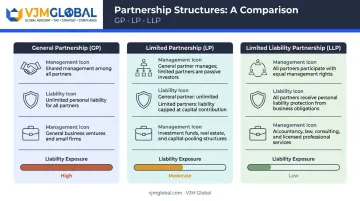
All partnership types benefit from pass-through taxation. In Tax Year 2023, partnerships filed more than 4.5 million returns representing over 30.2 million partners and $12.0 trillion in receipts.
A written partnership agreement defining profit splits, decision-making authority, and exit procedures isn't legally required in most states. Skipping it, though, is one of the more reliable ways to create expensive disputes later.
Best for: Professional service firms, joint ventures, and multi-owner businesses where partners want flexible governance.
Limited Liability Company (LLC)
The LLC is a hybrid: it offers the liability protection of a corporation with the tax flexibility of a partnership. Members are shielded from personal liability in most situations, and profits pass through to personal returns without corporate-level tax by default.
Management is flexible — members can run the business directly or appoint a manager. Formal requirements are lighter than a corporation's.
The main complexity: LLC rules and fees vary significantly by state.
| State | Annual State Fee / Tax |
|---|---|
| California | $800 annual franchise tax |
| Delaware | $300 yearly tax |
| Wyoming | $60 or 0.0002 of Wyoming assets (whichever is greater) |
| New York | $9 biennial statement fee (plus publication requirement) |
Delaware recorded 235,393 new LLC formations in 2025 — outnumbering new corporations more than three to one — making it a reliable indicator of where the market gravitates.
Best for: Small to mid-size businesses, solo operators seeking liability protection, and founders who want flexible management without corporate formality.
C Corporation
A C Corporation is a fully separate legal entity from its owners. Shareholders are insulated from business debts and lawsuits, providing the strongest personal liability shield available.
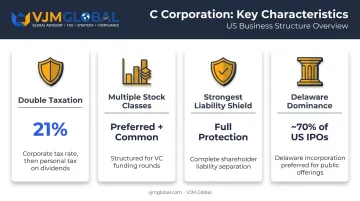
Key characteristics at a glance:
- Double taxation applies: The corporation pays a flat 21% federal corporate income tax on profits; shareholders then pay personal income tax on dividends received
- Multiple stock classes permitted: Makes C Corps the preferred structure for venture-capital-backed startups
- Strongest liability shield: Shareholders face no personal exposure to business debts or lawsuits
- Delaware dominance: Delaware corporations account for nearly 70% of US IPOs, driven by its specialized Court of Chancery, flexible corporate law, and deep body of case law
Best for: High-growth tech startups, businesses seeking VC funding, and companies planning to go public.
S Corporation
An S Corporation is a federal tax election (not a separate entity type) available to qualifying C Corporations. Its primary appeal: eliminating double taxation by passing profits and losses directly through to shareholders' personal returns.
A meaningful tax planning tool: owner-employees can split income between salary (subject to payroll tax) and dividend distributions (taxed at a lower rate). The IRS requires that the salary portion reflect reasonable compensation for services rendered — distributions cannot simply replace a wage.
Key restrictions:
- Maximum 100 shareholders
- All shareholders must be US citizens or permanent residents
- No foreign nationals, corporations, or partnerships as shareholders
- Only one class of stock permitted
Best for: Small, US-resident-owned businesses that want liability protection and a lower effective payroll tax burden.
Nonprofit Organization
A nonprofit corporation is organized to serve a public, charitable, educational, or religious purpose — not to generate profit for founders. The most common designation, 501(c)(3), grants federal income tax exemption. As of FY2025, the IRS recognized 1,596,231 organizations under Section 501(c)(3).
Key rules:
- Must apply separately to the IRS for tax-exempt status (Form 1023 or 1023-EZ)
- Surplus revenue must be reinvested in the organization's mission — it cannot be distributed to members or founders
- Donors may deduct contributions, making it easier to raise grant funding
Best for: Charitable organizations, educational institutions, and community benefit ventures.
Key Factors to Consider When Choosing a Business Structure
Six factors drive the decision. Each one maps directly to long-term financial and legal outcomes.
Liability Protection
Personal liability exposure determines whether a failed business can cost you your home, savings, or retirement accounts. Sole proprietorships and general partnerships offer no separation between personal and business assets.
LLCs, S Corps, and C Corps create a legal "corporate veil", but courts can pierce that veil if the owner fails to maintain proper separation. Common piercing factors include:
- Commingling personal and business funds
- Inadequate business capitalization
- Failing to maintain corporate records or hold required meetings
- Using the entity to commit fraud or create injustice
The corporate veil doesn't replace insurance either. Maintaining proper formalities and carrying appropriate coverage are both necessary — not alternatives to each other.
Tax Treatment
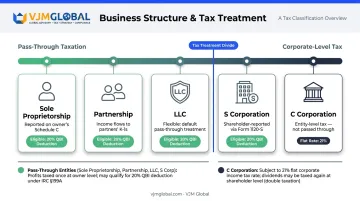
The spectrum runs from pass-through taxation to corporate-level tax:
- Pass-through entities (sole proprietorships, partnerships, LLCs, S Corps): income reported on owner's personal return, subject to personal income tax rates and self-employment tax
- C Corporations: pay 21% flat federal corporate tax, with double taxation on dividends distributed to shareholders
- Pass-through deduction: eligible pass-through entity owners can generally deduct up to 20% of qualified business income (QBI) under Section 199A, subject to income thresholds and limitations
For foreign nationals, an additional layer applies. US tax treaties, withholding obligations on partnership income (Section 1446), and FIRPTA rules for real estate sales can all influence which entity type is most tax-efficient. Getting this wrong is costly — expert cross-border tax guidance is essential before committing to a structure.
Ownership, Control, and Capital-Raising Ability
Your structure determines both who controls the business and how you fund it. The two decisions are inseparable.
Control:
- Sole proprietors retain 100% control
- LLCs offer flexible member-managed or manager-managed governance, customizable in the operating agreement
- Corporations are governed by a board of directors, which can dilute founder control as investors enter
Capital access:
- Sole proprietorships cannot issue equity and depend entirely on owner capital or debt
- LLCs can accept investors as members, but most institutional venture capital funds prefer not to invest in LLCs — primarily due to tax complications for their tax-exempt and foreign limited partners
- C Corporations can issue preferred and common stock, making them the clear choice for any startup planning institutional fundraising rounds
NVCA model financing documents are structured around corporate preferred stock mechanics — a practical signal of where institutional capital expects to invest.
Administrative Complexity and Long-Term Goals
The lightest structure to maintain today can create the most friction when you sell, transfer, or scale. Factor in exit strategy from the start.
Compliance spectrum:
- Sole proprietorships: minimal — local licenses and a Schedule C
- Partnerships: partnership agreement (strongly recommended), annual Form 1065
- LLCs: operating agreement, state annual reports and fees, Form 1065 or Schedule C depending on classification
- Corporations: articles of incorporation, bylaws, board minutes, annual meetings, shareholder records, state fees — requiring legal and accounting support on an ongoing basis
Exit and growth considerations:
- Building toward acquisition or IPO? Start as a C Corp. Converting later creates a taxable event and complicates the cap table
- Lifestyle business with no plans for outside capital? LLC or S Corp avoids corporate-level tax
- Passing the business to family or bringing in co-founders? Different structures handle these transitions differently from both a legal and tax standpoint
Delaware and Wyoming are popular incorporation states even for businesses operating elsewhere — Delaware for its Court of Chancery and case law depth, Wyoming for its low cost and privacy-friendly statutes.
Matching the Right Business Structure to Your Venture
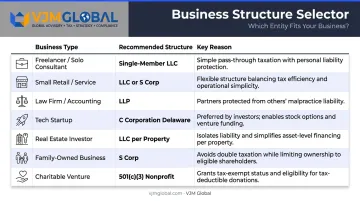
Here's a practical breakdown by common business profile:
| Business Type | Recommended Structure | Key Reason |
|---|---|---|
| Freelancer / solo consultant | Single-member LLC | Liability protection with minimal complexity |
| Small retail or service business | LLC or S Corp | Pass-through taxation + liability shield |
| Law firm, accounting practice | LLP or professional corporation | State-mandated or liability-appropriate |
| Tech startup seeking VC funding | C Corporation (Delaware) | Preferred stock issuance, investor expectations |
| Real estate investor | One LLC per property | Isolates liability across individual assets |
| Family-owned business | S Corp | Pass-through efficiency, structured ownership |
| Charitable or educational venture | 501(c)(3) nonprofit | Tax-exempt status, donor deductibility |
Some businesses benefit from going beyond a single entity. A holding company LLC that owns one or more operating subsidiaries is a common setup for businesses with multiple revenue streams or asset classes. Each operating entity carries its own liability — so a problem in one doesn't spill into the others.
Foreign Nationals Forming US Entities
Non-US residents can form LLCs and C Corporations in the US. State law governs formation, and there's no citizenship requirement at the entity level. What foreign founders cannot do is hold S Corporation shares — IRS rules explicitly bar nonresident aliens from S Corp ownership.
Additional compliance obligations apply:
- Form 5472 is required for 25%-or-more foreign-owned domestic corporations and foreign-owned US disregarded entities with reportable transactions. Failure to file correctly carries a $25,000 penalty per occurrence, plus additional penalties for continued non-compliance
- Section 1446 withholding applies to foreign partners' allocable share of partnership income
- Some states impose additional franchise taxes or requirements on foreign-owned entities
Cross-border entity formation sits at the intersection of state law, IRS rules, and applicable tax treaties. Getting it wrong is costly. Work with advisors who have specific experience in international entity structuring — not just general US business formation.
How VJM Global Can Help You Set Up the Right US Business Structure
VJM Global brings 30+ years of experience in tax, audit, and advisory services to entrepreneurs navigating cross-border business formation. With a US office in New York and a track record of serving 500+ American business owners, the firm supports foreign nationals and international founders who need expert guidance on US entity selection and compliance.
Services relevant to business structure selection include:
- Entity type evaluation based on your tax profile, funding goals, and ownership structure
- US company registration support in Delaware, Wyoming, or your operating state
- EIN application assistance
- Ongoing US tax compliance, including cross-border reporting obligations
- Accounting setup and financial reporting from day one
VJM Global's 95% client retention rate reflects a model built around long-term expert relationships. The firm serves clients across 15+ industries globally and operates as a member of EAI International — a recognized network of independent accounting and tax firms worldwide.
Key differentiators for foreign entrepreneurs:
- Specialists in cross-border tax obligations for non-US founders
- Rapid company formation with no unnecessary delays
- Transparent pricing with no hidden fees
- 24/7 personalized support with dedicated advisors
- Practical expertise where US entity requirements meet international tax obligations
Conclusion
Choosing the right US business structure comes down to four factors: your liability tolerance, tax situation, funding plans, and long-term vision. LLCs work well for most small businesses. C Corporations are the clear choice for investment-ready startups. S Corporations suit small, US-resident-owned businesses focused on tax efficiency.
That said, getting the initial choice right matters. Structures aren't always permanent, but starting with the wrong one creates costly, time-consuming complications to unwind. Review your structure as the business grows, and get qualified legal and financial counsel before registering — particularly when cross-border ownership or international tax considerations apply. Firms with cross-border advisory experience, like VJM Global, can help foreign founders and US-based businesses navigate those complexities before they become problems.
Frequently Asked Questions
What is the most common business structure in the USA?
The LLC is the most commonly formed structure for businesses seeking formal legal status. In Delaware's 2025 data, LLCs outnumbered new corporation formations more than three to one — a ratio driven by their combination of liability protection, pass-through taxation, and low administrative burden.
What are the 6 different types of US business structures?
The six main structures are: Sole Proprietorship, Partnership (GP, LP, or LLP), Limited Liability Company (LLC), C Corporation, S Corporation, and Nonprofit Organization. Each differs in how it treats personal liability, taxation, ownership eligibility, and required compliance.
What is the most effective business structure?
There's no single best structure — the right one depends on your risk profile, tax situation, funding needs, and goals. For most small businesses, the LLC offers the best balance of protection and simplicity. For startups planning to raise institutional capital, the C Corporation is typically the most effective choice.
Can a foreign national or non-resident start a business in the US?
Yes. Non-US residents can form LLCs and C Corporations in the US without citizenship requirements. They cannot, however, be shareholders of an S Corporation. Foreign-owned US entities face additional IRS reporting obligations, including Form 5472, and should work with a US-qualified advisor to stay compliant.
What is the difference between an LLC and an S Corporation?
Both avoid corporate-level tax through pass-through treatment, but differ in structure. An LLC has no ownership restrictions and flexible governance. An S Corp caps shareholders at 100 US residents, allows only one class of stock, and lets owner-employees split income between salary and distributions to reduce payroll tax exposure.
Can I change my business structure after registering?
Yes — a sole proprietorship can convert to an LLC, or an LLC can elect S Corp tax treatment. Conversions may trigger tax consequences, require state filings, and add legal costs. Getting the structure right upfront avoids those complications and the cost of undoing them later.