Introduction
There's no single "best" business structure for US tax purposes—and a mismatched choice can cost you in double taxation, self-employment tax, or limited investor options. The right entity depends on how you earn money, how much you distribute versus reinvest, and how you plan to raise capital.
Founders often fixate on headline rates and miss that tradeoff. A 21% corporate rate looks attractive until dividends face a second tax layer. A pass-through looks simpler until self-employment tax cuts into profits.
This guide compares the tax treatment of sole proprietorships, partnerships, LLCs, S corporations, and C corporations. We'll cover self-employment and payroll tax exposure, investor access, liability protection, and state-level costs. By the end, you'll have a practical framework for matching an entity choice to your ownership structure and growth plans.
Key Takeaways
- Sole proprietorships and partnerships use pass-through tax; C corps pay entity-level tax, with a second tax possible on dividends
- An LLC is a legal entity, not a tax category: federal treatment follows ownership or the election you make
- S corp status can cut employment-tax exposure but requires reasonable pay, payroll, and strict eligibility
- State income, franchise, and gross receipts taxes can change which structure wins on total cost
- Weigh near-term tax cost against liability protection, financing needs, and long-term growth plans
Overview of Business Structure Taxation in the US
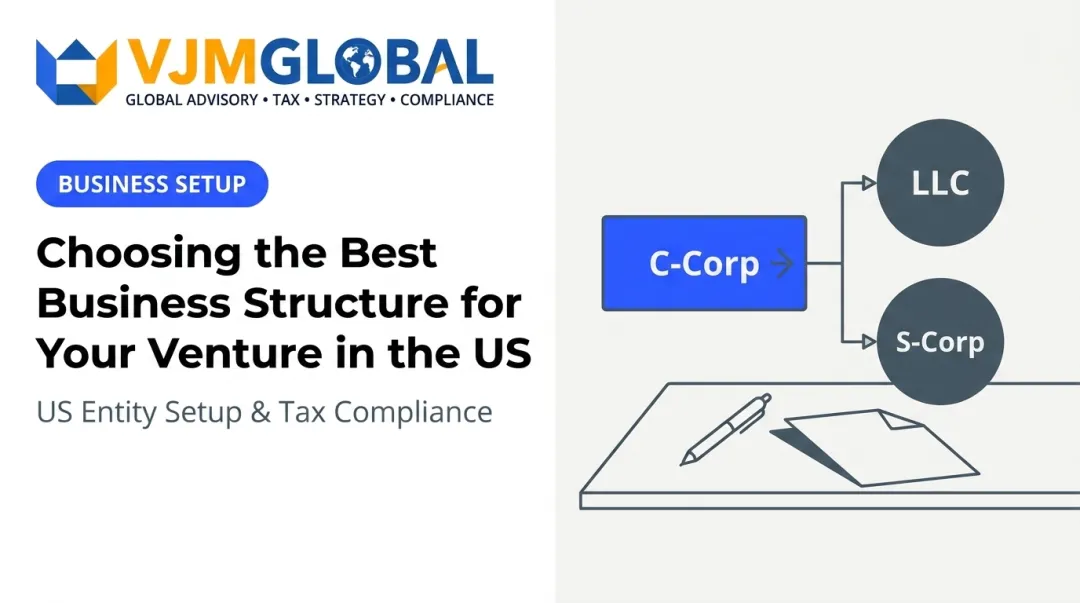
A business structure is the legal framework that governs ownership, liability, and management. It's separate from your federal tax classification, which determines how the IRS taxes your income. An LLC, for instance, is a legal structure, but its tax treatment can vary based on elections filed with the IRS.
Pass-Through Taxation
In a pass-through structure, business income flows directly to the owners' individual tax returns. The business itself generally doesn't pay federal income tax, though it may still have filing, payroll, or information-reporting duties.
- Sole proprietorships report income on Schedule C
- Partnerships file Form 1065 and issue Schedule K-1 to each partner
- S corporations file Form 1120-S and pass income through similarly
Entity-Level Tax for C Corporations
C corporations are separate taxpayers. They pay federal income tax at a flat 21% rate on taxable income, according to IRS Publication 542.
When the corporation later distributes after-tax profits as dividends, shareholders pay tax again: ordinary dividends at regular income rates, and qualified dividends at lower capital-gains rates.
Federal tax is only part of the picture. States layer on their own corporate income taxes, franchise taxes, gross receipts taxes, payroll taxes, and local business obligations. A state with no corporate income tax isn't necessarily a low-tax state; it may simply tax revenue or payroll differently instead.

The comparison below evaluates each structure against tax treatment, owner compensation, distribution rules, compliance burden, and typical fit.
Business Structures Compared for US Companies
Six factors shape this comparison for every structure:
- Federal tax classification
- Self-employment or payroll tax treatment
- Profit retention and distribution rules
- Ownership and investor restrictions
- Administrative burden
- State-level exposure
Sole Proprietorship
A sole proprietorship is the default structure for an unincorporated one-owner business. No formation paperwork is required: you simply start operating. You report income and expenses on Schedule C (Form 1040), and if net self-employment earnings hit $400 or more, you also file Schedule SE.
Tax mechanics:
- Business profit is taxed once, at the owner's individual rate
- Self-employment tax applies at 15.3% (12.4% for Social Security and 2.9% for Medicare) — per IRS guidance on self-employment tax
- An Additional Medicare Tax of 0.9% kicks in above certain income thresholds
Where it falls short:
- Unlimited personal liability
- No path to outside investors
- Full self-employment tax on every dollar of profit, not just wages
Partnership
Partnerships aren't a single legal form. General partnerships expose every partner to personal liability for business debts. Limited partnerships limit a partner's liability to what they've contributed. Limited liability partnerships (LLPs) shield partners from liability tied to another partner's actions.
Regardless of structure, most partnerships file Form 1065 as an informational return and issue Schedule K-1 to each partner, reporting their share of income, deductions, and credits.
What actually determines the tax outcome:
- The partnership agreement — how profits, losses, and guaranteed payments are allocated
- Whether a partner is treated as active (subject to self-employment tax) or a passive limited partner
- State-specific filing and registration obligations
No two partnerships look identical on paper, and the tax result often hinges on details buried in the partnership agreement rather than the entity type itself.
Limited Liability Company
An LLC is a state-law entity, not a fixed federal tax category. The IRS treats it based on ownership and elections:
- Single-member LLC: disregarded by default, reported on the owner's personal return
- Multi-member LLC: taxed as a partnership by default, using Form 1065
- Either type: can elect corporate or S corporation treatment via Form 8832 or Form 2553, per IRS LLC classification guidance
LLCs offer liability protection that sole proprietorships lack, plus flexibility in how profits are split among members. That flexibility comes with a cost: formation fees, annual reports, registered-agent requirements, and state-specific franchise fees.
When an S corp election makes sense: Once an LLC's profit consistently exceeds what a reasonable salary would cover, electing S corporation status can reduce the portion of income subject to payroll tax. That only pays off after payroll administration costs and the reasonable-compensation rules below. It is not automatic savings.
S Corporation
S corporation status is a federal tax election, not an entity type. An eligible LLC or corporation applies for it using Form 2553. Eligibility rules are specific:
- No more than 100 shareholders
- Only one class of stock
- No partnership, corporation, or nonresident-alien shareholders
- Election must be filed within 2 months and 15 days of the tax year's start, per IRS Form 2553 instructions
S corps use pass-through taxation, but shareholder-employees must be paid reasonable compensation before taking non-wage distributions. Wages are subject to payroll tax; distributions generally are not, which is the core tax appeal.
The IRS actively watches for owners who minimize wages and inflate distributions, per IRS guidance on S corp compensation.
S corp status may be a poor fit when:
- Ownership includes ineligible investors (foreign entities, other corporations)
- The company needs multiple classes of stock for economic flexibility
- Venture capital financing is on the roadmap — VCs typically require C corp structure
C Corporation
A C corporation is a separate taxpayer, taxed at 21% federally. It's the structure of choice when a company plans to retain significant earnings, issue multiple stock classes, court outside investors, or eventually go public.
The trade-off is real: corporate profits are taxed once at the entity level, and again at the shareholder level if distributed as dividends. Retained profits avoid the second tax layer, at least temporarily. Excessive accumulation beyond reasonable business needs can still trigger a 20% accumulated earnings tax under IRS rules.

Advantages beyond the rate comparison: C corps also support stock-based compensation, perpetual existence independent of ownership changes, and certain fringe benefit deductions unavailable to pass-through owners. The cost is heavier governance, accounting, and multi-state compliance obligations.
Structure Comparison at a Glance
| Structure | Federal Treatment | Owner-Level Tax | SE/Payroll | Investor Fit | Compliance | Best Fit |
|---|---|---|---|---|---|---|
| Sole Proprietorship | Pass-through | Individual rate | Full SE tax (15.3%) | Poor | Minimal | Solo, low-risk services |
| Partnership | Pass-through | Individual rate | Varies by partner role | Limited | Moderate | Multi-owner ventures |
| LLC (default) | Disregarded or partnership | Individual rate | Full SE tax typically | Limited | Moderate | Flexible small businesses |
| S Corporation | Pass-through | Individual rate | Payroll tax on wages only | Restricted | Higher (payroll + filings) | Profitable owner-operated firms |
| C Corporation | Entity-level (21%) | Dividend tax if distributed | Payroll tax on wages | Best | Highest | Investor-backed, growth-stage companies |
How to Choose the Best Structure for Your Company
Skip the universal ranking. Instead, work through these factors in order.
Start With Ownership
- How many owners, and are any non-US residents or entities?
- Will family members hold shares?
- Do you expect to bring in outside investors within the next few years?
Foreign ownership or plans for institutional funding rule out S corporation status immediately. Non-US owners are generally ineligible for S corp shares, and institutional investors typically require a C corp.
Model Your Profit Strategy
Will profits get distributed to owners each year, or reinvested into hiring, inventory, or expansion? This matters more than comparing the 21% corporate rate to your individual bracket in isolation.
- Distributing most profit? Pass-through treatment usually avoids the double-tax layer
- Reinvesting heavily? A C corp's flat rate on retained earnings can sometimes beat individual rates, especially at higher income levels
Assess Your Risk Profile
Consider liability exposure, whether you'll have employees, and whether your industry is regulated. A business with meaningful liability risk almost always needs an LLC or corporation — not a sole proprietorship or general partnership.
Factor in Administrative and State Costs
Entity choice isn't just federal. Look at:
- Formation fees and annual report requirements in your state
- Franchise tax exposure: Texas, for example, applies rates up to 0.75% on taxable margin above a $2,650,000 revenue threshold, per the Texas Comptroller's franchise tax guidance
- Gross receipts taxes in states like Washington, which apply regardless of profitability
- Registered-agent and multi-state nexus obligations if you operate across state lines
Common Scenarios
- Solo consultant, low liability risk: Sole proprietorship or single-member LLC often suffices early on
- Profitable owner-operated business: Model an S corporation election once profit consistently exceeds a reasonable salary
- Startup seeking venture funding: C corporation, typically incorporated in Delaware, is the standard expectation
- Multi-state or international expansion: Requires careful review of nexus rules, registered-agent needs, and cross-border tax treaties
When to Get Professional Advice
Entity selection should be modeled against your actual financial projections, not generic advice. Revisit the decision after major changes: new owners, employee growth, outside investment, relocation, acquisitions, or cross-border activity.
VJM Global supports US business owners with entity formation across all 50 states, tax compliance filings (Forms 1120, 1120-S, and 1065), payroll setup, and individual return preparation for Forms 1040 and 1040-NR. Use that support to model the choice against your projections when ownership, funding, or multi-state activity changes.

Conclusion
The best business structure for a US company balances tax treatment against liability protection, ownership flexibility, financing goals, and state-level costs. There's no shortcut that skips this analysis.
Don't choose an LLC, S corporation, or C corporation solely because you heard a favorable tax rate somewhere. Run the comparison using your company's actual projected income, distribution plans, and the current federal and state rules that apply to you.
If you're weighing entity choice or reviewing a structure that no longer fits your growth, VJM Global works with US business owners on tax compliance, accounting, audit, and advisory needs — from initial formation through ongoing filings.
Frequently Asked Questions
Which business structure is best for tax purposes?
It depends on ownership, profit level, distribution plans, reinvestment strategy, payroll needs, state exposure, and investor goals. Choosing an LLC as a legal entity is separate from electing S corporation or C corporation tax treatment.
How much tax do I pay if I have a limited company?
"Limited company" isn't a standard US federal tax category. The term is more common in the UK and elsewhere. In the US, an LLC's tax depends on its default classification (disregarded or partnership) or any corporate election, plus federal, state, and payroll taxes.
How do US corporate taxes compare to other countries?
The US federal corporate rate is 21%. Combined federal-and-state taxation averages 25.57%, versus a 24.20% OECD average, per the Tax Foundation's 2025 global comparison. Shareholder-level dividend tax adds another layer often missing from headline comparisons.
Who has the highest corporate tax rate in the USA?
Among states with a corporate income tax, New Jersey currently has the highest top marginal rate. Gross receipts tax states like Washington aren't directly comparable, since they tax revenue rather than net income.
Who pays 37% tax in the USA?
The 37% rate is the top federal individual marginal income tax bracket, not a business tax rate. For 2026, it applies above $640,600 (single) and $768,700 (joint). It can also hit pass-through owners whose business income flows onto their personal returns.