Introduction
Offshore company formation has changed significantly. It's no longer about finding the lowest-tax jurisdiction and registering a shell company — regulators across the globe have made sure of that. In 2026, building an effective offshore structure means navigating economic substance rules, CRS reporting obligations now covering 111 jurisdictions, BEPS compliance, and increasingly stringent banking requirements that can derail even well-planned structures.
This guide is written for entrepreneurs, NRIs, foreign investors, multinational companies, and startups evaluating international expansion. Whether you're building a holding company, entering a new market, or ring-fencing IP from operations, the decisions you make at the outset determine whether your structure holds up — with banks, tax authorities, and regulators.
Six practical tips follow. Each addresses a decision point where getting it wrong tends to be expensive.
Key Takeaways
- Jurisdiction selection must be driven by business purpose, banking needs, and compliance capacity — not tax rate alone
- CRS, FATCA, and BEPS rules now demand genuine operational grounding — substance requirements are non-negotiable in 2026
- UAE, Singapore, Hong Kong, BVI, Cayman Islands, Mauritius, and Cyprus each serve different business purposes
- Banking access is one of the most overlooked challenges — plan for it before you incorporate
- Professional advisory is not optional — the wrong structure creates legal and tax liability, not savings
Tip 1: Define Your Business Goals Before Choosing a Jurisdiction
The most common mistake in offshore formation is jurisdiction-first thinking. A founder hears "BVI is cheap" or "UAE is zero tax" and files papers without first asking what the structure actually needs to do.
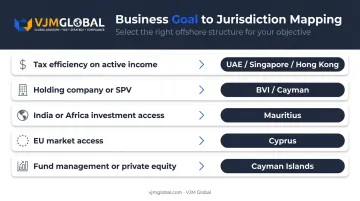
Different goals point to very different jurisdictions:
- Tax efficiency on active income → UAE free zones, Singapore, Hong Kong
- Holding company or SPV → BVI, Cayman Islands
- India or Africa investment access → Mauritius
- EU market access and VAT registration → Cyprus
- Fund management or private equity → Cayman Islands
Questions to Answer Before Incorporating
Before selecting any jurisdiction, your structure needs to answer these clearly:
- What is the primary business activity — trading, holding, consulting, IP licensing?
- Where are customers and revenue sources located?
- Does the structure need banking credibility for investors or counterparties?
- Is physical substance required — staff, premises, local management?
- What are your home-country CFC and transfer pricing obligations?
Operational vs. Passive Structures
The distinction matters. An operational company that invoices clients, employs staff, or holds contracts needs substance, banking access, and counterparty credibility. UAE free zones and Singapore are built for this.
A passive holding structure that simply holds shares or intellectual property may suit BVI or Cayman — but even those jurisdictions now require annual financial returns and beneficial ownership filings.
One critical point: forming an offshore company does not eliminate your home-country tax obligations. CFC rules in the US, UK, and Australia can attribute offshore income back to domestic shareholders. Transfer pricing requirements apply to related-party transactions regardless of where the entity is incorporated.
Get your tax residency position confirmed in writing before formation. Discovering a CFC exposure or FEMA violation after the fact is significantly more expensive to fix than addressing it upfront.
Tip 2: Know the Best Offshore Jurisdictions for 2026
Jurisdiction selection in 2026 requires weighing reputation, bankability, economic substance requirements, annual maintenance cost, and fit for the business activity. Here is a practical breakdown.
Jurisdictions for Active Operations and Trading
| Jurisdiction | Tax Rate | Best For |
|---|---|---|
| UAE Free Zones | 0% on qualifying income; 9% on non-qualifying income | Operations, consulting, e-commerce, holding with substance |
| Singapore | 17% headline; startup exemptions available | Asia-Pacific HQ, treaty access, investor credibility |
| Hong Kong | 8.25% on first HKD 2M; 16.5% above | China gateway, territorial source basis |
UAE free zones remain the top choice for businesses needing real international operations with strong banking access. The QFZP rates shown above are distinct mechanisms — not the same as the standard 0%/9% threshold that applies at AED 375,000 for ordinary taxable persons.
QFZP status requires adequate substance, audited accounts, and arm's-length compliance. A registered office alone won't satisfy modern bank requirements.
Singapore's startup exemptions (75% on first S$100,000; 50% on the next S$100,000) and ~100 tax treaties make it the credibility choice for Asia-Pacific structures. For Hong Kong, MNE entities should note the FSIE regime can tax specified foreign income received in-territory — the territorial basis has limits.
Jurisdictions for Holdings, Funds, and Asset Structures
Three jurisdictions dominate this category, each with a distinct use case:
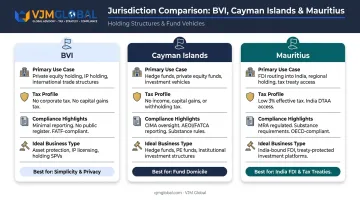
- BVI — No corporate income or capital gains tax; ideal for holding companies, SPVs, and investment structures. Annual financial returns required; banks demand full KYC, not just a registered office.
- Cayman Islands — The institutional standard for investment funds and private equity. No direct corporate tax and sophisticated legal infrastructure, but higher setup and maintenance costs. Better suited to premium structures than early-stage businesses.
- Mauritius — 15% standard corporate tax with a DTA network covering 45 counterparties, including India. A practical bridge for businesses managing Indian and African investment flows.
Jurisdictions for European Market Access
Cyprus increased its corporate tax rate from 12.5% to 15% effective 1 January 2026, aligning with global minimum tax standards while staying competitive within the EU. It suits holding companies, IP structures, trading businesses, and entities needing EU VAT registration and Eurozone credibility. CRS and EU anti-abuse rules apply.
Tip 3: Understand Tax Structures, Economic Substance, and Compliance Rules
Three Offshore Tax Profiles
| Profile | Examples | How It Works |
|---|---|---|
| Tax-neutral | BVI, Cayman | No conventional corporate tax, but substance rules and transparency obligations apply |
| Territorial | Hong Kong | Only locally sourced profits generally taxed (subject to FSIE for MNE entities) |
| Treaty-network | Singapore, Cyprus, Mauritius | Competitive rates with DTA access and banking credibility |
Economic Substance Requirements in Practice
Incorporation alone is not enough. BVI and Cayman statutes require companies conducting "relevant activities" — holding, headquarters, finance, IP, fund management, and shipping — to demonstrate real local presence: local direction, personnel, expenditure, and premises.
Non-compliance carries real penalties:
- BVI: First failure attracts USD 5,000–20,000 in penalties; repeat failure can reach USD 200,000, or USD 400,000 for high-risk IP activities, plus strike-off risk
- Cayman: Penalties begin at KYD 10,000, can escalate to KYD 100,000, and may lead to court-ordered action or strike-off
In the UAE, the former Economic Substance Regulations filing requirement was removed for financial years ending after 31 December 2022, but substance remains relevant through QFZP tax conditions.
Jurisdiction-level substance is only part of the picture. Global reporting frameworks add another compliance layer that offshore structures cannot avoid.
CRS, FATCA, and BEPS
CRS now covers 126 MCAA signatories, with 111 jurisdictions having exchanged financial account data in 2024. Offshore structures are visible to home-country tax authorities. Beneficial ownership records and annual filings are not optional.
BEPS Pillar Two sets a 15% global minimum effective tax rate for MNE groups with revenues exceeding EUR 750 million. This applies to large groups only, not every offshore company. Businesses approaching that revenue threshold should assess their exposure in each jurisdiction they operate in before their next reporting cycle.
Tip 4: Plan for Banking Access Before You Incorporate
Banking is where offshore formation plans most often collapse. A company can be incorporated in five business days. Opening a working bank account can take months — or fail entirely — if the jurisdiction or structure doesn't meet modern banking requirements.
Jurisdictions by Banking Access
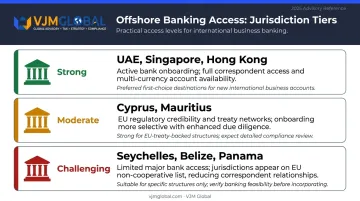
| Tier | Jurisdictions | Practical Reality |
|---|---|---|
| Strong | UAE, Singapore, Hong Kong | Established ecosystems; major banks actively onboard offshore entities with proper documentation |
| Moderate | Cyprus, Mauritius | Workable with right preparation; EU and treaty credibility helps |
| Challenging | Seychelles, Belize, classic offshore havens | Limited major bank access; Panama remains on the EU non-cooperative tax list as of February 2025 |
What Banks Require
Prepare this documentation pack before or during incorporation:
- Legal entity documents (certificate of incorporation, constitutional documents)
- Registered address and principal place of business
- Director and beneficial owner identity evidence
- Source of funds documentation
- Description of business activity and expected transaction flows
- Tax Identification Number(s)
- In-person interview or local presence (required by some banks)
Fintech and EMI Alternatives
Digital banking options through providers like Wise, Airwallex, and Revolut have expanded for offshore companies — useful for e-commerce and consulting businesses, among others. Each provider applies its own eligibility criteria by country and entity type, so verify supported jurisdictions before assuming access.
That said, these accounts may not satisfy investor due diligence requirements or certain regulatory thresholds. For businesses expecting institutional funding or regulated activity, a traditional bank account remains essential.
Tip 5: Avoid These Common Offshore Formation Mistakes
Choosing Cheapest Without Assessing Total Cost
A low incorporation fee in a poorly regarded jurisdiction often costs far more in downstream consequences: banking rejections, lost contracts, and counterparty credibility issues. A company incorporated in a jurisdiction on the EU non-cooperative list (Panama remains listed as of February 2025) can face practical obstacles that no amount of subsequent restructuring fixes quickly.
Ignoring Ongoing Compliance Obligations
Offshore does not mean "set and forget." Every jurisdiction imposes ongoing obligations:
- Annual renewal fees and registered agent maintenance
- Beneficial ownership filings (BVI, Cayman, and others have updated their frameworks through 2024–2025)
- Accounting record maintenance
- Economic substance assessments where relevant activities apply
- Annual returns or financial statements
Failure to comply risks deregistration or — in CRS-participating jurisdictions — automatic information reporting to home-country tax authorities.
Failing to Align with Home-Country Tax Obligations
This is the most expensive mistake. Forming an offshore company does not eliminate the founder's domestic tax exposure. Home-country obligations vary by jurisdiction:
- US persons must file FBAR (FinCEN Form 114) when foreign financial accounts exceed USD 10,000 in aggregate at any point during the year; Form 5471 also applies to certain US shareholders in foreign corporations
- UK and Australian founders face CFC rules that can attribute offshore income directly back to domestic shareholders
- Indian-connected structures are subject to transfer pricing rules on associated-enterprise transactions, regardless of where the offshore entity is registered
Model the home-country tax impact before incorporating — not after the structure is already in place.
Tip 6: Partner with an Experienced Offshore Formation Advisor
Offshore formation touches multi-jurisdictional legal, tax, banking, and compliance requirements simultaneously. Getting one layer wrong — entity type, jurisdiction, substance, banking, or home-country alignment — creates problems that take years to unwind.
That's where the right advisor earns their fee. Beyond filing paperwork, they:
- Match the jurisdiction to the specific business goal and revenue model
- Prepare compliant documentation that satisfies both the incorporation authority and the bank
- Flag CFC, transfer pricing, and home-country reporting obligations before they become problems
- Coordinate bank account opening and set up ongoing compliance processes from day one
VJM Global is a team of Chartered Accountants specializing in international taxation, transfer pricing, FEMA advisory, and cross-border structuring. The firm has served 500+ American businesses, 250+ UK businesses, and 250+ Australian businesses — with a 95% client retention rate across 30+ years of practice.
For businesses navigating offshore formation, VJM Global's advisory team offers pre-incorporation analysis tailored to your structure and home-country obligations. Start with a consultation at vjmglobal.com.
Frequently Asked Questions
Which country is best for an offshore company?
There is no single best country. UAE and Singapore lead for operational businesses needing substance and banking credibility. BVI and Cayman suit holding structures and investment vehicles. Mauritius works well for India- and Africa-linked investment flows, and Cyprus provides EU access with a 15% corporate rate from 2026.
Which is the best country to open an offshore bank account?
UAE, Singapore, and Hong Kong offer the strongest banking ecosystems for offshore companies, with major banks actively onboarding compliant structures. Classic offshore havens like Seychelles and Belize have more limited options and require extensive KYC. Panama's position on the EU non-cooperative tax list complicates banking relationships further.
Which EU country is easiest to start a business as a foreigner?
Cyprus is widely considered the most accessible EU jurisdiction for offshore formation by non-residents — 15% corporate rate from 2026, no minimum share capital requirement, and a straightforward registration process. Ireland is another popular option for EU-facing businesses, taxing trading income at 12.5%, though a director residency requirement applies unless a prescribed bond is in place.
Is offshore company formation legal?
Offshore company formation is completely legal when properly structured, declared to home-country tax authorities, and operated in compliance with CRS, FATCA, and relevant CFC rules. Correct implementation and transparent reporting are what separate legitimate offshore planning from tax evasion — US taxpayers must still report worldwide income regardless of where the entity is held.
What are the ongoing compliance requirements for an offshore company?
Requirements vary by jurisdiction but generally include annual renewal fees, accounting record maintenance, beneficial ownership filings, and economic substance assessments. BVI companies must file annual financial returns; Cayman entities face beneficial ownership transparency obligations updated through 2025.
How long does it take to set up an offshore company in 2026?
Formation timelines range from hours to weeks depending on jurisdiction — BVI offers a 4-hour premium service, Singapore typically registers within a few working days, and UAE free zone timelines vary by authority. Banking and KYC processes usually add several weeks or months beyond incorporation itself.