Introduction
Singapore businesses eyeing expansion into the Middle East and Africa face a recurring challenge: how to extend their reach without sacrificing operational control or exposing the parent company to unnecessary risk. DMCC (Dubai Multi Commodities Centre), a Government of Dubai free zone hosting over 25,000 companies, has become the default answer.
The appeal is concrete. DMCC offers 100% foreign ownership, zero personal income tax, and access to over 1,000 approved business activities — from commodities trading to financial services. Its English-language documentation requirements and common law-influenced governance structure map closely to what Singapore companies already know.
Most DMCC setup guides treat all applicants the same. Singapore businesses, however, face considerations that generic guides overlook: multi-stage document attestation through the UAE Embassy in Singapore, a structural choice between subsidiary and branch that directly affects parent company liability, and a tax and investment framework built across three bilateral treaties — not just one. This guide addresses those Singapore-specific realities directly.
Key Takeaways
- DMCC permits 100% foreign ownership with no Emirati sponsor requirement—Singapore shareholders retain full control
- Choose from three structures: FZ-LLC subsidiary (most common), branch office (faster but parent liable), or FZE (sole entrepreneur)
- Setup takes 4–6 weeks for an FZ-LLC or 6–10 weeks for a branch; Singapore document attestation adds 1–3 weeks to either timeline
- First-year costs range from AED 50,000–60,000 (approx. SGD 18,500–22,200) for registration, license, office space, and one visa
- All DMCC entities must register for UAE corporate tax regardless of revenue — the rate is 9% above AED 375,000, though qualifying free zone income may be taxed at 0%
What Is DMCC and What Can Singapore Businesses Do There?
DMCC is a UAE government-owned free zone authority established in 2002, now ranking as one of the world's most globally recognised free zone jurisdictions. Home to over 25,000 registered companies spanning commodities trading, professional services, technology, financial services, e-commerce, and industrial sectors, DMCC has won the Financial Times' fDi Magazine "Global Free Zone of the Year" award nine consecutive times (2016–2024).
Business Activity Scope
DMCC supports over 1,000 approved business activities across 20 sectors. Singapore businesses commonly license activities in:
- Trading: General trading, commodities, import/export, e-commerce
- Professional Services: Business consulting, market research, management advisory
- Technology: Software development, AI, blockchain, crypto asset services
- Financial Services: Investment advisory, fund management (with appropriate UAE regulatory approvals)
- Logistics & Supply Chain: Freight forwarding, warehousing coordination
Unlike industry-specific free zones such as Dubai Healthcare City or Dubai Internet City, DMCC accommodates diverse business models under one regulatory umbrella. This matters for Singapore businesses that want to combine activities — for example, running a commodities trading arm alongside a technology or advisory function — without needing separate licenses across multiple free zones.
Why Singapore Businesses Are Choosing DMCC Over Other UAE Zones
Complementary Geography Logic
Singapore serves as the Asia-Pacific hub; DMCC provides the Middle East, Africa, and Eastern Europe gateway. This dual-hub model lets Singapore Pte Ltd companies serve clients across 15 time zones without relocating headquarters or splitting operations.
DMCC-Specific Advantages
DMCC commands a premium over budget alternatives like IFZA (AED 17,000–25,000 setup) or RAKEZ (AED 12,000–18,000 setup):
- Banking acceptance: Major UAE banks (Emirates NBD, FAB, Mashreq) show stronger receptivity to DMCC licenses during KYC processes
- Regulatory prestige: DMCC's government backing and global awards enhance credibility with institutional clients and partners
- Prime location: JLT (Jumeirah Lakes Towers) address signals established presence, not virtual-only operations
- Common law framework: DMCC's corporate governance borrows from common law principles, familiar to Singapore businesses operating under similar legal traditions
For Singapore companies targeting commodity trading, banking partnerships, or high-value B2B contracts, the higher setup cost (AED 35,000–50,000+) translates directly into stronger bank approvals and institutional credibility.
Treaty Architecture: Three Agreements, Not One CEPA
Critical clarification: No bilateral Singapore-UAE Comprehensive Economic Partnership Agreement (CEPA) exists. Instead, the commercial relationship operates through three complementary treaties:
| Agreement | Year | Key Benefits for DMCC Subsidiary |
|---|---|---|
| Singapore-UAE Double Taxation Agreement (DTA) | 1995 (amended 2014) | Prevents double taxation on business profits; allocates taxing rights between jurisdictions |
| GCC-Singapore Free Trade Agreement (GSFTA) | 2008 (in force 2013) | ~99% tariff elimination on Singapore exports to GCC; services liberalisation |
| Singapore-UAE Bilateral Investment Treaty (BIT) | 2011 (in force 2012) | MFN treatment, expropriation protection, investor-state dispute settlement (ISDS) |
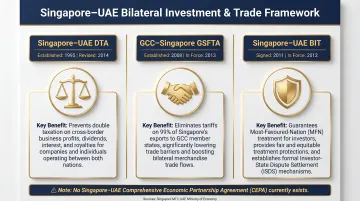
The DTA is most directly relevant for tax structuring, while the BIT provides investment protection mechanisms. In practice, most Singapore-DMCC structures lean on the DTA first — particularly its business profits article — to determine where income is taxed and at what rate.
100% Foreign Ownership, No Sponsor Required
Unlike UAE mainland companies (which historically required 51% Emirati ownership), DMCC entities permit 100% foreign ownership with zero local sponsor obligations. Singapore shareholders retain full equity and operational control—mirroring Singapore's own Pte Ltd model where foreign investors can hold 100% of shares.
Digital, English-Language Processes
DMCC's online registration portal, English-language documentation, and common law-influenced corporate governance reduce friction for Singapore businesses. Contrast this with jurisdictions requiring Arabic translations, in-person government visits, or unfamiliar legal frameworks.
Company Structures Available to Singapore Businesses in DMCC
Three Main Options
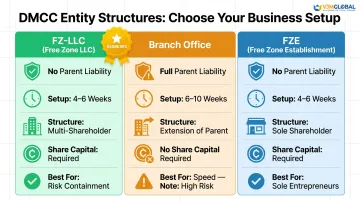
1. FZ-LLC (Free Zone Limited Liability Company) – Most Common
- Shareholders: 2–50 (individuals or corporates)
- Legal personality: Independent entity
- Liability: Limited to share capital
- Best for: Singapore Pte Ltd forming a subsidiary to ring-fence UAE operations from parent company risk
2. Branch Office of Singapore Parent Company
- Shareholders: N/A (extension of parent)
- Legal personality: None — operates as an extension of the Singapore parent
- Liability: Parent company bears full liability for branch obligations
- Best for: Singapore companies wanting faster setup and no separate share capital requirement, accepting parent liability exposure
3. FZE (Free Zone Establishment) – Sole Owner
- Shareholders: Single shareholder (individual or corporate)
- Legal personality: Independent entity
- Liability: Limited to share capital
- Best for: Individual Singapore-based entrepreneurs or single-shareholder setups
Practical Selection Guide
| Factor | FZ-LLC Subsidiary | Branch Office | FZE |
|---|---|---|---|
| Setup time | 4–6 weeks | 6–10 weeks | 4–6 weeks |
| Share capital | Required (activity-dependent) | Not required | Required (activity-dependent) |
| Parent liability | None (subsidiary is a separate entity) | Full (parent exposed to all branch obligations) | None (separate entity) |
| Recommended when | Risk containment, operational independence desired | Speed prioritised, parent comfortable with liability | Single-shareholder or solo entrepreneur setup |
Critical exclusion: DMCC does not offer LLP structures, public joint-stock companies (PJSC), or offshore-only holding company routes. This is a common misconception among Singapore business owners familiar with BVI or Cayman structures — clarifying this early prevents choosing the wrong registration path.
Once you've identified the right structure, the next step is walking through the actual registration process.
Step-by-Step: How to Set Up a DMCC Company from Singapore
The DMCC setup process flows through six key stages, most steps completable remotely via DMCC's digital portal. Budget 4–6 weeks for FZ-LLC subsidiaries, with Singapore document attestation adding 1–3 weeks.
Step 1: Choose Business Activity, Structure, and Company Name
Action items:
- Verify your intended business activity appears on DMCC's 1,000+ approved activity list
- Select legal structure (FZ-LLC, Branch, or FZE) based on liability and capital considerations
- Reserve company name via DMCC online portal—approval typically takes 1–2 business days
Name requirements: Must be unique within DMCC registry; cannot contain restricted words (e.g., "Royal," "Government") without approval; must reflect licensed activity.
Step 2: Prepare and Attest Singapore Company Documents
Singapore-origin corporate documents require multi-stage legalisation before DMCC acceptance — and document attestation is where most Singapore businesses lose time.
Required documents:
- ACRA Certificate of Incorporation
- Memorandum & Articles of Association
- Board Resolution authorising DMCC setup
- Shareholder resolution (if applicable)
- Passport copies of directors/shareholders
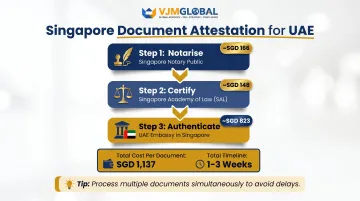
Attestation process for private/commercial documents:
- Notarise with Singapore Notary Public
- Certify at Singapore Academy of Law (SAL)
- Authenticate at UAE Embassy in Singapore
Timeline: 3–5 working days at UAE Embassy stage (excluding submission day), plus 3–5 business days for notary and SAL steps. Total realistic timeframe: 1–3 weeks.
Cost per commercial document: Approximately SGD 1,137 (notary ~SGD 166 + consular ~SGD 823 + service ~SGD 148).
Pro tip: Process multiple documents simultaneously to avoid serial delays. Confirm current attestation sequence with the UAE Embassy in Singapore before starting, as protocols occasionally change.
Step 3: Submit Initial Application and Obtain Pre-Approval
Upload your attested documents to the DMCC online portal, pay initial application fees, and complete KYC checks:
- Application fees: AED 6,000–9,020 depending on activity
- KYC requirements: Passport copies, proof of address, business plan, and CV/resume for all shareholders and directors
Timeline: DMCC typically issues initial approval within 5–10 business days, assuming complete documentation.
Step 4: Secure DMCC Office Space
Mandatory requirement: Every DMCC entity must maintain a physical address within Jumeirah Lakes Towers (JLT). Virtual-only addresses are not permitted.
Options:
- Flexi-desk: From AED 20,000/year—most cost-effective for Singapore businesses testing the market
- Private office: From AED 5,650–7,000/month for 150–200 sqft units
A signed lease agreement is required before final license issuance. Most arrangements can be completed remotely through DMCC's portal or approved property agents.
The physical office requirement also strengthens UAE corporate tax "substance" requirements for Qualifying Free Zone Person (QFZP) status — a prerequisite for the 0% tax rate.
Step 5: Open UAE Corporate Bank Account and Deposit Capital
UAE banks apply strict KYC on newly formed foreign-owned entities — account opening typically takes 2–4 weeks and often requires an in-person Dubai visit.
Commonly accessible banks for DMCC entities:
- Emirates NBD
- Dubai Islamic Bank
- Mashreq (NeoBiz)
- First Abu Dhabi Bank (FAB)
- RAKBANK
Each bank will request a standard package of supporting documents:
- Trade license and Certificate of Incorporation
- Memorandum & Articles of Association
- Passport copies and Emirates ID of authorised signatories
- Proof of address (utility bills, bank statements)
- Detailed business plan with contracts, website, and customer evidence
- Source of funds documentation
Singapore businesses accustomed to 1–2 week digital account opening should plan for 3–4 weeks in the UAE. Working with business setup advisors who have established banking relationships can meaningfully shorten this timeline.
Step 6: Obtain Final License and Complete Post-Incorporation Steps
Once your lease agreement, signed MOA/AOA, and bank capital confirmation are uploaded, DMCC issues:
- Trade license
- Certificate of Incorporation
- Establishment Card (required for visa processing)
Immediate post-incorporation tasks:
- Register for UAE corporate tax with Federal Tax Authority (FTA)—mandatory for ALL entities regardless of income; AED 10,000 penalty for late registration
- Appoint DMCC-approved auditor within 30 days
- Apply for Establishment Card (approx. AED 2,000/year) to enable employment visa processing
- Register UBO (Ultimate Beneficial Owner) details—any natural person owning/controlling 25%+ shares
Costs, Capital Requirements, and Timeline for Singapore Businesses
Share Capital Requirements
DMCC removed the mandatory AED 50,000 minimum under its 2020 Company Regulations. Share capital must now be "sufficient for the activities permitted under the license" — with interpretation varying by activity type.
In practice, many Singapore businesses still declare AED 50,000 (approx. SGD 18,500) to satisfy bank KYC requirements during account opening.
One key exception: the General Trading License requires a minimum AED 1,000,000 (approx. SGD 370,000) in share capital, and all declared capital must be deposited in a UAE corporate bank account.
First-Year Cost Breakdown
| Cost Item | Amount (AED) | SGD Equivalent | Frequency |
|---|---|---|---|
| Registration Fee | 6,000–9,020 | 2,220–3,335 | One-time |
| Trade License (standard) | 15,000–25,000 | 5,550–9,250 | Annual |
| Establishment Card | ~2,000 | ~740 | Annual |
| Flexi-desk (minimum office) | 20,000+ | 7,400+ | Annual |
| Investor/Employee Visa | ~5,000 per person | ~1,850 | Per 2-year visa |
| Document attestation (Singapore) | N/A | ~1,137 per document | One-time |
| Estimated Total (First Year) | 50,000–60,000 | 18,500–22,200 | License + office + 1 visa |
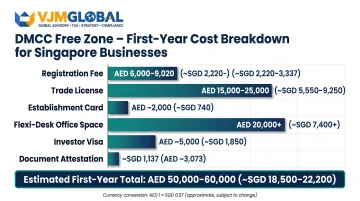
Conversion reference: AED 1 ≈ SGD 0.37. Verify current rates before budgeting.
Ongoing Annual Costs (Year Two Onwards)
- License renewal: AED 15,000–25,000 (~SGD 5,550–9,250)
- Office lease: AED 20,000+ (~SGD 7,400+)
- Mandatory audit: Market rates vary — obtain quotes from DMCC-approved auditors
- Corporate tax compliance: Filing and advisory fees depend on transaction complexity
- VAT registration triggers once annual turnover exceeds the AED 375,000 threshold
Total recurring annual cost estimate: AED 40,000–60,000+ (~SGD 14,800–22,200+) depending on office choice and transaction volume.
Timeline Summary
| Milestone | Duration |
|---|---|
| Name reservation | 1–2 days |
| Initial approval | 5–10 business days |
| Singapore document attestation | 1–3 weeks (done in parallel) |
| Bank account opening | 2–4 weeks |
| Total FZ-LLC Setup (Singapore applicant) | 4–6 weeks |
| Total Branch Office Setup (Singapore applicant) | 6–10 weeks |
Document attestation and bank account opening introduce the most timeline uncertainty — plan for delays in both stages.
Post-Setup Compliance, Pitfalls, and Common Misconceptions
Mandatory Ongoing Compliance
1. Annual Trade License Renewal
- Due date: License anniversary
- Requires updated audited financial statements and UBO register
2. UAE Corporate Tax (Federal Decree-Law No. 47 of 2022)
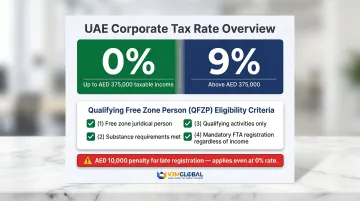
- Mandatory registration for ALL entities regardless of income
- Tax rates: 0% up to AED 375,000 taxable income; 9% above AED 375,000
- QFZP status: Qualifying Free Zone Persons can benefit from 0% rate on qualifying income (conditions: free zone juridical person, substance requirements met, qualifying activities only)
- Penalty for late registration: AED 10,000
- First return deadline: December 31 following first financial year-end
3. Audited Financial Statements (IFRS Standard)
- Must be prepared by DMCC-approved auditor
- Required annually for license renewal
- IFRS compliance mandatory (not Singapore FRS or other local GAAP)
4. VAT Registration
- Mandatory once annual taxable supplies exceed AED 375,000
- Standard rate: 5%
- Late registration penalty: AED 20,000
5. UBO (Ultimate Beneficial Owner) Register Maintenance
- Governed by Cabinet Resolution No. 109 of 2023
- UBO threshold: natural person owning/controlling 25%+ shares or voting rights
- Must maintain three registers: UBOs, Partners/Shareholders, Nominee Directors
- Changes must be reported within 15 days
- Penalties: 2nd violation AED 50,000; 3rd violation AED 100,000; serious violations may result in license suspension
Three Common Misconceptions Singapore Businesses Have
Misconception 1: "DMCC's 0% tax headline means no tax obligations exist"
Reality: All DMCC entities must register with the Federal Tax Authority and file annual corporate tax returns, even if qualifying for 0% rate under QFZP status. Non-registration triggers AED 10,000 penalty regardless of income level.
Misconception 2: "A branch is always cheaper and simpler than a subsidiary"
Reality: While branch offices don't require separate share capital, they expose the Singapore parent company to full liability for UAE-side obligations. The setup timeline is often longer (6–10 weeks vs. 4–6 weeks for FZ-LLC) due to additional parent company documentation requirements and attestation complexity.
Misconception 3: "Bank account opening is as fast as in Singapore"
Reality: Singapore businesses accustomed to 1–2 week digital account opening should plan for 3–4 weeks in the UAE. Most banks require in-person meetings for new DMCC entities, detailed business documentation (contracts, website, customer lists), and source-of-funds evidence. Setting realistic expectations prevents project timeline disruptions.
Working with Cross-Border Advisors
Singapore businesses unfamiliar with UAE compliance calendars often face avoidable penalties and operational disruptions. The DMCC regulatory framework differs substantially from Singapore's ACRA-based system — audit timelines, tax filing cycles, and UBO reporting obligations each follow UAE-specific rules that have no direct equivalent under ACRA.
VJM Global brings 30+ years of cross-border advisory experience to exactly this gap. From incorporation filing and document attestation through ongoing audit coordination and tax compliance, the firm helps Singapore businesses meet DMCC's requirements without diverting management attention from day-to-day operations.
Frequently Asked Questions
How much does it cost to set up a company in DMCC?
First-year DMCC setup costs typically range from AED 50,000 to AED 60,000 (approx. SGD 18,500–22,200), covering registration fees, trade license, basic flexi-desk office space, and one investor visa. Ongoing annual costs include license renewal (AED 15,000–25,000), office lease, mandatory audit fees, and corporate tax compliance expenses.
What is the Dubai Multi Commodities Centre line of business?
DMCC is not restricted to commodities despite its name. While it originated with a focus on gold, diamonds, and energy trading, DMCC now supports over 1,000 licensed activities across 20 sectors including trading, professional services, technology, financial services, e-commerce, and logistics.
Can a Singapore company open a branch in DMCC instead of forming a new entity?
Yes, a Singapore Pte Ltd can register a branch office in DMCC. Note that the parent company bears full liability for all branch obligations—unlike an FZ-LLC, where liability is ring-fenced. Singapore incorporation documents also require notarisation and UAE Embassy attestation before submission, adding 1–3 weeks.
Do Singapore businesses need a local UAE sponsor or Emirati partner to set up in DMCC?
No. DMCC allows 100% foreign ownership with no local sponsor or Emirati partner requirement. This applies equally to individual and corporate shareholders regardless of nationality, mirroring Singapore's Pte Ltd model.
How long does DMCC company setup take for a Singapore-based applicant?
A new FZ-LLC typically takes 4–6 weeks; a branch office requires 6–10 weeks. The main variable is document attestation through the UAE Embassy in Singapore (1–3 weeks), plus bank account opening (2–4 weeks). Most other stages are completed digitally via DMCC's online portal.
What are the ongoing compliance requirements for a DMCC company?
DMCC entities must complete five annual compliance tasks:
- Corporate tax registration and return filing with the Federal Tax Authority
- Audited financial statements (IFRS standard, DMCC-approved auditor)
- Annual trade license renewal
- UBO register updates within 15 days of any ownership changes
- VAT registration once annual taxable supplies exceed AED 375,000