Introduction
Forming an LLC in North Dakota gives you a legally recognized business entity with real structural benefits: personal asset protection, pass-through tax treatment, and a credible foundation for opening bank accounts, signing contracts, and hiring staff. The process is governed by North Dakota Century Code Chapter 10-32.1 and is more straightforward than most founders expect.
This guide is written for US-based entrepreneurs, solo founders, and small business owners who want a clear, accurate walkthrough of the LLC formation process — with plain language and current requirements.
Whether you're launching a side project or scaling a full-time operation, this guide covers what's required, what's optional, and where first-timers typically get tripped up.
Key Takeaways
- Filing Articles of Organization with the North Dakota Secretary of State costs $135
- Every LLC must maintain a registered agent with a physical North Dakota address
- Your LLC name must include "LLC," "L.L.C.," or "Limited Liability Company"
- Annual Reports are due November 15 (Business/Professional LLCs) with a $50 fee
- Both an EIN and an Operating Agreement are strongly recommended, even though neither is always legally required
What Is a North Dakota LLC?
A North Dakota LLC is a hybrid business entity that gives you the liability protection of a corporation and the pass-through tax treatment of a partnership. You create it by filing Articles of Organization under state law.
The Four LLC Types
The North Dakota Secretary of State recognizes four distinct LLC categories:
| LLC Type | Primary Use |
|---|---|
| Business LLC | General commercial activity — most founders form this |
| Farming or Ranching LLC | Agricultural operations; separate ownership and activity rules apply |
| Authorized Livestock Farm (ALF) LLC | Specific livestock or poultry operations |
| Professional LLC (PLLC) | Licensed professional services (such as law, medicine, or accounting) |
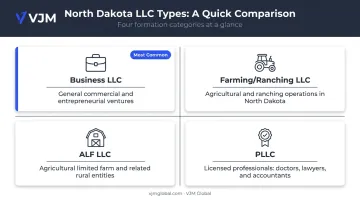
Most entrepreneurs forming a standard business will use the Business LLC category. PLLCs carry additional licensing requirements covered later in this guide.
Beyond the LLC type, you'll also need to understand one more distinction before filing.
Domestic vs. Foreign LLCs
These terms describe where your LLC was formed, not where you live:
- Domestic LLC — formed under North Dakota law, primarily operating in the state
- Foreign LLC — formed in another state but wanting to transact business in North Dakota; must obtain a Certificate of Authority from the Secretary of State under NDCC 10-32.1-75
Why Form an LLC in North Dakota?
Liability Protection
The core advantage is straightforward: members' personal assets — home, savings, personal bank accounts — are legally separated from the business. If the LLC faces a lawsuit or can't pay a debt, creditors generally cannot reach personal assets. Maintaining that protection requires a properly drafted Operating Agreement and clean separation between business and personal finances.
Tax Advantages
North Dakota's tax structure is favorable for small business owners:
- Individual income tax: 0.00% to 2.50% (tax year 2025 rates per the North Dakota Tax Commissioner)
- Corporate income tax: 1.41% to 4.31% (per the current Tax Commissioner schedule)
- State sales tax: 5% for most retail sales
Under pass-through taxation, LLC members report business income on their personal returns. The entity itself pays no corporate income tax, which keeps the overall tax burden lower for most small business owners.
Formation Activity
North Dakota's formation numbers tell a clear story about its business climate. According to the Secretary of State's biennial reports, new domestic LLC registrations reached 11,227 between July 2019 and June 2021 — up from 7,479 in the preceding two-year period. That 50% jump reflects a state with an accessible filing system and a regulatory environment that doesn't create unnecessary friction for new businesses.
How to Form an LLC in North Dakota: Step-by-Step
Step 1: Choose and Reserve Your LLC Name
Your name must meet two requirements under NDCC 10-32.1-11:
- Include the right designation — "Limited Liability Company," "LLC," or "L.L.C." must appear in the official name
- Be distinguishable from all existing registered entities in North Dakota — no restricted words (like "Bank" or "Insurance") without prior approval
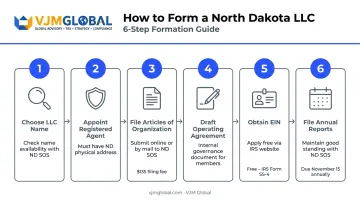
Check availability using the North Dakota Secretary of State's business search portal before you file anything.
If you're not ready to file but want to lock in your name, optional name reservation is available for $10 and holds the name for 12 months, renewable under NDCC 10-32.1-12.
Step 2: Appoint a Registered Agent
Every North Dakota LLC must designate a registered agent: someone responsible for receiving legal documents, lawsuits, and official state correspondence on the LLC's behalf.
Requirements:
- Must have a physical North Dakota street address (no P.O. boxes)
- Can be an individual member of the LLC, provided they reside in North Dakota
- The LLC itself cannot serve as its own registered agent
Remote founders without a North Dakota address will need a professional registered agent service. Many choose this route regardless, since it keeps personal addresses off public records and ensures nothing gets missed during business hours.
Step 3: File Articles of Organization
The Articles of Organization is your primary formation document. File it with the North Dakota Secretary of State through the FirstStop online portal or by mail.
- Filing fee: $135 (same for domestic and foreign LLCs)
- The SOS states that most registrations are handled through FirstStop — online filing is the faster option, though no official side-by-side processing time comparison is publicly stated
Standard information required includes your LLC name, registered agent details, and member/manager information. Note that Farm/ALF and PLLC filings carry additional disclosure requirements beyond the standard Business LLC.
Step 4: Draft an Operating Agreement
North Dakota does not require you to file an Operating Agreement with the state. That doesn't mean you should skip it.
A well-drafted Operating Agreement covers:
- Ownership percentages and capital contributions
- Management structure (member-managed vs. manager-managed)
- Profit and loss distribution
- Voting rights and decision-making procedures
- Steps for adding or removing members
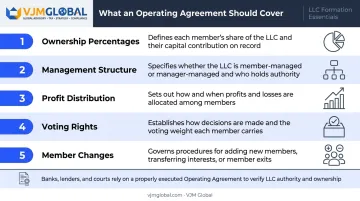
Most banks require one when you open a business account, and courts look to it first in any member dispute. Without it, your LLC falls back on North Dakota's default statutory rules, which may not match what you actually agreed to.
Step 5: Obtain an EIN from the IRS
An Employer Identification Number is your LLC's federal tax ID. You need it to:
- Open a business bank account
- Hire employees
- File federal and state tax returns
Single-member LLCs are treated as disregarded entities by default, but the IRS recommends obtaining an EIN rather than using your Social Security Number for business purposes, mainly to reduce identity theft exposure. The application is free and available online through the IRS EIN Assistant.
Step 6: File Annual Reports and Stay Compliant
Annual Reports keep your LLC in good standing with the state. Key dates:
- Business and Professional LLCs: Due November 15 each year
- Farming/Ranch and ALF LLCs: Due April 15 each year
- Fee: $50 per filing
Missing this deadline is serious. Under NDCC 10-32.1-90, failure to file within six months after the statutory due date results in involuntary termination of the LLC by operation of law, not just a late fee.
Ongoing compliance also includes:
- Tracking income for pass-through tax reporting
- Sales tax collection if you sell taxable goods (North Dakota rate: 5%)
- Payroll compliance if you hire employees
Managing these ongoing obligations alongside daily operations is where many founders hit a wall. VJM Global's CPAs support US businesses with bookkeeping, federal and state tax filing (Forms 1040, 1065, and 1120), payroll, and annual report preparation so compliance doesn't fall through the cracks.
Key Requirements and Costs at a Glance
| Requirement | Cost | Notes |
|---|---|---|
| Articles of Organization | $135 | One-time formation fee |
| Annual Report | $50/year | Due November 15 (Business/Professional LLCs) |
| Name Reservation (optional) | $10 | Holds name for 12 months |
| Trade Name / DBA Registration | $25 | Required if operating under a name other than your LLC's legal name; renewal every 5 years at $25 |
| Registered Agent Service (optional) | Varies | Third-party services typically $50–$300/year |
Naming note: If you operate publicly under a name different from your registered LLC name, you must file a separate Trade Name Registration with the Secretary of State.
PLLC additional requirement: PLLCs have two distinct filing obligations:
- Articles of Organization must include SFN 13610, completed by the relevant North Dakota licensing board, confirming licensure of all governors and members practicing the profession.
- Beginning January 1, 2027, SFN 13610 must also accompany annual PLLC reports, and the LLC must provide a copy of that annual report to the relevant professional regulatory board.
Common Mistakes to Avoid When Forming an LLC in North Dakota
1. Name Errors That Cause Instant Rejection
Using a name that isn't distinguishable from existing registrations — or omitting "LLC," "L.L.C.," or "Limited Liability Company" — gets your Articles rejected immediately. Always run the Secretary of State's name search before filing.
2. Letting Your Registered Agent Lapse
The registered agent must remain reachable throughout the life of the LLC. If your agent moves, resigns, or becomes unreachable, you risk missing legal notices or compliance deadlines. Update the registered agent information with the Secretary of State as soon as your agent's contact details change.
3. Assuming Formation Equals Compliance
Filing your Articles starts the process — it doesn't complete it. Three oversights consistently erode liability protection over time:
- Missing the November 15 Annual Report deadline
- Never drafting an Operating Agreement
- Commingling personal and business finances
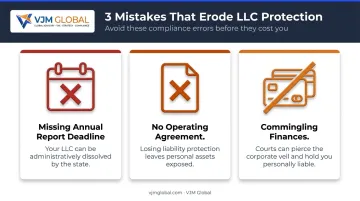
Courts that pierce the corporate veil and hold members personally liable almost always trace the problem back to one of these three failures.
Frequently Asked Questions
How much does it cost to create an LLC in North Dakota?
The mandatory formation fee is $135 for the Articles of Organization. The first Annual Report ($50) is due the following year. Optional costs — name reservation ($10), registered agent services, or professional filing assistance — add to that total. Budget approximately $185 for your first full year of state compliance.
How long does it take to get an LLC in North Dakota?
North Dakota does not publish an official processing timeframe, but online filing through the FirstStop portal is significantly faster than mailing paper documents. For the quickest turnaround, online filing is the recommended route.
Do I need a registered agent for my North Dakota LLC?
Yes — North Dakota law requires every LLC to maintain a registered agent with a physical in-state address for the entire life of the LLC. This can be you (if you have a North Dakota address), a trusted individual, or a professional registered agent service.
Do I need an operating agreement for my North Dakota LLC?
North Dakota does not require an Operating Agreement to be filed with the state. However, it governs internal operations, protects your limited liability status in disputes, and is typically required by banks when opening a business account. Most attorneys recommend having one in place before you start operating.
What are the ongoing compliance requirements for a North Dakota LLC?
File an Annual Report by November 15 each year ($50 fee), maintain your EIN, and handle applicable state tax filings. Businesses with employees also need to meet payroll tax and withholding obligations.
Can a non-US resident form an LLC in North Dakota?
North Dakota's Chapter 10-32.1 does not state a citizenship or residency requirement for Business LLC membership. However, foreign-owned US LLCs have additional federal tax obligations — including potential Form 5472 filing requirements with a $25,000 minimum penalty for non-compliance. Non-US residents should consult a US tax advisor before forming.