Introduction
Singapore businesses are expanding beyond Southeast Asia into the Middle East and Africa at unprecedented speed. Bilateral trade in goods between Singapore and the UAE reached S$27.94 billion in 2025, cementing the UAE as Singapore's largest Middle East trading partner. Against this backdrop, UAE offshore company formation has emerged as a strategic structuring tool that complements—rather than replaces—a Singapore base.
A UAE offshore company is a legal entity registered in a designated UAE jurisdiction (such as RAK ICC, JAFZA, or Ajman) authorised to conduct business internationally but not permitted to trade within the UAE's domestic market. Singapore businesses typically use these structures for three core purposes:
- Asset holding and protection — ring-fence IP, investments, or real estate from operational risk
- Regional contracting hub — centralise Middle East and Africa contracts under a single entity
- IP licensing platform — license intellectual property internationally from a tax-efficient base
This guide covers what UAE offshore formation means, why it makes sense specifically for Singapore businesses, how the registration process works, what it costs, and when it may not be the right structure.
Key Takeaways
- RAK ICC, JAFZA, and Ajman offshore structures offer 0% corporate tax on qualifying offshore income, full foreign ownership, and no local sponsor requirement
- Singapore passport holders and Singapore-incorporated companies can serve as shareholders or directors with no nationality restrictions
- Registration takes 3–10 business days; first-year costs typically range from USD 3,000 to USD 8,000 depending on jurisdiction
- Key restrictions: no UAE mainland trading, no visa sponsorship, and UAE account data is reported to Singapore's IRAS under CRS obligations
- Best suited as a holding, IP licensing, international trading, or cross-border investment vehicle for Singapore-based businesses
What Is a UAE Offshore Company and How Does It Differ from Other Structures?
A UAE offshore company is a corporate entity registered under a specialised offshore authority—RAK ICC, JAFZA, or Ajman—designed exclusively for international activities: holding assets, owning IP, and trading globally, but not conducting local UAE commerce.
Three UAE Structures Compared
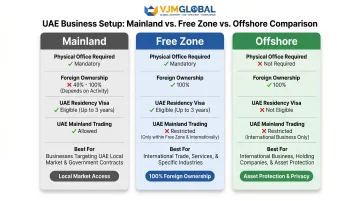
UAE company formation falls into three distinct categories. Here's how they compare across the factors that matter most to Singapore businesses:
| Attribute | Mainland | Free Zone | Offshore |
|---|---|---|---|
| Physical Office Required | Yes | Yes (within zone) | No |
| Foreign Ownership | Sector-dependent | 100% | 100% |
| UAE Residency Visa | Yes | Yes | No |
| UAE Mainland Trading | Yes | Restricted | Not permitted |
| Best For | Local market operations | Regional hub + visas | Holding, IP, cross-border contracting |
Three Primary Offshore Jurisdictions
Singapore businesses typically work with three offshore authorities:
- JAFZA (Jebel Ali Free Zone, Dubai) – Premium option, permits Dubai freehold property ownership, higher cost
- RAK ICC (Ras Al Khaimah International Corporate Centre) – Most widely used, lowest cost, fastest processing (2–5 days)
- Ajman Offshore – Most affordable, suited to consultants and smaller international structures
For most Singapore businesses, the choice between these three comes down to cost, timeline, and whether Dubai property ownership is part of the structure—covered in the next section.
Why Singapore Businesses Are Setting Up UAE Offshore Companies
Strategic Rationale: Tax-Neutral Regional Hub
Singapore's territorial tax system already offers advantages. A UAE offshore layer adds a separate international holding point for Middle East and Africa operations—allowing Singapore businesses to ring-fence assets, centralise regional contracts, and separate operational risk from their Singapore entity.
The institutional infrastructure now supports this approach. EnterpriseSG maintains offices in both Saudi Arabia and the UAE, the Singapore Business Federation launched its first Middle East office—the Singapore Enterprise Centre in Dubai—and the Market Readiness Assistance (MRA) Grant support increased to 70% for SMEs (from 50%) effective 1 April 2026.
Geographic Bridge
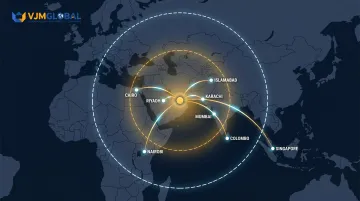
The UAE sits at the intersection of the Middle East, Africa, and South Asia. One-third of the world's population is within a 4-hour flight; two-thirds within 8 hours. Singapore businesses with supplier relationships or clients in the Gulf, East Africa, or the Indian subcontinent frequently use a UAE offshore entity as their regional contracting and invoicing hub—rather than routing everything through Singapore.
IP Holding Use Case
Singapore technology companies, SaaS businesses, and digital agencies commonly hold trademarks, patents, and licensing rights under a UAE offshore entity to collect royalties from international licensees under a tax-neutral structure. Before structuring IP this way, two compliance requirements apply:
- OECD BEPS Action 5: Tax benefits must be linked to qualifying R&D expenditure incurred by the taxpayer — not just nominal ownership
- UAE Economic Substance Regulations (ESR): The offshore entity must demonstrate adequate substance relative to the IP activity it claims
Asset Protection Rationale
Singapore businesses holding international real estate, shares in foreign subsidiaries, or financial portfolios can use a UAE offshore company to create a legal separation between personal or operational liability and these assets—particularly relevant for family businesses and high-net-worth entrepreneurs.
What CRS Means for Your Singapore Entity
Understanding CRS is essential before setup. Singapore is a CRS participant, meaning UAE financial institutions report account information directly to Singapore's IRAS — this is a fully transparent, legal structure, not a mechanism for tax evasion.
Both Singapore and the UAE commenced automatic exchanges of financial account information under CRS in 2018. UAE banks identify and report Singapore-resident account holders' financial information to the UAE competent authority, which then exchanges it with IRAS.
Singapore businesses should consult a qualified tax advisor before setup to understand their disclosure obligations under the Income Tax Act.
Top UAE Offshore Jurisdictions for Singapore Businesses
RAK ICC: Lowest Fees, Fastest Turnaround
Government fees:
- Incorporation (1-