The appeal is straightforward: two aligned brands can reach new audiences faster, split campaign costs, and amplify results that neither could achieve independently. But most businesses underestimate what it actually takes to set one up properly. The strategic conversation is only half the work. The legal structure, the agreement, the tax setup, the operational framework — these determine whether a partnership delivers on its promise or dissolves into disputes.
This guide covers everything a US business needs to know to set up a brand partnership business correctly: from defining objectives and choosing a legal structure to drafting agreements and building in accountability for the long run.
Key Takeaways
- A brand partnership is a formal arrangement where two or more brands collaborate toward shared commercial goals
- Before any campaign launches, US businesses must set clear goals, select a legal structure, and execute a written agreement
- Registration requires a business name, state-level filing, an EIN from the IRS, and a dedicated bank account
- Partner fit — based on audience overlap, values, and complementary strengths — matters more than brand size
- Long-term success depends on shared KPIs, performance tracking, and deliberate reassessment over time
What Is a Brand Partnership Business?
A brand partnership business is a formal arrangement where two or more brands collaborate toward shared goals: expanding audience reach, co-developing products, splitting marketing costs, or breaking into new markets. The arrangement is governed by a legal agreement or structured as a registered entity.
The key word is formal. A loose co-marketing arrangement where two businesses cross-post on social media is not a brand partnership business in any meaningful sense. A properly structured brand partnership involves defined roles, legal documentation, shared accountability, and often a registered business entity.
Common Types of Brand Partnerships
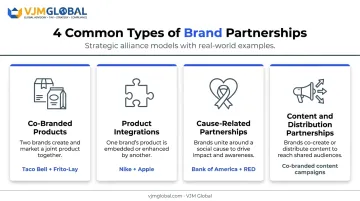
AMA's foundational framework treats co-branding as a broad label covering several distinct arrangements. The most common types relevant to US businesses include:
- Co-branded products — Two brands combine their identities in a single product, like the Doritos Locos Tacos collaboration between Taco Bell and Frito-Lay
- Product integrations — One brand's technology or capability is embedded within another's, such as the Nike+iPod Sport Kit that connected Nike footwear with Apple's iPod nano
- Cause-related partnerships — Brands align around a shared social mission, like Bank of America's ongoing partnership with (RED) to fight AIDS and COVID-19
- Content and distribution partnerships — Brands co-produce or cross-distribute content to reach shared or complementary audiences
The right type depends on the business's goals and resources — not on what's trending. A small regional brand launching a cause partnership without the operational infrastructure to sustain it will struggle regardless of the cause's merit.
Why US Businesses Are Turning to Brand Partnerships
The core business case is efficiency. Brand partnerships let companies access new customer segments faster, reduce per-acquisition costs, and amplify marketing impact without proportional increases in spend. That makes them especially valuable for small and mid-sized US businesses competing against larger players with deeper budgets.
There's also a credibility advantage. Entering an unfamiliar demographic or regional market as a solo brand takes time — audiences need to encounter a brand repeatedly before they act. Partnering with an already-trusted brand in that space compresses that timeline considerably. The partner's existing goodwill does some of the trust-building work.
Operational Benefits That Often Go Overlooked
Beyond reach and trust, partnerships offer practical efficiency gains:
- Co-branded campaigns split creative, media, and production expenses — reducing per-campaign cost for both sides
- A partner's existing retail channels, email lists, or platform integrations become immediately available without building from scratch
- One brand's technology or logistics can fill gaps in the other's offering, strengthening the combined product
- Testing a new geography or audience segment with a local partner reduces exposure compared to going it alone
Those operational gains only hold, though, when the partnership is the right fit. A 2021 meta-analysis of co-branding research found that the relationship between partner brands had a significantly greater effect on co-branding success than either brand's individual characteristics. Compatibility matters more than clout.
What to Know Before Setting Up a Brand Partnership Business
Many US businesses rush into brand partnerships without understanding the operational and legal groundwork required. Before any partnership is formalized, there are some practical realities worth addressing directly.
US businesses need to define contribution structures, profit and loss sharing arrangements, and decision-making authority before a single campaign launches. Without that foundation, disputes are almost guaranteed.
Common Early Mistakes to Avoid
- A well-known partner with a misaligned audience wastes resources — fit matters more than name recognition
- Verbal agreements are difficult to enforce and leave both parties exposed; written documentation is non-negotiable
- Without defined KPIs, there's no reliable way to assess whether the partnership is actually working
- Active partnerships require ongoing coordination, reporting, and decision-making across two organizations — the administrative load is real
The time and effort required to set up a brand partnership properly is front-loaded. Getting that groundwork right makes everything downstream — execution, conflict resolution, performance review — much easier to manage.
How to Set Up a Brand Partnership Business in the US — Step by Step
Setting up a brand partnership business involves both strategic decisions (who to partner with and why) and legal and operational steps (how to formally structure and register the venture). Getting both right determines whether the partnership creates lasting value or stalls out early.
Step 1 — Define Your Partnership Goals and Ideal Partner Profile
Start with a specific business objective: customer acquisition, market expansion, revenue sharing, product co-development, or co-marketing. Vague goals produce misaligned expectations and underperforming partnerships.
Then build an ideal partner profile based on:
- Audience demographics — Who does the partner reach, and how does that overlap with your target customer?
- Brand values — Are your positioning and public commitments compatible?
- Geographic reach — Is the partner strong where you're trying to grow?
- Complementary strengths — What does the partner offer that you lack, and vice versa?
Document what you're bringing to the table before approaching anyone. A clear value proposition makes the conversation more productive and filters out partners who aren't a genuine fit.
Step 2 — Validate the Partnership Opportunity
Before formalizing anything, confirm the partnership makes commercial sense. Assess the potential partner's audience size and engagement, verify genuine customer overlap or strategic complementarity, and gauge willingness to collaborate at a meaningful level.
A pilot campaign or limited engagement can reveal alignment issues early — before legal and financial commitments are in place. This is worth doing even when the fit looks obvious on paper.
Step 3 — Choose the Right Business Structure for the US Market
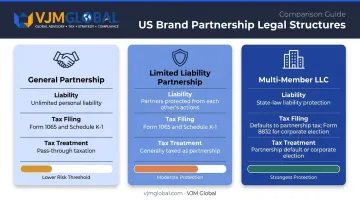
The main legal structures available to US-based brand partnerships are:
| Structure | Liability | Tax Treatment |
|---|---|---|
| General Partnership | Unlimited personal liability for all partners | Pass-through; Form 1065 + Schedule K-1 |
| Limited Liability Partnership (LLP) | Each partner protected from others' actions; state law varies | Generally taxed as a partnership |
| Multi-Member LLC | State-law liability protection | Defaults to partnership tax treatment unless corporate election made via Form 8832 |
Some brand partnerships operate under a formal contractual agreement without creating a new legal entity — this is common for co-marketing arrangements. But businesses sharing profits or jointly owning assets typically need a registered entity. The right choice depends on risk exposure, tax preferences, and the nature of the collaboration.
Step 4 — Register the Partnership and Handle US Legal and Tax Requirements
Registration involves several distinct steps:
- Choose a business name and confirm it's available in your state
- Register with the relevant state authority — most partnerships register at the state level, and may need foreign qualification in additional states where they conduct business
- Obtain a Federal Employer Identification Number (EIN) from the IRS — eligible domestic applicants can receive one online immediately; fax processing takes roughly four business days, mail around four weeks
- Open a dedicated business bank account to keep partnership finances separate
Tax and compliance obligations to understand:
- US partnerships are pass-through entities — the business itself does not pay federal income tax; income flows to partners' returns via Schedule K-1 on Form 1065
- State-level tax rules vary significantly — California, for example, charges an $800 annual tax on LLCs organized or doing business there, including partnership-classified LLCs
- Industry-specific licenses and permits may apply depending on the business type and operating states
For partnerships with a cross-border dimension — such as partnering with an Indian brand or entering global markets — compliance requirements expand considerably. Foreign entity registration, FEMA compliance, DTAA (Double Taxation Avoidance Agreement) advisory, and withholding tax obligations under Section 1446 all come into play.
VJM Global specializes in exactly this area. With a US office at 447 Broadway, New York and 1,000+ clients served across the US, UK, and Australia, the firm supports businesses managing US-India partnership structures — from RBI permissions and FEMA advisory to DTAA compliance and cross-border tax filings.
Step 5 — Draft a Brand Partnership Agreement
A written brand partnership agreement is essential regardless of whether a new legal entity is formed. It governs the relationship and protects both parties if disputes arise.
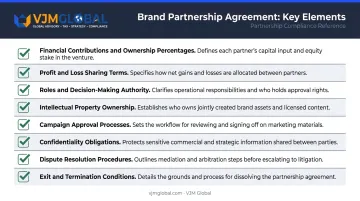
Key elements to include:
- Each partner's financial contributions and ownership percentages
- Profit and loss sharing terms
- Roles and decision-making authority
- Intellectual property ownership — particularly for co-branded assets or jointly developed products
- Campaign approval processes
- Confidentiality obligations
- Dispute resolution procedures
- Exit and termination conditions
Have a qualified US business attorney review or draft the agreement — especially where IP rights, revenue sharing, or significant liability exposure are involved.
Step 6 — Build the Go-to-Market Plan and Operational Structure
Define what the partnership will actually produce: a co-branded product, joint content campaign, shared distribution channel, or a combination. Set clear timelines, deliverables, and budget allocations.
Then build the operational infrastructure to run it:
- Shared communication channels and project management tools
- A defined reporting cadence (weekly, monthly, quarterly)
- Escalation processes for decisions that require input from both organizations
- A named owner within each company who is accountable for the partnership relationship day-to-day
Partnerships that skip this step often see momentum stall within the first 90 days — not because of poor strategy, but because no one defined who makes which call.
How to Make Your Brand Partnership Work Long-Term
A well-set-up partnership can still stall without consistent execution discipline. The most common cause of breakdown is not legal or strategic — it's poor communication, unclear accountability, and a lack of shared performance visibility.
Establish shared KPIs from the start. Define what success looks like in measurable terms:
- New customers reached or acquired through the partnership
- Co-branded revenue generated
- Audience engagement metrics on joint content
- Cost per acquisition versus solo campaign benchmarks
Review these regularly with the partner, not just internally.
Invest in performance monitoring. Use trackable tools to measure each brand's contribution clearly:
- Trackable links and UTM parameters for campaign attribution
- Shared dashboards that both teams can access in real time
- Partnership management platforms (such as PartnerStack or Impact) for structured tracking
Make adjustments based on actual results, not assumptions or goodwill.
Plan for evolution. Successful partnerships require periodic check-ins where both parties reassess goals and reset contribution terms if needed. A structure that worked at launch may need adjusting 18 months in — that's normal, as long as the decision is deliberate rather than reactive.
Conclusion
Setting up a brand partnership business in the US is a structured process — not just a strategic conversation. It requires clarity on goals, the right legal foundation, a solid written agreement, and ongoing operational discipline.
The businesses that get the most from brand partnerships are those who do the groundwork early: validating the fit before committing, and formalizing the structure before launching. Build in accountability from day one — because partnerships that skip that step rarely survive their first real disagreement.
Frequently Asked Questions
What is the 3-7-27 rule of branding?
The 3-7-27 rule is a brand recognition framework suggesting it takes 3 impressions to recognize a brand, 7 to remember it, and 27 to build genuine trust. Its origins are debated, and the better-documented Rule of 7 is the more established reference. Brand partnerships accelerate recognition by exposing each brand to the other's existing audience.
What are the 7 principles of partnership?
The commonly cited principles are: mutual benefit, trust, clear communication, defined roles, shared goals, accountability, and flexibility. Each applies directly to brand partnership structure — skipping any one typically creates friction early in the collaboration.
What legal documents are needed to set up a brand partnership in the US?
The core documents are a partnership agreement (or operating agreement if using an LLC), EIN registration with the IRS via Form SS-4, state-level business registration filings, and any required licenses or permits depending on the industry and state. Cross-border partnerships may require additional filings for foreign entity registration and tax treaty compliance.
How is a brand partnership business taxed in the US?
US partnerships are pass-through entities — the business itself does not pay federal income tax. Each partner reports their share of income or loss on their personal tax return using Schedule K-1, filed alongside the partnership's Form 1065. State tax treatment varies; California, for example, imposes an $800 annual tax on LLCs classified as partnerships.
What is the difference between a general partnership and a limited partnership in the US?
In a general partnership, all partners share management responsibilities and carry unlimited personal liability. In a limited partnership, at least one partner has limited liability and typically takes a passive investment role rather than managing day-to-day operations.
Do brand partners need a formal written agreement even for short-term collaborations?
Yes. A written agreement is recommended even for campaign-specific partnerships, as it defines IP ownership, financial terms, and exit conditions for both parties. Verbal agreements are difficult to enforce, and without documentation, both brands are exposed when expectations diverge.