
Introduction
PEO services have become a standard operating model for US small and mid-sized businesses managing HR, payroll, and compliance. According to NAPEO's 2025 industry data, over 4.5 million people are employed through PEO arrangements across more than 230,000 client businesses, with the industry generating $414 billion in annual revenue.
Widespread adoption hasn't eliminated confusion, though. Many business owners — especially those entering the US market or scaling a workforce for the first time — struggle to understand what co-employment actually means, what a PEO controls versus what the client retains, and where the model has real limits.
This guide breaks down exactly what a PEO service is, how the co-employment model works in the US, what it covers, and where it falls short — giving you a clear basis for deciding whether it fits your business.
Key Takeaways
- A PEO enters a co-employment agreement with your business, handling payroll, benefits, and compliance while you keep day-to-day operational control
- The PEO files federal payroll taxes under its own Employer Identification Number (EIN), making it the employer of record for tax purposes
- PEO pricing typically runs 2–12% of gross payroll or $50–$150 per employee per month
- PEOs do not cover accounting, bookkeeping, corporate tax filings, or financial advisory — those remain your responsibility
- PEO vs. EOR vs. ASO: the right choice depends on your US legal entity status and how much employer control you want
What Is a PEO Service?
A Professional Employer Organization (PEO) is a third-party firm that enters a co-employment agreement with a client business. Under this arrangement, the PEO becomes the employer of record for administrative and tax purposes — while the client retains full control over hiring decisions, day-to-day supervision, and business operations.
The Problem PEOs Solve
Small and mid-sized US businesses face a genuine operational gap. Managing federal and state employment law, payroll tax filing, workers' compensation, and benefits administration without a dedicated HR team is expensive and error-prone. PEOs absorb that burden at a cost that's typically lower than building equivalent in-house infrastructure.
NAPEO defines co-employment as a contractual allocation and sharing of employer responsibilities under a Client Service Agreement (CSA). A PEO co-employs your existing workforce — it does not supply workers like a staffing agency would.
What a PEO Is NOT
Three common misconceptions worth clearing up:
- Not a staffing agency — it doesn't recruit or place workers with you
- Not an employee leasing company — your workforce remains yours
- Not a full HR department replacement — it complements internal HR functions rather than eliminating them
Three Types of PEO Arrangements
| Type | Description | Key Distinction |
|---|---|---|
| Full-Service PEO | Assumes broad co-employment responsibilities across payroll, benefits, and compliance | Most common model for SMBs |
| IRS-Certified PEO (CPEO) | Certified under IRC section 7705 — carries specific federal tax treatment and filing certainty for clients | Adds IRS assurance for tax filings |
| ASO (Administrative Services Organization) | Handles HR administration without creating a co-employment relationship | Client retains full legal employer status |
The liability structure and legal employer status differ across all three models. Choosing the wrong type can affect how federal payroll taxes are filed and who bears compliance risk — so it's worth clarifying this before signing a Client Service Agreement.
How Does a PEO Work in the US?
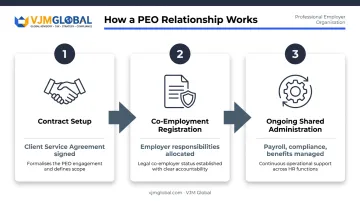
A PEO relationship runs through three stages: contract setup, co-employment registration, and ongoing shared administration. Each stage shifts specific responsibilities from your business to the PEO.
Entering a Co-Employment Agreement
Both parties sign a Client Service Agreement (CSA) — the document that defines which HR functions the PEO assumes, which the client retains, how fees are structured, and what compliance obligations each party holds.
Before signing, review carefully:
- Fee escalation clauses
- Exit terms and notice periods
- Data ownership provisions
- Which liability the PEO actually assumes
The resulting employment structure splits cleanly: the client becomes the worksite employer (responsible for directing work, hiring, firing, and operations), while the PEO becomes the administrative employer (responsible for payroll, taxes, benefits administration, and legal filings).
The Co-Employment Mechanism
The IRS states that a PEO may file aggregate Form 941 using the PEO's own EIN. For CPEOs specifically, IRS Schedule R guidance requires the CPEO to remit all federal employment tax deposits and payments using its own EIN — not the client's.
In practice, this means:
- Employees are technically on the PEO's payroll
- They show up to work for you, follow your instructions, and contribute to your business
- Day-to-day management authority never transfers to the PEO
That legal distinction — payroll filed under the PEO's EIN — is what separates co-employment from a standard HR outsourcing contract.
Ongoing Administration and Output
Once active, the PEO monitors changes in federal, state, and local employment law, adjusting payroll and benefits processes as rules shift. Under a CPEO arrangement, the PEO assumes liability for payroll tax errors, directly reducing your exposure to IRS penalties and state-level fines.
The arrangement delivers:
- Compliant payroll processing
- Access to competitive benefit packages through the PEO's pooled workforce
- Managed workers' compensation
- Freed-up internal resources — without setting up a separate HR legal entity
What Services Does a PEO Typically Provide?
PEOs cover the full range of HR and employment functions — from routine payroll processing to complex compliance work. Here's what most arrangements include.
Payroll and Tax Administration
PEOs handle the full payroll cycle: processing employee wages, withholding and remitting federal and state taxes (FICA, Medicare, FUTA, SUTA), filing required tax forms, and managing garnishments and deductions.
Benefits Administration
PEOs pool employees from multiple client companies to negotiate group rates on:
- Health, dental, vision, and disability insurance
- Retirement plans (401k)
- Workers' compensation coverage
- Life insurance and additional voluntary benefits
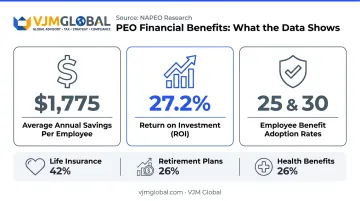
Small businesses gain access to benefit quality that would otherwise require the buying power of a much larger employer. NAPEO's 2019 ROI research found an average annual cost savings of $1,775 per employee and a 27.2% ROI — with new PEO clients frequently adding life insurance (42%), retirement plans (26%), and health benefits (26%) upon joining.
HR Compliance and Risk Management
PEOs monitor compliance with:
- Fair Labor Standards Act (FLSA)
- Americans with Disabilities Act (ADA)
- Family and Medical Leave Act (FMLA)
- State-specific labor laws and local minimum wages
- Anti-discrimination regulations
Beyond monitoring, PEOs provide employment practices liability insurance (EPLI), manage workers' compensation claims, and support workplace safety programs — reducing direct exposure for client businesses.
Additional Services (Vary by Provider)
- Onboarding and offboarding support
- Employee handbook development
- Performance management tools
- HR technology platforms (HRIS)
- Recruitment assistance
Service depth varies considerably across vendors. Review which of these are included — versus available at added cost — before signing a CSA.
Key Benefits and Real Limitations of Using a PEO
Benefits
The business case for PEOs is well-supported. According to NAPEO's 2025 industry overview, businesses using a PEO:
- Grow two times faster than non-PEO businesses
- Have employee turnover that is 12% lower
- Are 50% less likely to go out of business
Beyond survival and growth, PEOs allow small businesses to compete with larger employers on compensation packages — a genuine recruiting advantage. With employment laws varying state by state (workers' comp rules, paid leave mandates, local minimum wages), a PEO with multi-state expertise reduces the regulatory errors that generate IRS penalties and state-level fines.
Limitations
Control trade-offs are real. By entering a co-employment arrangement, you give up control over how HR processes, benefits plans, and compliance policies are structured — the PEO sets the framework. Employee data also resides with the PEO, which creates access and portability concerns if you ever transition away.
What a PEO does not cover is equally important to understand:
PEOs handle payroll, HR, and employment compliance. They do not provide:
- Accounting or bookkeeping
- Corporate tax filings (federal, state, or international)
- Financial reporting
- Tax strategy or financial advisory
- Cross-border financial compliance
That gap requires a separate accounting and compliance partner. VJM Global works with US businesses on exactly these areas: corporate tax preparation, multi-state compliance, international tax planning, and financial reporting for companies with cross-border operations.
PEO vs. EOR vs. ASO: Understanding the Key Differences
PEO vs. EOR
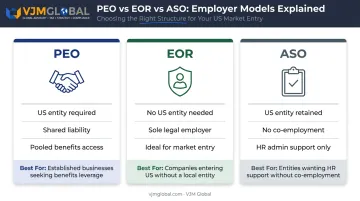
A PEO operates under a co-employment model — meaning you and the PEO share employer responsibilities. The PEO handles administration; you handle operations. Liability is shared between both parties.
An Employer of Record (EOR) acts as the sole legal employer. While PEOs are co-employers, EORs legally employ the workforce outright. The key practical difference: an EOR does not require the client to have an existing US legal entity, making it better suited for international companies testing the US market without incorporation.
PEO vs. ASO
That covers the two employer-of-record options. The third model — the Administrative Services Organization (ASO) — takes a different approach entirely.
An ASO performs similar HR administrative functions (payroll, benefits management, compliance support) but does not create a co-employment relationship. Unlike a PEO, an ASO will not remit taxes under its own EIN; tax filings go under the client's EIN, and the client retains full legal employer status.
Decision Framework
| Situation | Recommended Model |
|---|---|
| Have a US entity, want shared compliance liability and pooled benefits | PEO |
| Entering the US without a registered entity, need speed and flexibility | EOR |
| Have existing HR team, want administrative support without structural changes | ASO |
Conclusion
A PEO works by formally splitting employer responsibilities: the PEO takes on the administrative and tax-related burden of employment while you retain operational control. Businesses that understand this co-employment structure upfront avoid the most common friction points — disputes over control, gaps in liability coverage, and unmet service expectations.
Evaluate any PEO with a clear picture of what the CSA covers, what it doesn't, and what financial and compliance partners you'll need alongside it. The PEO handles your employment relationship. Payroll, benefits, and HR compliance fall under its scope; accounting, tax strategy, and broader business operations remain your responsibility to staff and structure separately.
Frequently Asked Questions
What does PEO stand for?
PEO stands for Professional Employer Organization — a third-party firm that enters a co-employment arrangement with a business to manage payroll, benefits, and HR compliance. Employer responsibilities are split between the PEO and the client through a Client Service Agreement.
Who is the employer when using a PEO?
Both parties share employer responsibilities. The PEO is the employer of record for tax and administrative purposes, filing payroll taxes under its own EIN. The client company remains the worksite employer, responsible for day-to-day management, hiring decisions, and business operations.
What are the three types of PEO arrangements?
The three main categories are:
- Full-service PEOs — broad co-employment with comprehensive HR outsourcing
- IRS-Certified PEOs (CPEOs) — federally recognized under IRS tax law, with specific liability protections
- ASOs (Administrative Services Organizations) — HR support without formal co-employment
Each differs in liability structure and legal employer status.
How does a PEO differ from an internal HR department?
An internal HR department manages people processes as employees of your company, with no separate legal status. A PEO is an external co-employer that formally takes on payroll filing and compliance obligations — functions an in-house team handles operationally but cannot assume as a legal employer entity.
Is a PEO the same as an EOR?
No. A PEO operates under a co-employment model with shared liability and requires the client to have a registered US legal entity. An EOR acts as the sole legal employer and doesn't require the client to have a US entity — making EORs more common for international companies entering the US market for the first time.
How much does a PEO cost in the US?
According to Forbes Advisor, PEO pricing typically runs $50–$150 per employee per month or 2–12% of gross payroll, depending on the provider, services included, and company size. The per-employee-per-month model offers more cost predictability; percentage-of-payroll pricing may suit businesses with variable workforces.