With that growth comes risk. Wiring a deposit to a UK "supplier" that turns out to be dissolved, or signing a contract with a firm that never held the licence it claimed, can mean lost funds and legal exposure with little recourse.
Here's the confusion many Singapore businesses run into: a "UK business licence" can mean two very different things. It might refer to basic company registration with Companies House, or a sector-specific licence for regulated activities like financial services, alcohol sales or gambling. Each requires a separate check.
This guide walks through exactly what information you need, the methods to verify both registration and licensing, and how to read the results before you sign anything.
Key Takeaways
- Companies House confirms UK incorporation and current status, but says nothing about sector licences
- Regulated activities (finance, alcohol, gambling, childcare) need a separate check with the relevant regulator
- Cross-check the registration number, address and director names — name-only searches invite false matches
- High-value or high-risk deals justify bringing in a cross-border compliance specialist, such as VJM Global
- Treating "dissolved" or "pending" as "active" is one of the costliest due-diligence errors businesses make
What You Need to Verify a UK Business Licence
A search is only as good as the details behind it. Enter the wrong spelling of a company name or skip the registration number, and you risk a false negative, or worse, matching the wrong entity entirely.
Information and Access Points Required
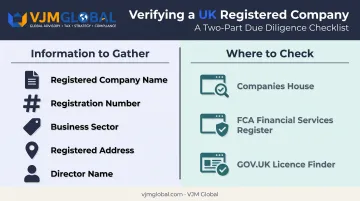
Gather these before you start:
- Exact registered company name (as it appears on Companies House, not a trading name)
- Company Registration Number (CRN), if you have it
- Sector of business activity (this determines which regulator to check)
- Registered office address
- Director's name (at least one)
You'll use three main access points:
- GOV.UK "Find and update company information" service (Companies House)
- FCA Financial Services Register for finance-related firms
- GOV.UK Licence Finder tool for other regulated activities
Preconditions Before You Search
Confirm which UK jurisdiction applies first. England & Wales, Scotland, and Northern Ireland can have different licensing bodies and legal requirements. Alcohol licensing under Scotland's Licensing (Scotland) Act 2005, for example, works differently from England's Licensing Act 2003.
Unincorporated sole traders will not appear on Companies House at all. They register with HMRC for Self Assessment instead, not as a company. If your counterparty is a sole trader, use an alternate check: a VAT number lookup or a direct documentation request.
Methods to Verify a UK Business Licence
No single register covers both incorporation and sector licensing. Combine at least two of the following methods, depending on the sector involved and how much is riding on the deal.
Method 1: Companies House Registration Check
This confirms whether a company is legally incorporated in the UK and what its current status is (active, dissolved, or in administration).
What you need: Company name or registration number, plus the free GOV.UK Companies House search tool.
Steps:
- Go to the Companies House "Find and update company information" service on GOV.UK
- Enter the company name or registration number and select the matching entity
- Review the company status, incorporation date, registered office address and filing history
The service is free of charge and requires no account to view. It covers Ltd companies, PLCs, LLPs, CICs and charitable companies.
Limitation: it doesn't confirm any sector-specific trading licence, and it won't show sole traders or unincorporated partnerships at all.
Method 2: Sector-Specific Licence Verification
A company can be perfectly legal on Companies House and still be trading without the licence its activity legally requires.
What you need: GOV.UK Licence Finder to identify the correct regulator, the FCA Register for finance firms, or the relevant local authority register for others.
Steps:
- Identify the nature of the UK company's activity, then use GOV.UK Licence Finder to find the relevant licensing body
- Search that regulator's public register using the firm's name or reference number
- Confirm licence status, permitted activities, and any restrictions or enforcement action listed
Coverage varies by sector:
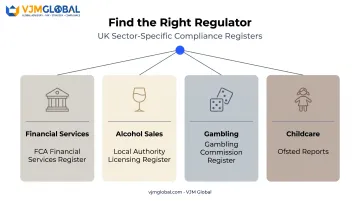
| Sector | Register to Check |
|---|---|
| Financial services / consumer credit | FCA Financial Services Register |
| Alcohol sales | Local authority licensing register (England & Wales) or council register (Scotland) |
| Gambling | Gambling Commission public register |
| Childcare | Ofsted inspection reports |
This method is essential for regulated industries and reveals restrictions Companies House simply won't show. The catch: you need to know which regulator applies, and not every licence type has a centralised, searchable public register.
Method 3: Professional Verification and Due Diligence Services
For higher-value or higher-risk transactions, engaging a cross-border compliance specialist adds a layer most in-house teams can't replicate quickly.
What it involves: A firm with UK and Singapore compliance expertise. VJM Global, for example, helps Singapore businesses verify UK counterparties, with chartered accountants who work to UK standards and HMRC requirements.
Steps:
- Share the UK company's name, registration details and nature of business with the verification provider
- Have the provider cross-check Companies House, relevant regulator registers and additional screening sources
- Receive a consolidated report covering registration status, licensing and any red flags before you proceed
This is the most thorough option for reducing fraud and compliance risk on significant deals. It involves a fee, so it's best reserved for higher-value transactions or new counterparties you have no prior history with.
How to Interpret the Verification Results
A search result is only useful if you read it correctly. Misreading "dissolved" or "pending" as "active" can mean signing with a company that legally no longer exists, or one that is not yet licensed for what it claims to do.
| Result | What It Means | Action |
|---|---|---|
| Active, current filings, valid licence | Company is legitimately trading and (where relevant) licensed | Proceed with standard commercial due diligence |
| Overdue filings or recent director/address change | Not necessarily a problem, but worth flagging | Request an explanation and recent accounts before proceeding |
| Dissolved, strike-off action, or in liquidation | Company may no longer legally exist or trade | Pause the transaction and request written clarification |
| No licence found for a regulated activity | Firm may be trading without required authorisation | Escalate to professional verification before proceeding |
Key status terms mean the following:
- Dissolved: Removed from the register entirely. It cannot lawfully sign contracts or hold assets.
- In administration: The company still exists, but an insolvency practitioner controls its assets and contracts. That can affect delivery timelines and payment terms.
- Strike-off action: A warning stage. The registrar has published a Gazette notice, and dissolution follows within two months unless someone objects with evidence.
Common Mistakes and Best Practices for Verification
Common Mistakes to Avoid
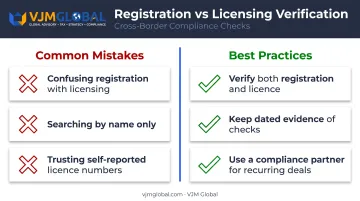
- Confusing registration with licensing — a company can be legally incorporated on Companies House yet completely unlicensed for the regulated activity it claims to perform
- Searching by name only without the registration number, which risks matching the wrong company among similarly named entities
- Trusting self-reported licence numbers on a company's website or logo without independently checking the regulator's own register
These aren't rare slip-ups. UK Finance reported over £1.17 billion stolen through payment fraud in 2024 alone. Unverified counterparties expose Singapore businesses to real financial risk.
Best Practices for Singapore Businesses
- Verify both incorporation status and any relevant sector licence before wiring funds, signing contracts or extending trade credit
- Keep dated screenshots or PDF exports of your verification results as evidence of due diligence
- For recurring UK partnerships or higher-value deals, use a compliance partner such as VJM Global to monitor counterparty status as circumstances change
Conclusion
Verifying a UK counterparty protects your business from fraud, wasted payments and compliance exposure. The check only works when it is thorough: confirm Companies House registration and any relevant sector licence. Do not treat one as a substitute for the other.
Once you have results in hand, use them to decide your next move: proceed, request clarification, or pause the deal. Act on what the records show, not on assumed good faith.
Frequently Asked Questions
How can I check a company's licence status in the UK?
Companies House confirms whether a company is legally incorporated and its current status. For any sector-specific licence, check the GOV.UK Licence Finder or the FCA Register, depending on the activity involved.
What information do I need before verifying a UK company?
At minimum, you need the registered company name, the registration number if available, the business sector, and the registered address. These details prevent false matches during your search.
Is verifying a UK company's registration free?
Yes. Companies House and the GOV.UK Licence Finder are both free to use. Professional due-diligence services charge a fee, but they deliver deeper, consolidated verification across multiple registers.
Can I verify a UK sole trader's business licence the same way?
No. Sole traders don't appear on Companies House. Use alternate checks instead, such as a VAT number lookup, a direct documentation request, or a professional verification service.
What does a "dissolved" status mean on Companies House?
A dissolved company has been removed from the register and no longer legally exists. It cannot lawfully trade, sign contracts, or act as a contracting party in any agreement.
Do I need to verify a UK company before every transaction?
Verification is strongly recommended for new counterparties, high-value deals, or regulated sectors. For established, trusted partners, routine periodic checks are usually sufficient.