Introduction
If you're a Singapore entrepreneur planning to expand into the UK and searching for how to set up a "UK LLC," there's one thing to sort out first: the UK doesn't have a structure called a Limited Liability Company. That term is specific to US company law. What you actually need is a Private Limited Company (Ltd) — the UK's equivalent, offering the same core benefit of separating your personal assets from business liabilities.
Many Singapore entrepreneurs target the UK for its stable legal framework, mature financial systems, and access to European markets. Registration itself is straightforward — most founders complete it online within 24 hours.
The harder part is what comes after. Tax obligations, compliance deadlines, director responsibilities, and the structural differences between UK and Singapore companies catch many remote founders off guard.
This guide clarifies the correct UK equivalent of an LLC, explains why Singapore entrepreneurs choose the UK for expansion, walks through the step-by-step registration process, and outlines what compliance looks like after your company is live.
Key Takeaways
- The UK does not recognise "LLC"; Singapore entrepreneurs must register a Private Limited Company (Ltd) through Companies House
- No UK residency required; Singapore nationals can register and own a UK Ltd remotely
- Online registration costs £100 and typically completes within 24 hours
- Corporation Tax registration with HMRC is required within three months of starting business activities
- Ongoing obligations include annual accounts, confirmation statements, and corporation tax returns filed each year
What Is an "LLC" in the UK? Understanding the Right Business Structure
The term "LLC" (Limited Liability Company) is rooted in US law and has no legal standing under English and Welsh law. If you're a Singapore entrepreneur familiar with this term from American or regional business contexts, understand that the UK equivalent is a Private Limited Company (Ltd) — specifically a company limited by shares, governed by the Companies Act 2006.
A UK Private Limited Company is a separate legal entity from its owners. It can hold assets and enter contracts in its own name, and shareholder liability is limited to the value of shares held — protecting personal assets from business debts.
The structure mirrors Singapore's Private Limited Company (Pte. Ltd.) in terms of limited liability, though UK governance requirements and tax treatment differ in ways Singapore entrepreneurs will need to plan around.
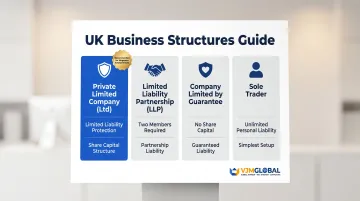
Before registering, it helps to understand how the Ltd sits relative to other UK structures — particularly if your business model or ownership arrangement doesn't fit a standard share-based company:
UK business structures at a glance:
- Limited Liability Partnership (LLP): Partnership structure with limited liability for members; requires at least two designated members
- Company Limited by Guarantee: No share capital; liability limited to guaranteed amount; typically used for non-profit organisations
- Sole Trader: Unincorporated; individual is personally liable for all business debts; simplest structure
For most Singapore entrepreneurs entering the UK market commercially, the Private Limited Company (Ltd) is the right starting point — and the structure this guide focuses on from registration through compliance.
Why Singapore Entrepreneurs Are Expanding to the UK
Why Singapore Entrepreneurs Are Expanding to the UK
The UK offers Singapore businesses access to one of the world's largest English-speaking economies. UK exports to Singapore reached £17.6 billion in the four quarters to Q3 2025, representing a 19% year-on-year increase — a figure that signals real commercial momentum, not just diplomatic proximity.
The UK-Singapore Free Trade Agreement (UKSFTA), which entered into force on 11 February 2021, eliminates tariffs on virtually all Singapore exports to the UK. This creates a structural advantage for Singapore businesses targeting UK and European markets through a UK entity.
Key structural advantages for Singapore entrepreneurs:
- Directors and shareholders can be Singapore nationals — no UK residency required
- Minimum share capital of just £1; a single share is sufficient to incorporate
- A UK Ltd address builds immediate credibility with UK and European clients
- Corporation Tax rates of 19% (profits under £50,000) and 25% (profits over £250,000)
Beyond the structural setup advantages, there are practical operating reasons why Singapore entrepreneurs choose a UK entity as their Western base.
Practical reasons to register a UK Ltd:
- Build credibility with UK and European clients who prefer dealing with local entities
- Access UK-based financing, investment, and banking relationships
- Enable local employment contracts for UK staff without complex cross-border arrangements
- Establish a physical operational base for European market expansion
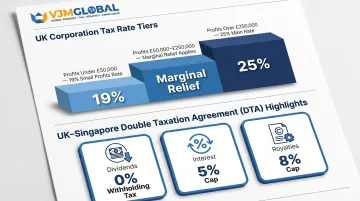
Underpinning all of this is the UK-Singapore Double Taxation Agreement (in force since 1997), which caps withholding tax on dividends at 0%, interest at 5%, and royalties at 8% — keeping cross-border profit repatriation straightforward.
How to Register a UK Private Limited Company: Step-by-Step
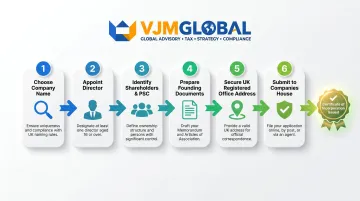
The entire registration process can be completed remotely through the Companies House online portal, typically within 24 hours. Here's the six-step process:
Step 1: Choose a Company Name
Your company name must meet these requirements:
- Be unique (not already registered with Companies House)
- End in "Limited" or "Ltd"
- Not include sensitive or restricted terms without permission
Use the Companies House name-availability checker to verify your preferred name is available before proceeding.
Step 2: Appoint at Least One Director
A UK Ltd requires at least one director who must be a natural person (not a company). There is no requirement for the director to be a UK resident — a Singapore national can serve as the sole director while residing in Singapore.
Directors have legal responsibilities under the Companies Act 2006, including:
- Acting in the company's best interests
- Exercising independent judgement
- Avoiding conflicts of interest
- Not accepting benefits from third parties
Step 3: Identify Shareholders and Persons of Significant Control (PSC)
Shareholders: At least one shareholder is required (who can also be the director). Singapore nationals can be shareholders without restriction.
Persons of Significant Control (PSC): Anyone holding more than 25% of shares or voting rights, or holding the right to appoint or remove the majority of directors, must be registered as a PSC. PSC details (name, address, nationality, and date of birth) are submitted to Companies House and appear on the public register.
Step 4: Prepare Key Founding Documents
Two core documents are required:
Memorandum of Association: A legal statement signed by all initial shareholders confirming their intention to form the company. When registering online, this is generated automatically.
Articles of Association: Written rules governing how the company is run — covering shareholder rights, director responsibilities, and decision-making procedures. Companies House provides standard "model articles" by default, which you can adopt as-is or replace with bespoke articles tailored to your structure.
Step 5: Secure a UK Registered Office Address
A physical UK address (not a PO Box) is required as the company's official address for receiving correspondence from Companies House, HMRC, and other government bodies. This address appears on the public register.
Singapore entrepreneurs typically use one of three options:
- A registered office service provider
- A UK accountant or solicitor's address
- A genuine physical UK office if establishing local operations
Step 6: Submit Registration to Companies House
Registration is completed online via the Companies House portal. Current fees (effective 1 February 2026):
- Online registration: £100
- Same-day incorporation (software only): £156
- Paper (postal) registration: £124 (processing takes a week or more)
Upon successful registration, Companies House issues a Certificate of Incorporation, confirming the company's legal existence and assigning your unique company registration number.
Key Requirements and Documents for Singapore Applicants
Identity Documents for Each Director and Shareholder
Valid passport or national ID is required for fraud prevention and Know Your Customer (KYC) compliance. Singapore passports are accepted without additional verification.
UK Registered Office Address
Singapore entrepreneurs cannot use a Singapore address for the registered office. Since this address is publicly visible on Companies House records, many foreign founders use a registered office service provider rather than disclosing a personal UK address or solicitor's office.
Share Structure Documentation
You'll need to prepare a statement of capital detailing:
- Number of shares issued
- Class of shares (typically ordinary shares)
- Nominal value of each share (for example, £1 per share)
- Shareholding allocation among founders
There is no minimum share capital requirement in the UK — a single share of £1 meets the legal threshold.
Shareholders' Agreement (Recommended)
While not mandatory for sole directors, a Shareholders' Agreement is worth having in place for businesses with multiple Singapore-based co-founders. This document governs decision-making, profit distribution, dispute resolution, and exit procedures outside the public Articles of Association.
Getting this structure right from day one matters — especially when founders are based across different jurisdictions. VJM Global works with Singapore entrepreneurs to align share structures with long-term business goals and cross-border tax considerations before incorporation.
Tax Obligations and Ongoing Compliance for UK Companies
Corporation Tax registration and rates
You must register with HMRC within three months of starting business activity. If registering via Companies House online, the option to register for Corporation Tax is provided during the incorporation process.
Current Corporation Tax rates (effective from 1 April 2023):
| Profit Level | Rate |
|---|---|
| Under £50,000 | 19% (small profits rate) |
| £50,000 - £250,000 | Marginal Relief applies (gradual increase from 19% to 25%) |
| Over £250,000 | 25% (main rate) |
These rates apply to profits earned globally if the company is UK tax-resident. The UK-Singapore Double Taxation Agreement prevents double taxation and caps withholding taxes on cross-border payments — including dividends, royalties, and interest — between the two countries.
VAT registration
VAT registration becomes mandatory once taxable turnover exceeds £90,000. Singapore entrepreneurs should register voluntarily if they expect to cross this threshold soon after launch.
Once registered, VAT returns are filed quarterly or monthly. All VAT-registered businesses must use Making Tax Digital (MTD)-compliant software to maintain digital records and submit returns — selecting the right MTD tool early avoids compliance gaps later.
Annual compliance obligations
| Obligation | Deadline | Authority |
|---|---|---|
| Confirmation Statement | At least once every 12 months | Companies House |
| Annual Accounts (first year) | 21 months after incorporation | Companies House |
| Annual Accounts (subsequent) | 9 months after financial year end | Companies House |
| Corporation Tax Return | 12 months after accounting period end | HMRC |
| Corporation Tax Payment | 9 months + 1 day after accounting period end | HMRC |
Late filing penalties:
- Accounts 1-3 months late: £375
- Accounts 3-6 months late: £750
- Accounts over 6 months late: £1,500
- Corporation Tax Return 1 day late: £100
- Repeat late filings: Penalties double if accounts are late in two successive years
Persistent non-filing can trigger company strike-off — involuntary dissolution by Companies House.
Payroll obligations for UK employees
If your UK Ltd hires UK-based employees, you must:
- Register for PAYE with HMRC before the first payday
- Calculate and pay employer National Insurance contributions
- Enrol eligible workers in a workplace pension scheme (auto-enrolment applies to workers aged 22 to State Pension age earning over £10,000 annually)
Managing PAYE, pension auto-enrolment, and MTD filings from Singapore adds meaningful administrative load. Most remote founders outsource these to a UK-based accountant or payroll provider — particularly for the first filing cycle, where setup errors are most common.
Common Mistakes and Misconceptions Singapore Entrepreneurs Should Avoid
Assuming a UK Ltd Is the Same as a US LLC
The most common misconception is that "setting up an LLC in the UK" follows the same process as forming a US LLC. The structures are fundamentally different:
- A US LLC can elect pass-through taxation (income flows directly to owners)
- A UK Ltd is a separate taxable entity subject to Corporation Tax at the company level
- Governance rules, tax treatment, and terminology differ completely
Neglecting UK Compliance Obligations While Managing Remotely from Singapore
Many entrepreneurs successfully register their company but fail to maintain annual filings, confirmation statements, or HMRC deadlines while managing operations from Singapore. Even a dormant company (one that is not trading) must file:
- A Confirmation Statement annually with Companies House
- Annual accounts with Companies House (simplified dormant accounts apply if the company qualifies)
Failure to file is a criminal offence and can trigger financial penalties, director fines, and involuntary company dissolution.
Treating a UK Ltd Identically to a Singapore Pte. Ltd.
While both structures offer limited liability, they differ in:
- Governance requirements under the Companies Act 2006 vs. Singapore Companies Act
- Tax treatment (UK Corporation Tax vs. Singapore corporate tax)
- Director duties and reporting standards
- Filing deadlines and compliance calendars
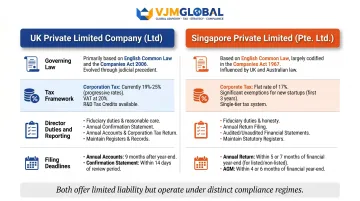
Treating these two structures as interchangeable is one of the fastest ways to create compliance gaps — particularly when setting up cross-border operations between Singapore, the UK, and India.
Frequently Asked Questions
How much does it cost to register an LLC in the UK?
Online registration with Companies House costs £100 (effective from 1 February 2026). Additional costs include registered office address services (typically £50-£200 annually) and professional assistance if needed. Ongoing costs include annual filing fees and Corporation Tax compliance.
Can you form an LLC in the UK?
No. The UK does not recognise the LLC as a legal structure. The correct equivalent is a Private Limited Company (Ltd) registered with Companies House, which provides the same core benefit of limited liability protection for shareholders.
Can foreigners open an LLC in the UK?
Yes. Foreign nationals, including Singapore citizens, can register and own a UK Private Limited Company without any residency requirement, as long as they provide valid identification and secure a UK registered office address. Directors and shareholders can reside entirely outside the UK.
Which is better, Ltd or LLC?
The LLC is a US structure with no legal equivalent in the UK. For Singapore entrepreneurs targeting the UK market, a Private Limited Company (Ltd) is the only recognised option for limited liability protection. There is no meaningful comparison — Ltd is simply what exists in the UK.
What is the UK equivalent of a US LLC?
The UK equivalent is a Private Limited Company (Ltd), registered with Companies House under the Companies Act 2006. Both structures offer limited liability, but they differ in tax treatment (Corporation Tax vs. potential pass-through taxation) and governance requirements.
Does an LLC mean I own a business?
In the UK context, owning shares in a Private Limited Company means you hold a proportional ownership stake. Ownership is recorded through share allocation in the company's register of members. The company itself holds the business's assets and liabilities, not individual shareholders.
Ready to set up your UK company the right way? VJM Global has worked with 250+ UK businesses on compliance, cross-border tax planning, and entity management. If you're a Singapore entrepreneur navigating UK registration remotely, our team can guide you through the process. Reach us at [email protected] or call +91 98915 76441.