Introduction
Singapore business owners searching for a "UK business licence" often expect something similar to ACRA registration back home: one application, one certificate, one regulator. The UK doesn't work that way.
This mix-up causes real problems. Founders confuse Companies House registration (which creates the legal entity) with sector-specific trading licences (which permit a specific activity). The result? Wasted weeks, rejected applications, or compliance spend on permits that were never actually required.
Here's what "getting a UK business licence" really means for a Singapore company: the registration steps involved, which industry licences might apply to your activity, and the mistakes that trip up overseas founders most often.
Key Takeaways
- The UK has no single universal business licence — Companies House registration creates the entity; extra licences depend on your activity
- Singapore residents can register a UK limited company fully online, with no relocation or UK visa required
- Only regulated sectors (financial services, food, alcohol, transport, waste) need extra licences from bodies such as the FCA or local councils
- Companies House incorporation costs £100 and usually finishes within 24 hours — sector licences can take months and cost far more
- Correct structure and licensing from day one helps you avoid fines, delays, or a rejected application
Is There a Single "UK Business Licence"? What Singapore Businesses Actually Need
Unlike some jurisdictions that issue one universal trading permit, the UK splits business permission into two distinct layers. Overseas founders regularly assume Companies House registration covers everything. It doesn't.
Layer one: mandatory legal registration. Every UK company must:
- Register with Companies House to become a legal entity
- Register with HMRC for tax purposes once trading begins
Layer two: sector-specific licensing. This only applies if your business activity is regulated. It's a separate application, to a separate authority, with its own fee and timeline.
Businesses That Need No Extra Licence
Most companies stop at layer one. If you're running general consulting, e-commerce, SaaS, or most B2B professional services, company and tax registration is typically the entire legal requirement.
Businesses That Do Need Additional Licensing
Regulated sectors include:
- Financial services (payments, lending, investment advice)
- Food and drink
- Alcohol sales
- Transport and logistics
- Healthcare
- Import/export of controlled goods
- Waste management
- Gambling
Each sector answers to a different regulator — the FCA for finance, local councils for food and alcohol, the DVSA for transport, the Environment Agency for waste. Companies House has no involvement in any of these. Singapore founders need to check with the actual regulator governing their activity, not assume registration alone covers it.
VJM Global's cross-border team helps Singapore companies identify which registrations and licences apply to their activity before any forms are filed.
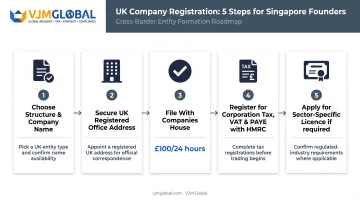
How to Register Your UK Business From Singapore: Step-by-Step
Registering a UK company from Singapore is more straightforward than most founders expect. None of it requires a UK visa or physical presence.
Step 1: Choose Your Structure and Company Name
A private limited company (Ltd) is the default structure for non-resident founders. It offers limited liability and is the fastest structure to register.
Your chosen name must:
- Be unique and not too similar to an existing registered company
- Avoid sensitive words unless you have approval
- Not imply a government connection it doesn't have
Step 2: Secure a UK Registered Office Address
Every UK company needs a registered office address in the same jurisdiction as its registration (England, Wales, Scotland, or Northern Ireland). This address becomes public record.
Singapore founders typically don't have a physical UK presence, so most use a third-party registered office service rather than delaying incorporation.
Step 3: File With Companies House
You'll need to prepare:
- Director and shareholder details
- Persons with Significant Control (PSC) information (generally anyone holding more than 25% of shares or voting rights)
- Articles of Association
- A SIC code describing your business activity
Online filing costs £100 and is usually completed within 24 hours. Directors and PSCs must also complete identity verification with Companies House as part of the process.
Step 4: Register for Corporation Tax, VAT, and PAYE With HMRC
Once you start trading, complete these HMRC registrations on time:
- Corporation Tax within 3 months of starting to trade (late notification can trigger a penalty)
- VAT once taxable turnover exceeds £90,000 in a rolling 12-month period
- PAYE before your first payday, and no more than two months in advance
Step 5: Apply for Any Sector-Specific Licence Identified for Your Business
If your activity falls into a regulated category, this is a separate application to the relevant regulator, with its own fee, form, and timeline, entirely distinct from Companies House. VJM Global supports Singapore founders with licence identification and the filing itself.
Industry-Specific UK Licences and Permits Singapore Companies May Need
Licence type, regulator, and cost depend entirely on what your business actually does. Confirm exact requirements with the relevant authority before you start trading. The summary below is a starting point, not a substitute.
| Sector | Regulator | What's Required |
|---|---|---|
| Financial services | FCA | Authorisation with fit-and-proper checks |
| Food & beverage | Local council | Business registration plus hygiene rating |
| Alcohol sales | Local licensing authority | Premises licence and personal licence |
| Import/export of controlled goods | HMRC/Border Force | EORI number and specific goods authorisation |
| Waste management | Environment Agency | Waste carrier licence or environmental permit |
| Passenger transport/private hire | Local council + DVSA | Operator licence and vehicle compliance |
Financial Services
Anything involving payments, lending, or investment advice generally requires FCA authorisation. Fees run from £280 to over £225,170 depending on complexity. A complete application typically takes up to 6 months to assess, and an incomplete one up to 12 months. Start this process long before your planned launch date.
Food and Beverage Businesses
You'll need to register your food premises with the local council at least 28 days before trading. Registration itself is free and can't be refused, but it's separate from the hygiene rating your premises later receives after inspection.
Alcohol Sales
Selling alcohol requires a premises licence from your local licensing authority, plus a personal licence held by a designated premises supervisor. Premises licence fees range from £100 to £635 depending on rateable value; personal licences typically cost around £37.
Import/Export of Controlled or Regulated Goods
An EORI number is mandatory for moving goods between the UK and other countries, but it only identifies you for customs. Controlled goods still need separate HMRC or Border Force authorisation. Check your commodity code and route before shipping.
Waste Management or Environmental Activities
Carrying waste that isn't your own typically requires waste carrier registration (around £191 initially, renewing every three years). Actually storing, treating, or disposing of waste needs a separate Environment Agency environmental permit.
Passenger Transport/Private Hire
Private hire operators need a council operator licence lasting up to five years. Larger passenger operations (9+ seats) fall under PSV rules via the Traffic Commissioners, with applications recommended at least nine weeks ahead.
Choosing Your UK Structure: Subsidiary, Branch, or Licence-Only Registration
Before applying for any licence, decide how you'll legally exist in the UK. That choice drives liability, tax treatment, and which entity regulators will licence.
UK subsidiary: A new, separate limited company incorporated in the UK. It carries its own liability, separate from the Singapore parent, and pays Corporation Tax on its profits.
UK establishment (branch): Register via Form OS IN01 within one month of opening (£124 fee). This isn't a separate legal entity; it's an extension of the Singapore company, so liability sits with the parent. It still pays UK Corporation Tax on UK-derived profits.
"Licence-only" registration doesn't exist as a structure. A sector licence never replaces a subsidiary or an OS IN01 filing if you establish any UK presence.
| Factor | Subsidiary | Branch/UK Establishment |
|---|---|---|
| Legal separation | Independent entity | Extension of parent |
| Liability | Contained to UK company | Sits with Singapore parent |
| Filing | Standard incorporation | OS IN01, £124, within 1 month |
| Tax | UK Corporation Tax on all profits | UK Corporation Tax on UK activity only |
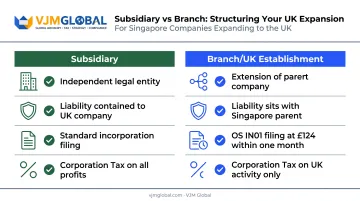
Finalise this decision before any licence application. Regulators typically need to know which legal entity they are licensing.
Common Mistakes Singapore Businesses Make When Applying for UK Licences
A handful of avoidable errors show up repeatedly among Singapore businesses:
- Assuming Companies House covers everything. Registration creates the entity; it says nothing about whether you can legally trade in a regulated sector.
- Applying to the wrong authority. England, Wales, Scotland, and Northern Ireland each run separate licensing bodies for some activities, so an England food hygiene registration will not cover Scotland.
- Underestimating timelines. Trading before a licence is actually granted risks penalties or forced closure. FCA authorisation alone can stretch to 12 months if the application is incomplete.
Getting the sequence right—structure, then registration, then licence—saves far more time than it costs.
Frequently Asked Questions
Do I need a business licence in the UK?
All UK companies must register with Companies House and HMRC. A separate trade licence only applies if your business operates in a regulated sector like finance, food, or alcohol.
Can I register a business in the UK as a foreigner?
Yes. Singapore residents can register and own a UK limited company entirely remotely, with no residency requirement for directors or shareholders.
What licence do I need to start a business in the UK?
It depends entirely on your activity. Most businesses only need Companies House and HMRC registration; regulated sectors need an additional specific licence from the relevant authority.
How much does it cost to get a UK business licence?
Companies House registration costs a fixed £100. Sector-specific licences vary widely, from free food registration to over £225,000 for complex FCA authorisation.
How long does it take to get a UK trade licence approved?
Company registration usually completes within 24 hours. Sector licences take considerably longer — weeks for local council permits, up to 12 months for complex FCA applications.
Can a Singapore company apply for a UK licence without visiting the UK?
Most registrations and licence applications can be completed remotely. Some regulators may still request additional verification or supporting documentation during the process.