Many US business owners approach the wrong authority entirely, contacting Dubai's mainland department when they actually need a free zone, or vice versa. That mismatch alone can cost weeks of back-and-forth before anyone touches an actual application.
This guide breaks down every registration authority a US business needs to know: mainland, free zone, and offshore. You'll also learn how to verify a company's registration and how to pick the right authority the first time.
Key Takeaways
- The UAE has no single national registrar: authority depends on whether a company is mainland, free zone, or offshore
- Since 2021 reforms, US businesses can own 100% of most mainland UAE companies without a local partner
- DIFC and ADGM run independent common-law registers most familiar to US and UK compliance teams
- Verifying a UAE company means identifying its specific licensing authority first, not running a generic government search
Understanding the UAE's Multi-Layered Registration System
Americans are used to a fairly centralized model: pick a state, file with its Secretary of State, get a certificate. The UAE doesn't work that way.
Each of the seven emirates has its own economic development authority. On top of that, more than 40 free zones operate with their own licensing power, and a handful of jurisdictions run entirely separate legal systems. There is no single office that issues every UAE company license.
Federal Oversight: Ministry of Economy
The Ministry of Economy and Tourism (MoET) sets national foreign investment policy and administers the Commercial Companies Law, Federal Decree-Law No. 32 of 2021. It also operates the National Economic Register, a nationwide portal for licence and trade-name enquiries.
What MoET does not do is issue individual company licenses. That job belongs to each emirate's "Competent Authority," meaning your actual registration always happens at the local or free zone level, never directly with the federal ministry.
Why This Matters for US Businesses
US LLCs and corporations don't have a one-to-one equivalent in the UAE. Depending on the authority you choose, your structure will be one of the following:
- LLC — mainland entity, most flexible for UAE-wide trading
- FZE (Free Zone Establishment) — single-shareholder free zone company
- FZ-LLC — multi-shareholder free zone company
- Branch office — extension of your existing US entity, no separate legal identity
Timelines vary too:
- US incorporation: Often same-day, filed entirely online through a Secretary of State portal
- UAE registration: Anywhere from instant approval to several business days, frequently requiring in-person document submission or a licensed local agent
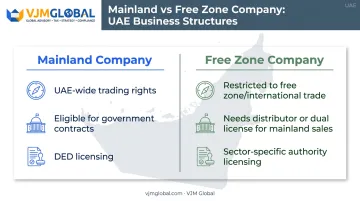
There's also a structural distinction that trips up a lot of first-time founders. Mainland companies can trade UAE-wide and bid on government contracts. Free zone companies generally can't sell directly into the mainland without an additional license or a local distributor. That single fact drives most of the "which authority do I choose" decision, which we'll cover in detail below.
Mainland Registration: The Department of Economic Development (DED)
Each emirate's DED is the sole licensing authority for companies operating on UAE mainland. The naming varies by emirate:
| Emirate | Mainland Authority |
|---|---|
| Dubai | Dubai Department of Economy and Tourism (DET) |
| Abu Dhabi | Abu Dhabi Department of Economic Development (ADDED) |
| Sharjah | Sharjah Economic Development Department (SEDD) |
| Ajman | Department of Economic Development – Ajman |
| Ras Al Khaimah | RAK Department of Economic Development |
| Umm Al Quwain | Department of Economic Development |
| Fujairah | Department of Industry and Economy |
What the DED Actually Handles
The DED manages the full mainland licensing sequence:
- Trade name reservation
- Initial approval of the business activity
- Memorandum of Association (MOA) processing
- Issuance of the final commercial license
A mainland license is the only structure that lets a US-owned company bid for government contracts and trade freely anywhere in the UAE. That's a real advantage if your target customers are domestic UAE businesses or government entities, not just international clients, and it's made more accessible today thanks to ownership reforms passed in 2020.
Ownership Rules Since 2020
Federal Decree-Law No. 26 of 2020 eliminated the requirement for UAE nationals to hold 51% ownership in mainland companies. Most sectors now allow 100% foreign ownership, including for US citizens. A short list of "strategic impact" activities, such as security, banking, and telecommunications, still carry local ownership or capital conditions set by the sector regulator.
A frequently overlooked step: mainland companies must also register with the Chamber of Commerce and Industry in their emirate. In Dubai, for example, most licensed businesses must join Dubai Chambers, with limited exemptions for very small or freelance operations.
Free Zone Authorities: Where Most US Businesses Register
Free zones remain the most common entry point for US businesses. Historically, they offered 100% foreign ownership without needing a local sponsor, well before mainland rules caught up. Full profit repatriation and no corporate tax below certain thresholds sweetened the deal further.
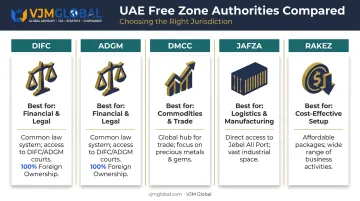
Here's how the major free zone authorities stack up:
| Authority | Best For | Notable Feature |
|---|---|---|
| DIFC | Financial services, fintech | Independent common-law courts |
| ADGM | Financial services, holding companies | English law applied directly |
| DMCC | Trading, commodities | Largest free zone, 1,000+ permitted activities |
| JAFZA | Logistics, industrial, trade | Strong port and customs infrastructure |
| RAKEZ | Cost-sensitive SMEs and startups | Lower setup and renewal costs |
Why DIFC and ADGM Stand Out
DIFC and ADGM aren't just free zones with lighter paperwork. They run independent common-law legal systems, each with their own courts. ADGM applies English common law and equity directly, while DIFC operates its own statutory and common-law framework modeled closely on English legal principles.
For a US legal or compliance team used to clear precedent and predictable court procedure, this is the closest structural match the UAE offers.
The Mainland Access Problem
Free zone companies are generally restricted to operating within the free zone itself or trading internationally. Selling directly into the UAE mainland market usually requires:
- A licensed mainland distributor, or
- A dual license arrangement, which lets a free zone company also operate on the mainland
DMCC and ADGM both offer structured dual-licensing paths with mainland authorities.
Choosing the right authority comes down to business activity, not just cost. DMCC suits commodity and trading businesses. DIFC fits fintech and financial services. RAKEZ works well for budget-conscious startups that don't need a prestige address. Each authority licenses a different set of permitted activities, so the wrong choice means re-registering later.
Offshore Company Authorities
Offshore structures, primarily RAK ICC and JAFZA Offshore, exist for holding companies, asset protection, and international trading. They're not built for US businesses that want an actual operational presence in the UAE.
Key restrictions to know:
- Registered agent required. US business owners cannot approach RAK ICC or JAFZA Offshore directly; a licensed registered agent must handle the registration.
- Registered office required. This can be satisfied by using the agent's UAE office rather than leasing dedicated space.
- Limited banking and visa access. Offshore companies can hold UAE bank accounts for routine transactions, subject to the bank's own approval. Visa eligibility is narrow, and most standard offshore packages don't include general residence visa rights.
If your goal is running actual operations in the UAE, hiring staff, or securing multiple visas, offshore isn't the right vehicle. It's a tool for holding structures, not day-to-day business — and choosing the right structure from the start avoids costly restructuring down the line.
Choosing the Right Authority: A Framework for US Businesses
Use this as a starting filter:
- Choose mainland if you're targeting UAE-based customers directly or pursuing government contracts
- Choose a free zone if your business is export-facing, international, or fits a specific sector like fintech, trading, or media
- Choose offshore only if you need a holding entity or asset-protection structure, not day-to-day operations
US Tax Considerations Founders Often Miss
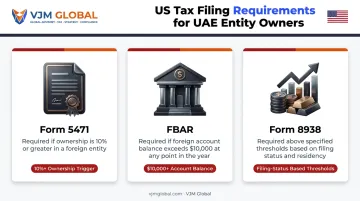
Setting up in the UAE doesn't remove US reporting obligations. Depending on ownership percentage and structure, US persons may need to file:
- Form 5471 — required once a US person holds a 10% or greater interest, or controls the foreign corporation
- FBAR — triggered when foreign account balances exceed $10,000 at any point in the year
- Form 8938 — triggered at higher asset thresholds depending on filing status and residency
There's also no comprehensive US-UAE income tax treaty in force, unlike many other jurisdictions Americans expand into. That absence changes how foreign tax credits and double taxation issues get handled, so UAE entity formation should be coordinated with US tax planning, not treated as a separate project.
This is exactly the kind of complexity where founders benefit from cross-border tax expertise rather than handling UAE filings and US compliance as separate tracks. VJM Global has spent over 30 years advising international businesses, including 500+ US clients, on structuring foreign entities alongside US tax obligations like Form 5471 and FBAR filings. A quick consultation before you finalize a jurisdiction can help you avoid costly compliance gaps down the line.
Verifying a UAE Company's Registration
Because there's no single registry, verifying a company starts with one question: which authority licensed it? This matters most before signing a contract or wiring funds to a UAE-based partner.
Once you know that, here's where to check:
| Jurisdiction | Verification Method | Access |
|---|---|---|
| DIFC | Public register search | Free, no login required |
| ADGM | Public register search | Free, no login required |
| Dubai (DET) | License number search | No login for basic search |
| Abu Dhabi (ADDED) | Economic Register Certificate | Requires UAE Pass; small fee applies |
Most portals ask for the trade license or registration number as the primary identifier, since business names can repeat or get transliterated differently from Arabic. If you only have a company name, expect more friction and possibly false matches, so ask your UAE counterpart directly for their license number before you search.
Frequently Asked Questions
How can I check if a company is legally registered in the UAE?
First identify the licensing authority, whether that's a specific DED, a free zone, DIFC, or ADGM. Then search that authority's own online portal using the trade license or registration number.
What are the requirements for company registration in UAE?
Core requirements include passport copies, passport-sized photos, a defined business activity, and a reserved trade name. Depending on the structure, you'll also need an MOA or local service agent agreement, plus any activity-specific government approvals.
What is the company registration code in UAE?
This refers to the trade license or registration number issued by the DED or free zone authority. It's the unique identifier used for renewals and official verification searches.
Can a US citizen own 100% of a company in the UAE?
Yes, since 2021 reforms, US citizens can own 100% of most mainland companies and virtually all free zone companies. A small list of strategic sectors, like banking and telecommunications, still requires local participation.
Should a US business choose mainland or a free zone in the UAE?
Choose mainland if you need to trade directly with UAE customers or government entities. Choose a free zone if your business is primarily international or export-focused.
Do I need a local sponsor to register a company in the UAE as a US business owner?
No. The historic 51% local sponsor requirement for mainland companies was largely abolished in 2021. Free zone companies have never required a local sponsor.