The trend is accelerating. UAE businesses are diversifying beyond the GCC, and Ireland's English-speaking, low-tax, common-law framework makes it one of the easiest entry points into the EU single market for Gulf-based founders.
This guide covers what actually matters for UAE applicants: the eligibility quirks non-EEA founders face, the exact CRO filing sequence, how to pick between an LTD, DAC, or branch, and the tax obligations that follow incorporation.
Key Takeaways
- Incorporate and own an Irish company fully remotely from the UAE; no visa unless you relocate to work there
- All-UAE boards must appoint an EEA-resident director or arrange a Section 137 bond before filing
- The Private Company Limited by Shares (LTD) suits most UAE-owned Irish subsidiaries
- Ireland’s 12.5% trading tax rate is the main benchmark against the UAE’s 9% corporate tax
- UAE-issued documents typically need notarisation and legalisation before CRO submission
Why UAE Businesses Are Setting Up in Ireland
Diversification is driving the move. GCC companies that once relied entirely on regional trade are now building compliant footholds inside the EU, and Ireland has become a preferred landing spot for e-commerce, tech, and export-driven businesses.
The core draw is market access. A UAE entity trading into Europe still faces tariffs, customs friction, and regulatory divergence. An Irish-incorporated company doesn't.
It trades as a full EU member state. That gives a UAE-owned business tariff-free, regulation-aligned access to a single market of 450 million consumers. No UAE-based entity can match those terms from outside the bloc.
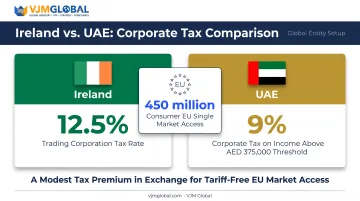
Tax often comes up next, but it isn't the main driver. Ireland applies a 12.5% corporation tax rate to trading income, while the UAE charges 9% on taxable income above AED 375,000. On paper, the UAE rate is lower. Founders choosing Ireland are paying a modest tax premium in exchange for genuine EU market access, not chasing a cheaper tax bill.
Credibility matters too:
- Ireland runs on common law, the same legal tradition UAE free-zone courts like the DIFC already use
- Corporate and CRO documentation is entirely in English
- European HQ base for major tech and pharma firms — a reference point EU banks and partners already trust
For a UAE founder, an Irish subsidiary reads as a genuine EU presence, not a mailbox address. Market access, a manageable tax trade-off, and institutional credibility together explain why Ireland is now the default EU base for GCC businesses that once traded only from Dubai or Abu Dhabi.
UAE-Specific Requirements Before You Register
Before filing anything, UAE applicants need to clear a few structural requirements that founders from EEA countries never encounter.
No Visa Needed to Incorporate
Owning and directing an Irish company from Dubai or Abu Dhabi requires no visa or residence permit. The CRO accepts filings electronically through its CORE portal, and there's no physical-presence requirement to incorporate. A visa only becomes relevant if you intend to relocate and work inside Ireland.
The EEA-Resident Director Rule
This is the requirement that trips up most all-UAE boards. Under Section 137 of the Companies Act 2014, at least one director must be resident in an EEA state. Since the UAE sits outside the EEA, a board made up entirely of UAE residents doesn't automatically satisfy this, regardless of shareholding or nationality.
There are two ways around it:
- Appoint a director who is genuinely resident in an EEA country
- Arrange a Section 137 bond instead
The bond in practice:
- Statutory amount is EUR 25,000, for a minimum of two years
- Covers unpaid Companies Act fines, specified tax offences and penalties, and certain company expenses, capped at EUR 25,000 in aggregate
- Insurance companies and specified licensed banks can act as surety
- Commercial premiums vary by provider, so get a live quote rather than an advertised starting price
Most UAE-only boards choose the bond, since sourcing a genuine EEA-resident director isn't always practical.
Document Authentication
Because UAE applicants don't hold an Irish PPSN, identity verification runs through the CRO's Verified Identity Form process instead. UAE-issued identity and corporate documents typically need notarisation and legalisation through the UAE Ministry of Foreign Affairs before they're accepted. Skipping or mis-sequencing this step is one of the most common causes of registration delay for Gulf-based applicants.
VJM Global's cross-border team can source an EEA-resident director, arrange the Section 137 bond, and coordinate document attestation so these requirements don't stall your filing.
How to Set Up a Business in Ireland from UAE: Step-by-Step
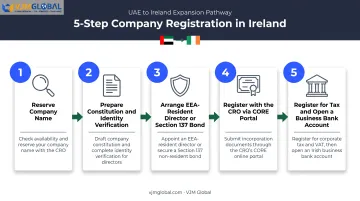
From the UAE, Irish company formation follows five steps through the Companies Registration Office (CRO). Online registration on the CORE portal typically takes several weeks, and timelines shift with processing volumes — check the CRO's published queue before you fix a launch date.
Step 1: Check and Reserve Your Company Name
Search the CRO's CORE portal to confirm your chosen name isn't already taken or too similar to an existing one. Reserving it costs a small fee and holds the name for 28 days while you prepare the rest of your filing.
Step 2: Prepare Constitutional Documents and Identity Verification
Gather these before you file:
- Constitution
- Completed A1 incorporation form
- Identity verification through the CRO's VIF process
UAE applicants do not have an Irish PPSN, so VIF depends on attested and apostilled identity documents. Start authentication early; it is one of the slower prep items.
Step 3: Arrange Your EEA-Resident Director or Section 137 Bond
Finalise your EEA-resident director or Section 137 bond before you submit the A1 form. For GCC-based applicants, this is consistently the single biggest delay point in the process.
Step 4: Register with the CRO
Submit the A1 form and Constitution through CORE, along with the electronic filing fee. Once approved, the CRO issues your Certificate of Incorporation and CRO number, and your company legally exists.
Step 5: Register for Tax with Revenue and Open a Business Bank Account
Register for corporation tax through Revenue's ROS system, and for VAT if you expect to exceed the threshold (currently €85,000 for goods, €42,500 for services). Then move on to banking.
Banking is often the slowest stage for UAE-based directors. With beneficial ownership outside the EEA, expect enhanced KYC/AML checks, source-of-funds requests, and questions about the company's Irish substance before an account opens.
Choosing the Right Business Structure
Most UAE founders default to one of three structures, and the right choice depends on how independent you want the Irish entity to be.
| Structure | Directors | Best For |
|---|---|---|
| LTD | One minimum | Standalone EU trading presence — the default for most UAE-owned subsidiaries |
| DAC | Two minimum | Regulated activity or joint ventures where stated objects matter |
| Branch | None separately required | Extending a UAE or free-zone entity — parent retains liability; no separate Irish limited company |
For most UAE entrepreneurs building a standalone EU trading arm, the LTD is the practical default. It typically offers:
- Only one director required (plus a separate company secretary)
- No stated-objects restriction in the constitution
- Option to dispense with holding an AGM
A DAC makes sense for regulated sectors or joint ventures where partners want permitted activities clearly defined in the constitution. It requires two directors, which adds another EEA-residency consideration.
If you're running a UAE free-zone entity, such as a DIFC or DMCC company, and considering a branch instead of a subsidiary, confirm your entity type actually qualifies for Part 21 branch registration first. Not every free-zone structure meets the definition of a qualifying non-EEA external company.
Tax, Compliance & Common Pitfalls for UAE Entrepreneurs
Ireland taxes trading income at 12.5%. Non-trading income and income from an excepted trade are taxed at 25%. That distinction matters more than the headline rate: confirm your revenue actually qualifies as trading income before assuming the lower rate applies.
Double taxation isn't a real risk if you use the treaty correctly. The Ireland-UAE Double Taxation Agreement, in force since 2011, protects UAE-resident directors and shareholders from being taxed twice:
- Dividends are taxable only in the recipient's state where they're the beneficial owner
- Royalties follow the same residence-state-only treatment
- Directors' fees can be taxed in the state where the company is resident
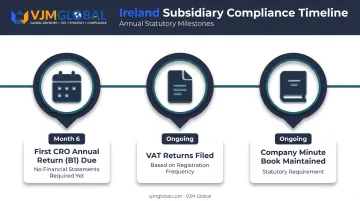
Your annual compliance calendar:
- First CRO annual return (B1): due exactly six months after incorporation, no financial statements required at that point
- VAT returns: frequency depends on your registration and turnover once registered
- Company minute book: a statutory requirement, not optional paperwork
The "run it informally from Dubai" mistake is the pitfall we see most. Because the UAE has low corporate tax and no personal income tax, some founders assume an Irish subsidiary can be managed casually from a UAE office. It can't.
Irish tax residency and EU substance rules look at where decisions are actually made: company policy, investment decisions, major contracts, and where directors genuinely live and work. A Dublin registered office address doesn't satisfy this on its own.
When Ireland might not be worth it: if your business has no EU customer base, or transaction volumes are too low to justify ongoing filings, the compliance overhead can outweigh the benefit. Trading directly from the UAE, or choosing a lighter-touch EU hub, may serve you better.
Running dual obligations (UAE corporate tax and VAT alongside Irish corporation tax, VAT, and substance rules) is easy to get wrong from a distance. VJM Global's multi-jurisdiction accounting team keeps both sets of filings on track.
Frequently Asked Questions
How much does it cost to set up a business in Ireland?
CRO fees are modest: name reservation and the A1 registration filing together cost under €100. The larger cost for UAE applicants is usually the Section 137 bond premium or EEA-director arrangement fee, which varies by provider.
Which business is best to start in Ireland?
Tech, professional services, e-commerce/export, and holding or IP companies benefit most. Ireland's tax treatment and EU-market access suit digital, low-physical-footprint models common among UAE-based founders.
Is Ireland a tax haven for companies?
No. Ireland isn't on the EU's list of non-cooperative jurisdictions, and its 12.5% rate is a transparent, OECD-compliant statutory rate, not a secrecy arrangement.
Can a UAE national own 100% of an Irish company?
Yes. Ownership has no nationality or residency restriction under Irish company law. The EEA-resident director requirement is separate and concerns board composition, not shareholding.
Do UAE citizens need a visa to register a company in Ireland?
No visa is required to incorporate or own a company remotely. You'd only need a visa or residence permit if you plan to physically relocate and work in Ireland.
Is there a double taxation agreement between UAE and Ireland?
Yes. The Ireland-UAE DTA prevents double taxation on dividends, royalties, and director's fees, provided treaty conditions such as beneficial ownership are met.