Introduction
UAE companies eyeing Europe keep landing on the same answer: Ireland. It's the only English-speaking, common-law jurisdiction left in the EU, and its 12.5% corporate tax rate is one of the lowest on the continent.
But the path isn't frictionless. UAE-owned entities face an EEA-resident director requirement, extended banking timelines, and a compliance calendar that doesn't forgive missed deadlines.
This article breaks down what an Irish Private Limited Company actually involves, the real pros and cons for a UAE-based founder, and what it costs to get one off the ground.
Key Takeaways
- Ireland's 12.5% trading tax rate and full EU market access make it a strong European entry point
- UAE-owned Irish companies need an EEA-resident director or a €25,000 Section 137 bond
- CRO incorporation can take as little as 5-10 working days, but banking often takes much longer
- Annual filings (B1, CT1, RBO) carry real financial penalties if missed
- Remote director, tax registration, and filing support keeps UAE founders compliant without relocating
What is a Private Limited Company (LTD) in Ireland?
The Private Company Limited by Shares, or LTD, is Ireland's default company structure under the Companies Act 2014. For UAE companies familiar with LLCs, the Irish LTD is the nearest equivalent—and what most people mean when they ask what an LLC is called in Ireland.
Shareholders' liability is capped at whatever remains unpaid on their shares. Personal assets stay protected if the business runs into debt.
Key structural features:
- Can be formed by a single person
- Maximum of 149 members (not 50, as commonly assumed)
- One director is permitted, but then the company secretary must be a different individual
- Every subscriber must take at least one share, though Irish law doesn't fix a mandatory €1 minimum
Other Structures UAE Companies May Consider
Some businesses need something other than a standard LTD:
- DAC (Designated Activity Company) — for firms with a restricted, defined business purpose
- PLC — for companies planning to list shares publicly
- CLG (Company Limited by Guarantee) — common for non-profits or industry bodies
- Unlimited Company — rare, used for specific tax or liability planning scenarios
For most UAE trading, consulting, or e-commerce businesses, the LTD remains the practical default.
Pros of Setting Up a Private Limited Company in Ireland for UAE Companies
UAE companies gain several practical advantages when they form an Irish private limited company (LTD):
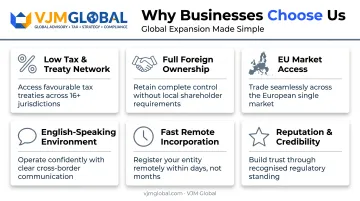
Low corporate tax and treaty network. Trading income is taxed at 12.5%, among the lowest rates in the EU. Ireland also has 78 signed double-tax treaties, 75 of which are currently in effect, including one with the UAE dating back to 2010.
Full foreign ownership. UAE nationals and entities can own 100% of an Irish LTD—no local ownership cap.
EU market access. An Irish company can trade across all 27 EU member states without a separate entity in each country.
English-speaking environment. Contracts, filings, and banking run in English, so you avoid translation costs and language-driven legal ambiguity common in France or Germany.
Fast, largely remote incorporation. Complete online filings through the CRO's CORE portal are typically processed within 5–10 working days.
Reputation and credibility. Ireland hosts major global tech and finance operations. That association helps when EU customers or investors want reassurance about who they are dealing with.
Cons and Challenges of Setting Up a Private Limited Company in Ireland for UAE Companies
The advantages are real, but so are the friction points UAE founders consistently run into.
The EEA-Resident Director Requirement
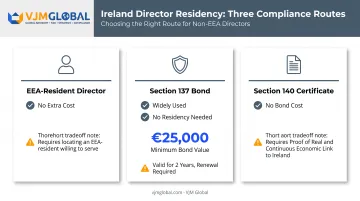
Irish law requires at least one EEA-resident director on every company board. If you can't appoint one, the alternative is a Section 137 bond worth €25,000, valid for a minimum of two years. Skip both, and you're looking at a category 4 offence.
There's a third route: a Section 140 certificate from the Registrar, proving your company has a genuine economic link to Ireland. It's a narrower path, but it avoids both the bond cost and dependency on a director you don't control.
Banking Friction
Non-resident, UAE-owned entities face enhanced due diligence when opening Irish business accounts.
Banks such as AIB typically ask for current identification, proof of permanent address no older than six months, and further documents from non-resident applicants. There's no official published timeframe, so founders should plan for this stage to take considerably longer than incorporation itself.
Other Practical Challenges
- Time zone gaps (typically 3 hours) slow real-time coordination with Irish directors, banks, and advisors
- Ongoing compliance covers annual returns, financial statements, corporation tax filings, and RBO updates — all with late-filing penalties
- No residency rights come with Irish company registration; living or working there is a separate immigration process
- Relationship-driven culture can delay onboarding with banks and advisors who favour in-person or long-term ties
None of these are dealbreakers. But they mean a UAE founder going it alone should budget extra time, not just extra euros.
Cost and Tax Considerations for UAE Companies
Incorporation Costs
| Item | Cost |
|---|---|
| Electronic Form A1 (CRO incorporation) | €50 |
| Optional name reservation (28 days) | €25 |
| Section 137 bond (if no EEA director) | €25,000 minimum, 2-year validity |
| Registered office & company secretary | Quoted per provider |
Statutory CRO fees are modest. The real cost driver is whether you need the Section 137 bond or can secure an EEA-resident director instead.
Tax Rates
Ireland applies 12.5% on trading income, but this is not a blanket rate. Non-trading income, including rental and investment income, is taxed at 25% instead. Classify revenue correctly at registration and on each return so the right rate applies from day one.
VAT
The standard VAT rate is 23%, with reduced rates of 13.5% and 9%. UAE-owned Irish companies must register for VAT once they cross the relevant activity thresholds, or immediately if trading intra-EU in certain goods and services.
Professional Support Costs
DIY filing through the CRO is cheap on paper. Real-world setup usually also needs:
- Banking setup
- Registered office arrangements
- Company secretarial duties
- Tax registration
Professional support costs more than bare statutory fees, but it removes most of the risk of a rejected filing or missed deadline.
Step-by-Step Overview: Setting Up an Irish Company from the UAE
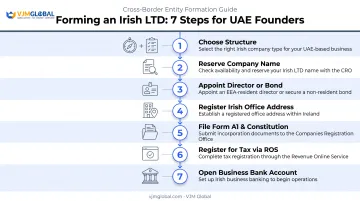
UAE founders usually form an Irish private limited company (LTD) in a fixed sequence. Filings run through the Companies Registration Office (CRO) and Irish Revenue.
- Choose your structure: LTD is the standard vehicle for most UAE trading and consulting businesses
- Reserve your company name on the CRO’s CORE portal (optional, 28-day hold)
- Appoint an EEA-resident director, or arrange the Section 137 non-resident director bond
- Register an Irish office address for service of documents (a UAE address is not accepted)
- File Form A1 and the company constitution with the CRO to complete incorporation
- Register for tax with Revenue through the Revenue Online Service (ROS)
- Open a business bank account, allowing extra time for enhanced due diligence on non-resident entities
Documents UAE entrepreneurs typically need:
- Valid passport
- Proof of address (usually dated within six months)
- UAE trade licence or board resolution authorising the incorporation
- Source-of-funds evidence for bank KYC checks
How VJM Global Supports UAE Companies Expanding into Ireland
VJM Global delivers entity formation, tax registration, and ongoing compliance support across 16+ markets, including Ireland. The firm draws on more than 30 years of cross-border advisory experience supporting UAE businesses that expand overseas.
For Ireland specifically, that means handling:
- CRO filing through Form A1 and constitution preparation
- Registered office and company secretary arrangements
- Navigating the EEA-director requirement or bond alternative
- Revenue tax registration through ROS, plus ongoing CT1 corporation tax and B1 annual return filings
- RBO beneficial-ownership filings
- Payroll administration through PAYE Modernisation, PRSI, and USC once the company is trading
UAE founders stay focused on the business; Ireland filings, tax registrations, and ongoing returns stay on schedule and off their desk.
Frequently Asked Questions
How much does it cost to start a limited company in Ireland?
Companies Registration Office (CRO) electronic Form A1 filing costs €50, plus an optional €25 name reservation. Budget rises if you need a €25,000 Section 137 bond or paid formation and secretarial support.
What is an LLC called in Ireland?
Ireland doesn't use the term "LLC." The closest equivalent is the Private Company Limited by Shares (LTD), which offers similar limited-liability protection under the Companies Act 2014.
How much tax does a limited company pay in Ireland?
Trading income is taxed at 12.5%, one of the lowest rates in the EU. Non-trading income, such as rental or investment income, is taxed at 25% instead.
Do UAE nationals need a local partner or director to set up a company in Ireland?
No local partner is required, and 100% foreign ownership is permitted. However, the company needs either an EEA-resident director or a €25,000 Section 137 bond.
Can a UAE company register in Ireland without visiting in person?
Yes. CRO incorporation is fully remote through the CORE portal. Banking is different: most Irish banks require in-person verification or detailed video-based KYC for non-resident applicants.