But setting up in Singapore from the UAE isn't simply a matter of filing a form online. There are structural decisions to make, a mandatory local director requirement that catches many founders off guard, and ongoing compliance obligations that don't pause because you're based overseas.
This guide covers what UAE founders actually need to know: which structure fits your goals, what Singapore law requires before you can incorporate, how the registration process works step by step, what it costs, and the mistakes worth avoiding.
Key Takeaways
- UAE residents can own 100% of a Singapore Pte. Ltd. but must appoint at least one Singapore-resident director before incorporation proceeds
- ACRA registration typically takes 1–3 business days for straightforward applications once documents are submitted
- Singapore's corporate tax rate is 17%, with start-up exemptions reducing effective rates significantly in the first three years
- The UAE-Singapore DTAA prevents double taxation on cross-border income, protecting founders who earn in both countries
- First-year setup costs (including nominee director, secretary, and registered address) typically range from SGD 3,000 to SGD 6,000+
Why UAE Entrepreneurs Are Expanding to Singapore
ASEAN's population reached 684.1 million in 2024, and Singapore sits at the region's financial and commercial centre — with 24 Free Trade Agreements and participation in RCEP, effective 1 January 2022. For UAE founders, that footprint translates into concrete business advantages.
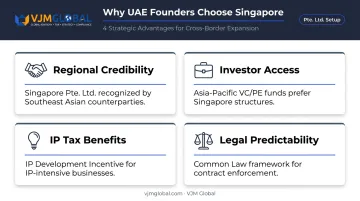
For UAE founders, the specific advantages are:
- A Singapore Pte. Ltd. carries more weight with Southeast Asian counterparties than a UAE free zone entity, giving you a recognized regional base from day one
- Institutional VC and PE funds in Asia-Pacific are far more comfortable underwriting Singapore structures than offshore holding vehicles
- IP-intensive businesses benefit from favorable tax treatment under Singapore's IP Development Incentive
- Singapore's Common Law framework makes contract enforcement more predictable across the region — familiar to international commercial parties
If any of these factors apply to your business, the next step is understanding exactly how the incorporation process works — and what UAE founders need to prepare before they start.
What to Know Before You Start
ACRA processes most straightforward applications within 1–3 business days after payment — but incorporation is just the starting point. Complex or referred applications can take up to 15 working days, and some regulatory referrals run 14 to 60 days. But the certificate of incorporation is just the starting point.
Realistically, plan for 6–10 weeks from initiation to full operational readiness, accounting for:
- Nominee director engagement and documentation
- Post-incorporation compliance setup (bookkeeping, GST assessment, statutory registers)
- Corporate bank account opening, which adds significant time at traditional banks
Ongoing Compliance Is Non-Negotiable
A Singapore Pte. Ltd. carries structured annual obligations whether or not the owner ever sets foot in Singapore:
- Annual return filing with ACRA within 7 months of financial year end
- Corporate tax submissions to IRAS (ECI within 3 months of FYE; Form C-S/C by 30 November)
- Maintenance of statutory registers
- AGM requirements (unless exempt under the Companies Act)
UAE-based founders who manage this informally often miss deadlines. Penalties start at SGD 300 for late annual returns, escalating to SGD 600 after 3 months, with potential director disqualification for repeated offences. Remediation costs consistently exceed what proper compliance setup would have cost from day one.
A qualified company secretary and accounting partner are not optional extras for a foreign-owned entity. Budget for them from the outset.
Choosing the Right Business Structure in Singapore
| Structure | Best For | Key Limitation |
|---|---|---|
| Private Limited (Pte. Ltd.) | Most UAE founders | Requires Singapore-resident director |
| Branch Office | Established UAE companies needing legal continuity | Full liability flows to UAE parent |
| Representative Office | Market research only | Cannot generate revenue or sign contracts |
Private Limited Company (Pte. Ltd.)
This is the default and most appropriate structure for UAE entrepreneurs. It offers 100% foreign ownership, limited liability, perpetual succession, and is the vehicle banks and investors in the region recognize and expect. Sole proprietorships, by contrast, offer no liability protection and are rarely appropriate for foreign-owned businesses.
Branch Office
A branch remains legally tied to the UAE parent — meaning the parent bears full liability for branch actions. A branch suits an established UAE company that needs legal continuity across both jurisdictions. Banks and commercial counterparties often treat branch offices differently from standalone incorporated entities, which can complicate day-to-day operations.
Dual-Structure Strategy
Many UAE businesses maintain their UAE entity for MENA operations while incorporating a Singapore Pte. Ltd. for Asia-Pacific activities. This dual approach offers three practical advantages:
- Uses the UAE-Singapore Double Tax Avoidance Agreement (DTAA) to reduce cross-border tax exposure
- Segregates regional operational risk between two distinct legal entities
- Serves separate investor or banking relationships in each market
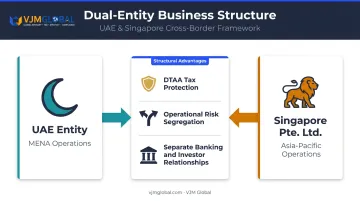
Running parallel entities across two jurisdictions, each with its own tax, compliance, and governance requirements, requires specialist cross-border advisory to ensure both are correctly positioned from the start.
Regulated Activities
Certain Singapore business activities require additional licensing beyond standard ACRA registration — including financial services (MAS), healthcare (MOH), and education (MOE). Check whether your intended activity triggers any of these requirements before finalizing your structure choice.
Key Requirements UAE Founders Must Meet Before Incorporating
Local Resident Director
Every Singapore company must have at least one director ordinarily resident in Singapore — a citizen, permanent resident, or valid EntrePass/Employment Pass holder. UAE residents without Singapore presence must engage a licensed nominee director service before any ACRA submission.
Published fee ranges:
- SGD 2,000–4,000+ per year (Sleek), plus security deposits of SGD 2,000–10,000
- SGD 2,000/year plus SGD 2,000 refundable deposit (3E Accounting)
Non-compliance carries serious consequences: a fine up to SGD 2,000 plus SGD 1,000 per day for continuing default if a Registrar direction is ignored.
Choose a provider whose contract clearly defines the nominee's scope of authority and includes explicit liability protections for both parties. The same due diligence applies to your registered office and company secretary requirements below.
Registered Office Address and Company Secretary
- A physical Singapore registered office address is mandatory from day one, accessible to the public for at least 3 hours during normal business hours each day
- A qualified company secretary (Singapore resident) must be appointed within 6 months of incorporation — failure carries a fine up to SGD 1,000
- Most corporate service providers bundle secretary and address into annual packages
Paid-Up Capital
The legal minimum is SGD 1. This makes initial capitalization a low barrier. That said, plan your actual operating capital separately — account for:
- The current AED-to-SGD conversion rate
- The time required to open a Singapore bank account before funds can be received
- Any nominee director deposits already paid upfront
Step-by-Step: How to Set Up a Business in Singapore from the UAE
Most UAE founders can complete incorporation entirely remotely. Banking may require additional steps depending on the institution.
Step 1 – Define Your Business Activity and Choose Your Structure
Confirm your primary activity and whether it triggers regulatory pre-approvals. Decide on shareholding structure: list of shareholders, nationalities, percentage holdings, and number of shares before proceeding.
Step 2 – Reserve Your Company Name
Submit your proposed name through ACRA's BizFile+ portal. The name must be unique and not misleading. Approved names are reserved for 120 days. Have two or three alternatives ready, particularly if you plan to use your UAE brand name in Singapore.
Government fee: SGD 15
Step 3 – Appoint a Resident Director and Company Secretary
Engage your nominee director service before filing anything. The nominee must sign a consent form and provide identification documents. Appoint the company secretary at the same time. Many providers bundle nominee director, secretary, and registered address into a single annual package — compare on service scope and contract terms, not just the annual fee.
Step 4 – Prepare Documents and Submit to ACRA
Documents required from UAE applicants:
- Valid passport copy
- UAE residential address proof
- Completed ACRA application forms
- For companies expanding from a UAE parent: Certificate of Incorporation, board resolution authorizing the Singapore entity, and parent company shareholder details
Submit through BizFile+. ACRA typically issues the Certificate of Incorporation and Unique Entity Number (UEN) within 1–3 business days for straightforward applications. Government fee: SGD 300.
Engaging an experienced cross-border advisory firm to review submissions before filing can reduce errors and prevent delays caused by inconsistent documentation.
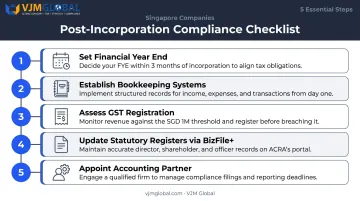
Step 5 – Complete Post-Incorporation Compliance
After receiving your certificate:
- Set your financial year end (FYE) — all statutory filing deadlines flow from this date
- Establish bookkeeping and accounting systems before any transactions begin
- Assess GST registration — mandatory once annual taxable turnover exceeds SGD 1 million
- Update all statutory registers via BizFile+ as required
- Appoint an accounting partner familiar with compliance obligations for foreign-owned Singapore entities
Step 6 – Open a Corporate Bank Account
This step takes longer than most UAE founders expect:
- Traditional banks (DBS, OCBC, HSBC Singapore): require extensive KYC documentation. Traditional banks (DBS, OCBC, HSBC Singapore): expect requests for certified ID and address proof for all directors, signatories, and ultimate beneficial owners, plus your constitution, board resolution, ACRA business profile, and FATCA/CRS tax forms. DBS requires Relationship Manager assistance for foreign-owned companies.
- Digital banking options: MAS-licensed Major Payment Institutions including Airwallex Singapore and Revolut Technologies Singapore offer faster onboarding for incorporated entities. Aspire also serves Singapore-incorporated companies, though founders should verify MAS licensing status directly.
Start banking applications immediately after receiving your Certificate of Incorporation. Do not treat this as a post-launch task.
Costs and Timelines: What UAE Entrepreneurs Should Budget For
Singapore's government fees are among the lowest of any major business hub — but the true cost of setup goes well beyond the ACRA registration charge. Here's a realistic breakdown for UAE entrepreneurs planning their first year.
Government Fees (Fixed)
| Item | Fee |
|---|---|
| Name application | SGD 15 |
| Company registration | SGD 300 |
| Annual return filing | SGD 60 |
Professional Service Fees (First Year)
Government fees only tell part of the story. Because UAE residents cannot be physically present for all filings, most will require a nominee director and registered address service — which together form the bulk of first-year costs.
| Service | Typical Range |
|---|---|
| Nominee director | SGD 2,000–4,000/year |
| Company secretary | SGD 300–800/year |
| Registered address | SGD 200–400/year |
| Incorporation service | SGD 600–1,650 (one-time) |
| Total first-year (fully supported) | SGD 3,000–6,000+ |
Ongoing Annual Costs (Often Underestimated)
Professional service fees recur every year. Add compliance and banking costs to get a realistic picture of your annual overhead:
- Accounting and bookkeeping: SGD 2,000–8,000/year depending on transaction volume
- Audit fees (if required): SGD 1,500–3,000+ depending on company size and revenue thresholds
- Banking maintenance: SGD 0–500/year depending on bank and account tier
- ACRA annual return: SGD 60
Run a two-year total cost of ownership before benchmarking Singapore against other jurisdictions on government fees alone — the registration cost is low, but the ongoing compliance structure is where the real budget sits.
Common Mistakes UAE Entrepreneurs Make When Setting Up in Singapore
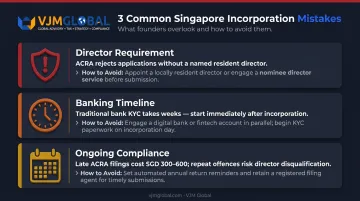
Most of these pitfalls are avoidable — but they consistently catch UAE founders off guard. Here are the three that cause the most disruption:
Leaving the director requirement unresolved before filing. ACRA will not process any application without a valid resident director already named. Filing first and sorting the director afterward is not an option — ACRA will reject the application outright.
Treating banking as a post-launch task. UAE founders accustomed to streamlined corporate banking often expect similar timelines in Singapore. Traditional banks require extensive KYC for foreign-owned companies, and the process takes weeks. Launching commercially before the account is open creates real cash flow risk.
Neglecting ongoing compliance from a distance. Singapore's annual filing and tax submission requirements are structured and enforced. Missing ACRA deadlines costs SGD 300–600 in late penalties per filing. Repeat offences can trigger director disqualification. Changes to officers or shareholders must be filed within 14 days of the change occurring.
Frequently Asked Questions
How to set up an LLC in Singapore?
Singapore's closest equivalent to an LLC is the Private Limited Company (Pte. Ltd.), registered through ACRA's BizFile+ portal. The process involves name reservation, appointment of a Singapore-resident director and company secretary, and document submission — with ACRA typically approving straightforward applications within 1–3 business days.
Can a UAE resident own 100% of a Singapore company?
Yes. Full foreign ownership is permitted under Singapore law. The company must have at least one director who is ordinarily resident in Singapore. UAE residents without Singapore residency must engage a licensed nominee director service before incorporation.
Do I need to travel to Singapore to set up a company from the UAE?
Incorporation can be completed remotely through ACRA's online BizFile+ system. Corporate bank account opening at traditional banks may require in-person verification, while MAS-licensed digital banking platforms generally allow fully remote onboarding for incorporated Singapore entities.
How long does it take to set up a business in Singapore from the UAE?
ACRA incorporation takes 1–3 business days once documents are ready. Banking adds significant time at traditional banks. Total operational readiness — including compliance setup and banking — typically takes 6–10 weeks from initiation.
What is the UAE-Singapore Double Taxation Agreement (DTAA)?
The UAE-Singapore DTAA (in force since 1996, updated 2016) prevents income from being taxed in both countries simultaneously. Dividends and interest are taxable only in the recipient's state of residence, while royalties are capped at 5%. This is directly relevant to UAE founders receiving income from their Singapore entity.
What are the ongoing compliance requirements for a Singapore Private Limited Company?
Key annual obligations include:
- Filing annual returns with ACRA within seven months of the financial year end
- Submitting corporate tax returns to IRAS (ECI within 3 months of FYE; Form C-S/C by 30 November)
- Maintaining statutory registers
- Holding an AGM unless exempt under the Companies Act