But here's the problem: nobody warns you about the layers.
You've got City of Miami rules stacked on top of Miami-Dade County requirements, sitting on top of Florida state law. Miss one step and your grand opening gets delayed by months, not days. This guide walks through the exact registrations, licenses, and costs you'll face, plus what happens after you launch.
Key Takeaways
- Florida charges no personal income tax, but corporate and sales taxes still apply
- All business structures except sole proprietorships under your name must register with Sunbiz
- Get a Certificate of Use and Business Tax Receipt before opening any Miami location
- Filing costs range from $50 for a basic DBA to $1,000+ for regulated industries
- Skipping bookkeeping and compliance after launch invites costly penalties
Why Miami Is a Smart Choice for Entrepreneurs
The Tax Math Works in Your Favor
Florida's biggest selling point is simple: no state personal income tax. On top of that, the corporate income tax rate sits at just 5.5%, and the first $50,000 of net income is exempt entirely. Combined state and Miami-Dade sales tax lands around 7% on ordinary taxable sales.
There's another change adding to these savings. Starting October 1, 2025, Florida eliminated the state sales tax and county surtax on commercial rent. If you're leasing office or retail space, that's real savings baked into your monthly overhead going forward.
A Genuine Gateway to Latin America
Beyond tax savings, Miami's location delivers a real edge: unmatched access to Latin American trade. PortMiami handled $90.4 billion in trade value in fiscal 2025, with nearly half of that trade flowing to and from Latin America and the Caribbean. Miami International Airport tells a similar story, moving 82% of all US air imports connected to Latin America.
If your business touches import, export, logistics, or cross-border trade, this location advantage is hard to replicate anywhere else in the country.
A Workforce Built for Global Business
Miami-Dade's workforce is genuinely multilingual, which matters enormously if you're targeting Latin American or Caribbean customers. You won't need to hire a translator to close deals in Bogotá or São Paulo.
The startup scene backs this up too. Miami's ecosystem carries an estimated $95 billion valuation, according to the 2024 Global Startup Ecosystem Report from Beacon Council, with over 2,500 startups and six unicorns calling the city home.

Several organizations offer free guidance before you spend a dime:
- Miami-Dade Beacon Council: site selection, incentives, and permitting guidance
- Florida SBDC Network: free consulting on planning, financing, and marketing
- SCORE Miami-Dade: mentorship from experienced business owners, including a veterans-focused program
Step-by-Step: How to Register Your Business in Miami
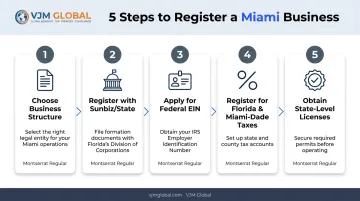
Step 1: Choose Your Business Structure
Your structure determines your liability, your taxes, and your paperwork burden.
- Sole proprietorship: simplest option, but no liability protection; personal assets are exposed
- General partnership: similar exposure, split between partners
- LLC: shields personal assets, flexible tax treatment, most popular choice for small businesses
- Corporation: stronger liability protection, better for raising outside capital, more compliance overhead
Only sole proprietors operating under their exact legal name skip state registration entirely. Everyone else, including anyone using a different business name, needs a Sunbiz filing or a fictitious name registration (DBA).
Step 2: Register With the State (Sunbiz)
LLCs file Articles of Organization; corporations file Articles of Incorporation. Both go through the Florida Division of Corporations, and both require a registered agent with a physical Florida address (no PO boxes allowed).
Current mandatory state filing fees look like this:
| Entity Type | State Fee |
|---|---|
| LLC | $125 |
| Profit Corporation | $70 |
| Fictitious Name (DBA) | $50 |
| LP or LLLP | $1,000 |
Step 3: Apply for a Federal EIN
Think of an EIN as your business's Social Security number. You'll need it to open a bank account and file taxes; hiring employees requires it too. The IRS issues it free of charge, and most US-based applicants can get one instantly online.
Step 4: Register for Florida and Miami-Dade Taxes
File the Florida Business Tax Application (online wizard or paper Form DR-1) to register for sales tax and use tax; add reemployment tax registration if you're hiring. Corporate income tax only kicks in above the $50,000 exemption threshold, which shields many small operations entirely.
Step 5: Obtain Required State-Level Licenses
Florida doesn't issue a general statewide business license. However, certain professions need sign-off from the Department of Business & Professional Regulation, including:
- Construction and electrical contracting
- Real estate and appraisal
- Restaurants, hotels, and alcohol sales
- Cosmetology and barbering
- Accountancy and veterinary medicine
Check your industry against the DBPR list before you assume you're clear to open.
Licenses, Permits & Certificate of Use You'll Need in Miami
Here's where most new owners get tripped up: local approvals. Before you sign a lease, verify zoning compatibility for that exact address. Signing first and checking zoning later is one of the most expensive mistakes founders make in Miami.
Certificate of Use (CU)
The CU confirms your business use matches the zoning for that address. The application costs a non-refundable $50, and the process typically includes:
- Confirm zoning eligibility for the address
- Submit the application and pay the fee
- Complete Code Compliance and Fire inspections
- Receive final zoning approval
All inspections must wrap up within 90 working days, or you'll need to restart the application. One common holdup: businesses that haven't yet contracted with an approved commercial waste hauler before their inspection date.
Business Tax Receipt (BTR): City and County
Once your CU clears, you'll apply for the City of Miami's BTR. You'll need your EIN (or SSN for sole proprietors), a government photo ID, and any applicable state professional license.
The City BTR is separate from the Miami-Dade County Local Business Tax Receipt, which is required for every business location and classification, processed through the county's BTExpress system. Missing this step is a frequent oversight for first-time owners who assume the city receipt covers everything.
Other permits worth checking: If you own business equipment, file a Tangible Personal Property Tax return by April 1 (the first $25,000 is exempt). Short-term rental and hospitality businesses also owe Tourist Development and Convention Taxes, an additional 6% on top of standard sales tax.
How Much Does It Cost to Start a Business in Miami?
State filing fees set your floor, but they're rarely your ceiling.
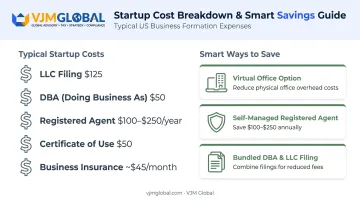
| Cost Category | Typical Range |
|---|---|
| State LLC filing | $125 |
| State DBA filing | $50 |
| LLC + DBA combined | $175 |
| Registered agent service (annual) | $100 - $250 |
| Certificate of Use (CU) application | $50 (plus inspection fees, if applicable) |
| Business insurance (general liability) | ~$45/month average |
Insurance premiums vary widely based on your industry, payroll, and coverage limits, so treat that figure as a starting benchmark rather than a quote.
Where to save money early on:
- Skip the long-term lease. Virtual offices start around $3/day, with coworking day passes from $39, letting you test locations before committing.
- Handle your own registered agent duties if you meet the statutory address requirements, rather than paying an annual service fee.
- Bundle your DBA filing with your LLC registration instead of filing them separately at different times.
Setting Up Accounting & Compliance for Long-Term Success
Registration is the easy part. Staying compliant afterward is where most new owners lose momentum.
Florida's compliance calendar fills up fast once you factor in ongoing filings:
- File an annual report every year between January 1 and May 1 — missing the deadline triggers a $400 late fee, regardless of entity type
- Remit sales tax on an ongoing basis once you start selling taxable goods or services
- Submit quarterly payroll tax filings once you bring on employees
Foreign founders and NRIs launching a US business from abroad face an even bigger challenge here. Understanding US bookkeeping standards, tax deadlines, and cross-border reporting on top of running daily operations is a lot to juggle alone, and mistakes here tend to be expensive.
This is where VJM Global fits in. The firm's team of CPAs, Chartered Accountants, and finance postgraduates specializes in cross-border accounting and international tax compliance, helping foreign founders and NRIs keep books audit-ready without hiring a full in-house finance department. Clients typically see cost savings of up to 50% compared to building that capability internally, backed by a 95% client retention rate.
Bringing in outside expertise early, before deadlines pile up, tends to be far cheaper than fixing penalties after the fact.
Frequently Asked Questions
Is Miami a good place to start a company?
Yes, largely thanks to Florida's tax structure, Miami's trade connections to Latin America, and a fast-growing local economy. That said, expect real competition and a higher cost of living than many other US cities.
How much money do you need to start a business in Florida?
Basic LLC or DBA filings can run under $200 total. Regulated industries like construction, food service, or healthcare will cost far more once licensing and insurance are factored in.
What is the first step to starting a business in Miami?
Choose your business structure first, then verify zoning compatibility for your target address before signing any lease. Skipping the zoning check is the most common costly mistake new owners make.
Do I need a Certificate of Use to open a business in Miami?
Yes, if you're operating from a physical storefront, office, or commercial location. The CU confirms your business use matches zoning rules and requires passing Code Compliance and Fire inspections beforehand.
How long does it take to register and open a business in Miami?
State registration through Sunbiz can process in days. The Certificate of Use and Business Tax Receipt process, including inspections, often takes several weeks to a few months.
Do I need to speak Spanish to start a business in Miami?
Spanish fluency isn't required, but it offers a genuine edge in local business dealings. With most Miami-Dade residents speaking a language other than English at home, bilingual capability opens doors with customers and vendors alike.