Interest in setting up shop here is climbing again, fueled by renewed VC activity, the prestige of a US business address, and San Francisco's role as a gateway into the broader American market. This isn't just a tech-startup story anymore. Local service founders, remote entrepreneurs, and foreign companies expanding into the US are all part of the wave.
This guide walks through the practical steps: registration, licensing, realistic costs, and the compliance layers you'll need to manage after launch.
TL;DR
- Expect state registration, a city Business Registration Certificate, permits, and ongoing tax filings
- Plan for three compliance layers: federal, California state, and San Francisco city/county
- Allow several weeks for registration and permitting, plus costs such as the $800 California franchise tax
- Foreign founders should lock entity type and incorporation state before filing
What Is Involved in Starting a San Francisco Business?
Starting a business in San Francisco means legally registering an entity to operate within the city and county jurisdiction. That covers legal structuring, state and city registration, licensing, and tax setup. It does not include marketing, product development, or hiring strategy.
Common formats vary by goal:
- Sole proprietorship or LLC: typical for local service businesses (consultants, contractors, small retail)
- S-Corporation: common when owners want limited liability with pass-through taxation
- C-Corporation: standard for venture-backed startups or foreign-owned companies planning to raise US capital
What to Know Before You Start a Business in San Francisco
Many founders underestimate how much city-specific compliance stacks on top of standard state requirements. Set realistic expectations on timing and permits before you sign a lease or start invoicing.
Key things to plan around:
- Register with both the California Secretary of State and San Francisco's Treasurer & Tax Collector before you legally operate
- Budget extra time for San Francisco's heavier permitting load, especially in retail, food, and entertainment
- Build permit approval, zoning, and lease delays into your revenue timeline before you plan to open
- Secure separate industry licenses when you operate in food service, retail, or professional services
- Match entity structure to your goals: a simple LLC for local services differs sharply from an investor-ready C-Corp
Why Start a Business in San Francisco? (When It Makes Sense)
San Francisco works when your business fits a specific set of conditions—not as a default choice for every founder.
The economic case:
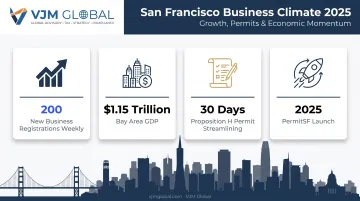
- San Francisco's Office of Small Business reported nearly 200 new business registrations per week based on a rolling 12-month average as of January 2024
- The wider Bay Area economy generated $1.15 trillion in regional GDP in 2023 (Bay Area Council), roughly the size of the world's 17th-largest economy
- Healthcare and education led Bay Area job gains in the 12 months ending May 2024, while tech and professional services lost jobs
The support infrastructure:
- Proposition H, approved by voters in 2020, streamlined small-business permit review down to a 30-day process for many permit types
- The city's newer PermitSF initiative, launched in February 2025, aims to make permitting faster and more transparent
- SBDCs, the SF Office of Small Business (SFOSB), accelerators, and city grant programs provide direct support for new founders
None of this erases San Francisco's cost problem. But if your business depends on proximity to capital, talent, or a specific industry cluster, these factors matter more than rent.
Early Decisions That Matter When Starting a Business in San Francisco
Underestimating California's tax structure and San Francisco's layered registration requirements creates most of the early friction for new founders.
Costs people forget to budget for:
- The $800 California annual LLC tax, due even if the business is inactive (first payment by the 15th day of the fourth month after filing)
- The same $800 minimum franchise tax for corporations, though newly incorporated companies skip it in their first taxable year
- San Francisco Business Registration Certificate fees (2026-27): $55 for receipts up to $100,000, then $95 and $160 at higher tiers, plus a $4 state fee
Structural decisions to make early:
- LLC vs. C-Corp vs. S-Corp: hinges on liability protection, tax treatment, and whether you'll need outside investment
- Zoning verification: check before signing any lease; San Francisco's Planning Code restricts many use types by district
- Fictitious Business Name (FBN) filing: required if you operate under a name different from your registered legal entity
- Delaware vs. direct California incorporation: common for foreign founders who want Delaware's investor-familiar framework, but California still requires foreign-entity registration if you do business there
How to Start a Business in San Francisco – Step by Step
Two mistakes come up constantly when founders register in San Francisco: skipping the zoning check before committing to a location, and missing the city's 30-day registration deadline after you start operating. Work through the stages below in order so those errors do not stall the rest of your launch.
Step 1 – Choose Your Legal Structure and Register with California
Your structure choice shapes everything downstream: taxes, liability, and whether investors will even consider funding you.
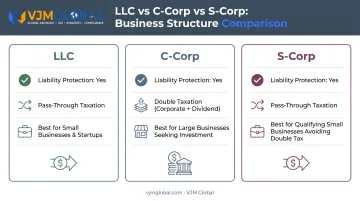
| Structure | Liability Protection | Tax Treatment | Best For |
|---|---|---|---|
| LLC | Yes | Pass-through | Local service businesses |
| C-Corp | Yes | Double taxation, but VC-friendly | Venture-backed startups |
| S-Corp | Yes | Pass-through, restrictions apply | Small businesses avoiding double tax |
To register:
- File Articles of Organization (LLC) or Incorporation (Corporation) through the CA Secretary of State's BizFile Online system ($70 for an LLC, $100 for a general stock corporation)
- Obtain a Federal EIN from the IRS, which is free and can typically be done online if your principal place of business is in the US
Do not pick a structure only for speed. An LLC is quick to form, but investors funding a startup almost always expect a Delaware or California C-Corp.
Step 2 – Register with the City of San Francisco (BRC)
Once your entity exists at the state level, you need a Business Registration Certificate from the SF Treasurer & Tax Collector.
- Apply within 30 days of starting operations in the city
- The fee scales with your projected gross receipts
- You'll receive a Business Account Number (BAN), which unlocks every other city permit
- Renewal is annual. Starting in 2026, the deadline shifts to the last day of February, replacing the old May 31 cutoff
Delaying this step blocks access to nearly everything else, including industry permits.
Step 3 – Confirm Zoning and Secure a Business Location
Before signing anything, check the SF Planning Property Information Map. Search your address or Assessor's Block/Lot, then open "Zoning Information" to see what's allowed in that district.
- Some uses are straightforward, others require conditional approval, and some aren't allowed at all in a given zone
- A virtual office or home-based setup can cut early overhead significantly in a market where commercial rent runs high
- Signing a lease before checking zoning is one of the most expensive mistakes a new founder can make here
Step 4 – Obtain Industry-Specific Licenses and Permits
The BRC alone doesn't make you legally operational. Depending on your industry, you'll need additional approvals:
- Food businesses: Health permit from SF's Environmental Health Branch
- Entertainment venues: Place of Entertainment permit from the Entertainment Commission
- Retail selling taxable goods: Seller's Permit from CDTFA (free to register, though a security deposit may apply)
Use the CalGold tool to identify which agencies you need to contact — it points you to the right permits but doesn't issue them directly. Build inspection timelines into your launch plan; physical review can add weeks.
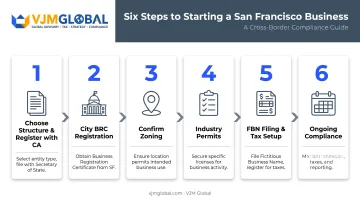
Step 5 – File Fictitious Business Name (if applicable) and Set Up Tax Compliance
If you're trading under a name that isn't your registered legal entity name, file an FBN with the SF County Clerk.
- Search the SF FBN index to confirm the name is available
- Register with the Tax Collector, then file the FBN Statement with the County Clerk
- Publish the statement in a court-approved San Francisco newspaper
- File Proof of Publication with the Clerk within 45 days after the fourth publication
Separately, register for San Francisco's Gross Receipts Tax (rates for 2025-2026 range from 0.100% to 3.360% depending on business activity and receipts band) and set up California payroll tax accounts through EDD if you're hiring.
Step 6 – Plan for Ongoing Compliance and Cross-Border Considerations
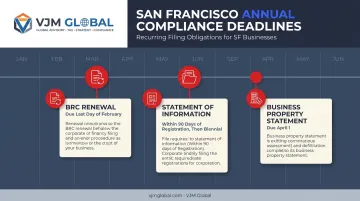
Registration isn't a one-time event. Track these recurring deadlines:
- BRC renewal — annual, shifting to last day of February from 2026
- Statement of Information — due within 90 days of initial LLC registration, then every two years
- Business Property Statement — due April 1 for qualifying businesses
For foreign companies entering the US market, the stack gets harder: entity formation, EIN applications, registered agent requirements, payroll setup, and franchise tax obligations, under rules that rarely map cleanly onto a home-country system.
VJM Global supports companies expanding into the US without a local team. That work covers LLC, C-Corp, S-Corp, and branch formation in states including California and Delaware, plus EIN issuance, registered agent appointment, and ongoing federal and state filings. For California, it also includes tax nexus assessment and franchise tax registration.
The common mistake is treating US entity setup as a task you finish once and forget. It is an ongoing obligation that resets every year.
Conclusion
Starting a business in San Francisco comes down to clearing state, city, and industry-specific compliance layers correctly and on time. Launch speed matters less than getting the foundations right:
- Confirm zoning before you sign a lease
- Choose the entity structure that fits your ownership and tax goals
- File your BRC registration on schedule
Long-term success depends less on the initial paperwork and more on annual renewals. As reforms like PermitSF reshape local rules, keep a compliance calendar current so filings and license updates do not slip.
Frequently Asked Questions
How much does a business license cost in San Francisco?
The Business Registration Certificate fee scales with estimated gross receipts, starting around $55-$160 for lower-revenue businesses in the 2026-27 schedule, plus a separate $4 state fee. Higher-revenue businesses pay more, and industry-specific permits add extra costs.
Is San Francisco good for startups?
San Francisco offers strong access to venture capital, talent, and a dense small business ecosystem. High costs and multiple compliance layers mean it works best for businesses that genuinely need those advantages.
What is the deadline to register a business in San Francisco?
Businesses must register with the city within 30 days of starting operations. Starting in 2026, annual renewal shifts to the last day of February, replacing the previous May 31 deadline.
Do I need a permit to run a home-based business in San Francisco?
There's no separate Home Occupancy Permit, but rules restrict client visits, prohibit home signage, and cap commercial use at roughly one-third of the unit's floor area.
Can a foreign company register a business directly in San Francisco?
Yes, foreign entities can register to do business in California and San Francisco directly. Multi-jurisdiction filings (state, city, and federal) are easy to get wrong alone, so many companies use professional entity formation help.
What taxes does a San Francisco business need to pay?
Depending on structure and revenue, businesses face the California franchise tax, SF gross receipts tax, business property tax, and payroll taxes if they have employees.