California isn't like most states. It charges higher formation-adjacent fees, layers on a mandatory $800 annual franchise tax, and expects a Statement of Information within 90 days of registering. Miss a step, and you're looking at penalties or a suspended entity.
This guide breaks the process into eight clear steps, with current fees and the structure decisions that affect your taxes for years to come.
Key Takeaways
- California registration requires filing Articles of Organization or Incorporation, plus an $800 minimum annual franchise tax
- LLCs and corporations both owe the $800 tax, so let liability and tax treatment drive your entity choice instead
- Initial state filing fees run $90 to $125, but budget closer to $890+ once the franchise tax kicks in during year one
- Professional guidance helps avoid missed deadlines, especially for founders managing this from outside the US
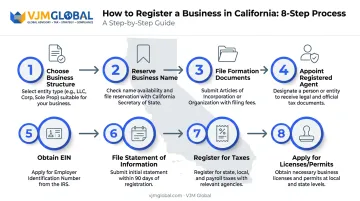
Step-by-Step Process to Register a Business in California
Registering a business here follows a specific sequence: state filing, federal registration, then local licensing. Skip a step or do them out of order, and you risk rejected filings or compliance gaps later.
Step 1: Choose Your Business Structure
Your entity type determines liability exposure, tax treatment, and how much paperwork you'll file every year. California recognizes:
- Sole Proprietorship - no SOS filing required, but zero liability protection
- LLC - pass-through taxation by default, personal asset protection
- Corporation (C-Corp or S-Corp) - stronger for raising capital, but more compliance
- LP, GP, LLP - suited to specific partnership arrangements, each with its own SOS filing
This decision affects every subsequent step. Talk to a tax advisor or accountant before filing anything. Reversing course after formation means additional filings and fees.
Step 2: Choose and Reserve a Business Name
Check name availability through the California Secretary of State's BizFile Online portal before you file anything. Your name needs to be "distinguishable" from existing entities on record.
- LLCs must include "Limited Liability Company," "LLC," or "L.L.C."
- Reserving a name costs $10 and holds it for 60 days
- Reserving a name isn't the same as registering the business
Operating under a different name? You'll need a Fictitious Business Name (DBA) filing at the county level. Costs vary widely: $23 in Orange County, $26 in Los Angeles County, and $69 in San Francisco.
Step 3: File Formation Documents with the Secretary of State
LLCs file Articles of Organization. Corporations file Articles of Incorporation. Both go through BizFile Online or by mail.
| Entity Type | Formation Document | Filing Fee |
|---|---|---|
| LLC | Articles of Organization | $70 |
| Stock Corporation | Articles of Incorporation | $100 |
These fees are current per the California Secretary of State's Business Entities Fee Schedule. Mail filings and drop-off submissions carry additional handling charges if you need faster turnaround.
Step 4: Appoint a Registered Agent
California law requires every LLC, corporation, LP, and LLP to designate an agent for service of process — someone who receives legal and tax documents on the entity's behalf.
- An individual agent must reside in California
- A corporate agent must be registered with the SOS
- Your business cannot act as its own agent
Founders based outside California, or outside the US entirely, typically use a registered agent service. It keeps a physical address on public record without exposing a founder's home address, and it guarantees someone's available during business hours to accept documents.
Step 5: Obtain an EIN from the IRS
Your Employer Identification Number is free and required for tax filing, hiring staff, and opening a business bank account. Apply directly through the IRS EIN application.
One catch for international founders: the online tool requires a US-based principal business location and a responsible party with a valid SSN or ITIN. If your business location or responsible party is based abroad, you'll apply by phone, fax, or mail instead — not everyone qualifies for instant online issuance.
Step 6: File Your Initial Statement of Information
Within 90 days of formation, file your initial Statement of Information with the SOS. This includes your business address, and details on managers/members (LLCs) or officers and directors (corporations).
- LLCs: $20 filing fee, then every 2 years afterward
- Corporations: $25 filing fee, then annually afterward
Miss this deadline and the SOS can assess a $250 penalty, per FTB's penalties and fees guidance.
Step 7: Register for State and Local Taxes
Depending on your business activity, you'll likely need to register with:
- Franchise Tax Board (FTB) - handles entity-level income and franchise tax
- California Department of Tax and Fee Administration (CDTFA) - required if you sell taxable goods
- Employment Development Department (EDD) - required within 15 days of paying more than $100 in wages in a calendar quarter, if you're hiring
Step 8: Apply for Necessary Licenses and Permits
Requirements vary heavily by city, county, and industry — there's no single statewide business license. Use the CalGOLD tool to identify exactly which permits your business needs based on location and industry type.
How Much Does It Cost to Register a Business in California?
The sticker price for California formation looks deceptively small until the franchise tax enters the picture.
Initial state filing costs:
| Item | LLC | Corporation |
|---|---|---|
| Formation filing | $70 | $100 |
| Initial Statement of Information | $20 | $25 |
| Total mandatory SOS filings | $90 | $125 |
Add an optional name reservation ($10) or a county DBA filing ($23-$69, depending on county) if applicable.
The $800 franchise tax is where costs jump. Every LLC and corporation registered in California owes a minimum $800 annual franchise tax to the FTB. Here's the nuance most guides get wrong:
- LLCs owe the $800 in their very first year. The AB 85 exemption that once waived first-year tax only covered tax years 2021 through 2023. It's expired.
- Corporations get a genuine first-year break. New C-corps and S-corps skip the $800 minimum in their first taxable year — but income tax still applies (8.84% for C-corps, 1.5% for S-corps).
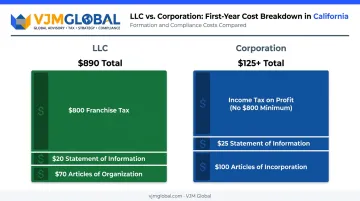
So a new LLC's realistic first-year state-only cost looks like:
$70 (Articles) + $20 (Statement) + $800 (franchise tax) = $890
A new corporation's first-year state-only cost is closer to $125 plus income tax on actual profit, with no $800 minimum yet.
Budget for these additional costs too:
- Registered agent service fees (typically $100-$300/year if outsourced)
- Business licenses and permits (varies by city/industry)
- Professional consultation for entity selection and tax planning
LLC vs. Corporation: Which Structure Should You Choose in California?
This is the decision most founders get stuck on, and rightly so, since it shapes your liability, taxes, and paperwork for as long as the business exists.
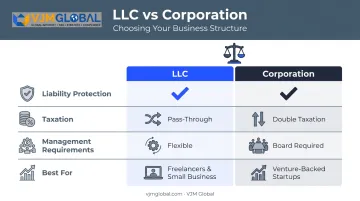
Liability protection: Both LLCs and corporations shield personal assets from business debts and lawsuits, assuming you maintain proper separation between business and personal finances.
Taxation:
- LLCs default to pass-through taxation: profits flow to your personal return, taxed once
- C-corporations face double taxation, meaning the entity pays 8.84% on profit, then shareholders pay tax again on dividends
- Both entity types can elect S-Corp status (via IRS Form 2553) for pass-through treatment with potential self-employment tax savings
Management and paperwork:
- LLCs offer flexible management structures and fewer formal requirements (no mandatory board meetings or minutes)
- Corporations require a board of directors, officer roles, and more rigid recordkeeping
One thing that shouldn't drive your decision: the $800 franchise tax. Both structures pay it once past their first year (corporations) or immediately (LLCs), so it's a wash either way.
Here's a general rule of thumb:
- Choose an LLC if you're a freelancer, consultant, or small operation prioritizing simplicity
- Choose a Corporation if you're planning to raise venture capital, issue stock, or bring on institutional investors
These rules cover the basics, but one nuance deserves a closer look before you file: the S-Corp election. It can reduce self-employment tax exposure for profitable LLCs, though California still taxes S-corps at 1.5% on California-source income. Get a CPA's input here, since the tax implications compound every year you operate under the wrong structure.
Staying Compliant After Registration
Formation is the easy part. Staying in good standing with the state is the ongoing responsibility that trips people up.
Recurring obligations:
- Statement of Information: biennial for LLCs, annual for corporations
- $800 minimum franchise tax, due annually regardless of profit or loss
- Payroll tax filings with EDD if you have employees
- Sales tax filings with CDTFA if you sell taxable goods
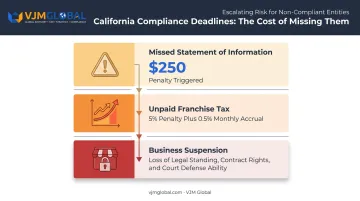
What happens if you miss a deadline? A missed Statement of Information can trigger a $250 penalty. Unpaid franchise tax accrues penalties starting at 5% plus 0.5% per month, and your business can be suspended, losing its right to legally operate, sign contracts, or defend itself in court.
Juggling operations while tracking every filing window is exactly where founders lose focus on the business itself.
International founders face an extra layer here. Business owners with cross-border ties, such as NRIs, OCIs, or foreign investors expanding into the US, often deal with additional reporting nuances around ownership disclosure and tax treaty considerations. Firms like VJM Global specialize in this exact gap, helping cross-border founders manage compliance without missing deadlines buried in unfamiliar paperwork.
Common Mistakes to Avoid When Registering in California
A few recurring errors cause the most headaches for new business owners:
- Name availability check: Filing before confirming your name is distinguishable in SOS records leads to rejected filings, wasted fees, and sometimes trademark disputes down the line.
- 90-day Statement of Information deadline: This is easy to forget once the formation paperwork feels "done," but the SOS doesn't send a reminder before assessing the $250 penalty.
- $800 franchise tax: This isn't optional or one-time — it's due annually regardless of whether your business turned a profit, and it catches new LLC owners off guard more often than you'd expect.
Working with an experienced compliance advisor helps catch these deadlines and filings before they become costly penalties, particularly if you're managing registration alongside other cross-border business priorities.
Frequently Asked Questions
How much does it cost to register a company in California?
State filing fees run $90 for an LLC and $125 for a corporation, covering Articles and the initial Statement of Information. Add the $800 annual franchise tax, and first-year LLC costs typically land near $890. See the cost breakdown section above for the full picture.
Do you have to pay the $800 California LLC annual fee every year?
Yes. LLCs owe the $800 minimum franchise tax every year, including their first year of operation. Corporations get a first-year exemption from the $800 minimum but still owe income tax on profits.
Should I form an LLC or a corporation in California?
It depends on your liability needs, tax preferences, and growth plans. LLCs suit simplicity-focused small businesses, while corporations suit those planning to raise capital. A CPA or business advisor can help confirm the right fit.
How long does it take to register a business in California?
Online filings through BizFile Online are generally faster than mail, though the SOS doesn't publish a fixed turnaround time. Expedited options exist, ranging from $350 for 24-hour service to $750 for same-day processing.
Do I need a registered agent to form an LLC or corporation in California?
Yes, it's mandatory. Your registered agent receives legal and tax documents on your business's behalf and must maintain a physical California address during business hours.
Can a non-US resident or foreign business owner register a company in California?
Yes, non-residents can register LLCs and corporations in California. You'll likely need extra steps, such as obtaining an EIN through the international application route and possibly an ITIN.