That combination is why multinationals keep showing up. Predictable regulation, access to roughly 2.5 billion consumers within a few hours' flying time, and fewer entry barriers than London, Singapore, or New York make the UAE hard to ignore for companies scaling regionally.
Interest isn't limited to Fortune 500 names. Tech firms, logistics operators, FMCG brands, energy companies, and mid-sized businesses looking to establish a regional foothold are all evaluating UAE entry right now. This guide breaks down exactly what setting up a multinational entity in the UAE actually involves, step by step.
Key Takeaways
- Mainland, free zone, and offshore structures each determine your market access and tax treatment
- Setup costs vary widely by jurisdiction, activity, and visa count, not a single flat fee
- Most sectors now permit 100% foreign ownership with no local sponsor required
- Corporate tax registration is mandatory even below the AED 375,000 profit threshold
- Setup timelines range from a few days to several weeks, depending on banking and approvals
What Is a Multinational Company Setup in the UAE?
A multinational company setup in the UAE means establishing a legal entity that lets a foreign-headquartered business operate, trade, or manage regional activities locally. That entity can take several forms depending on your goals.
The core distinction comes down to purpose, with entities typically used in one of two ways:
- To serve the local or regional market directly through a mainland structure with full trading rights
- As an international trading or holding base through a free zone or offshore vehicle built for tax efficiency rather than local sales
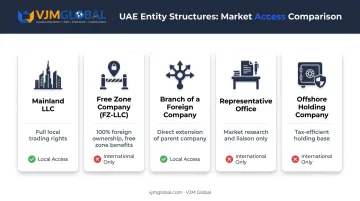
Common structures multinationals use include:
- Mainland LLC
- Free Zone Company (FZ-LLC)
- Branch of a Foreign Company
- Representative Office
- Offshore Holding Company
A US software firm, for instance, might use a mainland LLC to sell directly to UAE clients while routing IP licensing through an offshore holding company. Each structure carries different ownership rules, tax exposure, and operational scope, so getting this choice right early avoids expensive restructuring later.
Why the UAE Makes Sense for Multinational Expansion
Before assuming UAE entry is automatically the right move, treat it as a conditional decision. It works well under the right circumstances, not as a universal shortcut to growth.
The Numbers Behind the Confidence
Investor confidence in the UAE isn't anecdotal. UAE inward FDI reached $48.243 billion in 2025, up 5.7% from the prior year, ranking the country ninth globally and first across West Asia for foreign investment.
That capital inflow reflects a business environment built around a few concrete advantages:
- 100% foreign ownership across most mainland and free zone sectors, removing the local sponsor requirement in the majority of cases
- No personal income tax, plus corporate tax capped at 0% up to AED 375,000 in taxable income and 9% above that threshold
- Strategic access to Africa, Asia, and Europe through Jebel Ali Port and major international airports
- More than 40 active free zones, each tailored to a specific industry, from finance to logistics to technology
- Golden Visa residency, offering 5 to 10 year terms for investors and business owners who meet capital or investment thresholds
Free Zones Aren't All Interchangeable
Picking the right free zone matters more than picking any free zone. Each one caters to a distinct industry:
- DIFC serves financial services firms through an English common-law framework
- JAFZA anchors logistics and trade businesses next to Jebel Ali Port
- Dubai Internet City caters to technology companies needing a built-in innovation ecosystem
One caveat worth flagging: qualifying for the 0% free zone tax rate isn't automatic. It applies only to "Qualifying Income" and requires meeting substance, transfer pricing, and audit conditions, plus staying under a de minimis cap on non-qualifying revenue. Free zone status alone doesn't guarantee the lower rate.
Key Considerations Before You Set Up in the UAE
Most setup mistakes multinationals make aren't about lacking resources. They come from underestimating structural complexity or picking the wrong jurisdiction for their actual business model.
The Real Cost Breakdown
There's no single "UAE setup cost" figure. Fees are modular and depend heavily on structure and activity:
| Structure | Indicative Annual Licence Fee | Notes |
|---|---|---|
| JAFZA trading/industrial (single activity) | AED 5,000 | Excludes visas, lease, approvals |
| JAFZA general trading/logistics | AED 15,000 | Higher activity scope |
| JAFZA holding licence | AED 30,000 | For group holding structures |
| DMCC business licence | From AED 20,285 | Total rises with office and visa needs |
Mainland licensing costs vary further based on legal form, activity count, and external approvals, with no fixed industry-wide range published.
Mainland Access vs. Free Zone Perks
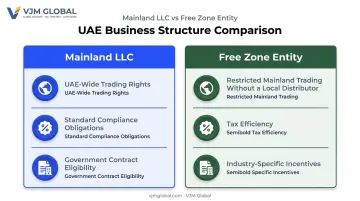
This is the decision multinationals get wrong most often. A free zone entity offers tax efficiency but generally can't trade directly with UAE mainland clients or government entities without appointing a local distributor.
A mainland LLC can trade UAE-wide but comes with different cost and compliance obligations. Match the structure to where your actual customers sit.
Tax and Compliance Obligations
A common misconception is that AED 375,000 is a corporate tax registration threshold. It isn't. It's the rate breakpoint. Every resident taxable entity must register for corporate tax regardless of profit level.
VAT registration becomes mandatory once taxable turnover crosses AED 375,000, with a voluntary option from AED 187,500.
Emiratisation Requirements
Companies with 50 or more employees must raise Emirati employment in skilled roles by 2% annually, reaching a cumulative 10% by the end of 2026. Selected companies with 20-49 employees in 14 specified sectors face similar hiring obligations, so headcount planning needs to account for this early.
Thinking Beyond the UAE Alone
Many multinationals expanding into the Gulf pair their UAE entry with a parallel move into India, given the trade ties and talent pool both markets share. This is where firms like VJM Global come in. They support foreign companies with India entity setup, FEMA and RBI compliance, transfer pricing between UAE and Indian entities, and DTAA advisory to prevent double taxation on cross-border income.
How to Set Up a Multinational Company in the UAE – Step by Step
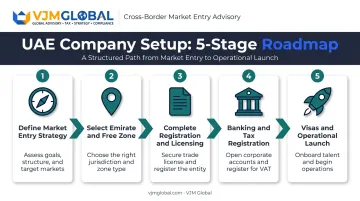
The process breaks down into five practical stages. The most common mistake at every stage: choosing a structure for cost savings alone without checking whether it actually supports the business model, or leaving tax and compliance registration until after launch.
Step 1 – Define Market Entry Strategy and Choose the Right Legal Structure
Decide whether the priority is local UAE market access or an international operational base. That decision determines whether you need a Mainland LLC, Free Zone entity, Branch Office, or Offshore holding company.
Also clarify the entity's purpose within your broader group structure:
- Regional headquarters overseeing multiple markets
- Operational hub handling direct sales or service delivery
- Holding company for group structuring and asset protection
Common miss: Selecting a free zone purely for tax perks, then discovering it restricts direct mainland trading.
Step 2 – Select the Right Emirate, Free Zone, and Business Activity
Match your industry to the jurisdiction built for it:
- Finance firms gravitate toward DIFC
- Logistics and trading companies lean toward JAFZA
- Tech businesses tend to choose Dubai Internet City
Each free zone maintains a defined list of licensable activities, so confirm your parent company's core operations align with what's permitted. This alignment matters beyond initial licensing, since switching zones later means re-registering with a new authority and reissuing contracts.
Common miss: Choosing a free zone without checking industry-specific infrastructure, then facing relocation costs once operational gaps surface.
Step 3 – Complete Registration: Trade Name, Licensing, and Approvals
Reserve a compliant trade name and secure initial approval from the relevant mainland or free zone authority. Prepare the required documentation, which typically includes:
- Memorandum of Association
- Shareholder and director passports
- Parent company incorporation certificate
- Board resolutions and KYC/UBO forms
Foreign corporate documents generally need notarization and attestation before submission.
Common miss: Submitting incomplete or unattested corporate documents, which delays licensing by weeks.
Step 4 – Set Up Banking, Tax Registration, and Compliance Framework
Corporate bank account opening for foreign-owned structures involves thorough KYC review and can take several weeks, separate from the licensing timeline entirely. In parallel, register for corporate tax with the Federal Tax Authority (mandatory regardless of profit level) and for VAT if turnover exceeds AED 375,000. Banks generally request certified proof of the parent company's ownership structure and source of funds before approving the account, so prepare these documents early.
Common miss: Underestimating how much documentation banks require for multinational shareholder structures, which stalls account activation past the launch date.
Step 5 – Arrange Visas, Office Space, and Operational Launch
Lease compliant office space. Mainland entities need a physical address registered through Ejari in Dubai, while free zones typically offer flexi-desk options.
Visa allocation scales with office size, sometimes as tightly as one visa per nine square meters. Once premises are secured, apply for investor, employee, and dependent residency visas through the relevant immigration channel.
Common miss: Underestimating visa quota limits tied to office size, which restricts hiring plans right after launch.
Conclusion
Setting up a multinational company in the UAE comes down to matching structure to strategy, not chasing tax benefits alone. Clarity on jurisdiction, compliance obligations, and long-term operational needs matters far more than how quickly you can get a license issued.
Long-term success also depends on staying current with evolving regulations around corporate tax and Emiratisation. For companies coordinating UAE entry alongside expansion into India, working with an experienced partner such as VJM Global helps keep both jurisdictions' compliance requirements moving in sync. This avoids the pitfalls of managing each market in isolation.
Frequently Asked Questions
How do you set up a company in the UAE?
Choose a jurisdiction (mainland, free zone, or offshore), select a licensable business activity, secure initial approvals, register the trade name and license, then arrange banking and visas. Each stage has its own documentation and timeline.
How much does it cost to set up a company in the UAE?
Costs vary by jurisdiction and activity. Free zone licenses can start around AED 5,000 to AED 20,000+ annually. Mainland setups depend on legal form, activity count, and external approvals, plus office lease and visa costs on top.
Can a multinational company have 100% foreign ownership in the UAE?
Yes, for most mainland and free zone activities following the UAE's Commercial Companies Law reforms. A short list of strategically sensitive sectors, including banking, insurance, and telecommunications, still carries ownership conditions.
What is the difference between mainland and free zone setup for multinational companies?
Mainland entities can trade directly across the UAE, including with government clients. Free zone entities offer tax efficiency but generally need a local distributor to sell directly into the mainland market.
Do multinational companies need a local UAE sponsor or partner?
No, for most activities. The local sponsor requirement has largely been abolished, with exceptions limited to a small list of strategic sectors like security, banking, and telecommunications.
How long does it take to set up a company in the UAE?
Free zone license issuance can take as little as 3 to 14 business days once documents are complete. Add several more weeks for bank account opening, office leasing, and visa processing before the entity is fully operational.