Yet UAQ gets far less attention than Dubai or RAKEZ. Most "UAE free zone" content glosses over the specifics — the actual tax mechanics, what fast setup really means, and where the savings are genuine versus overstated.
This article covers what UAQ Free Zone company formation actually delivers: verifiable advantages in cost, ownership structure, taxation, and scalability — along with the caveats that matter before you commit.
Key Takeaways
- UAQ Free Zone permits 100% foreign ownership — no local sponsor required
- License issuance can happen in one working day after documents and payment are complete
- Qualifying Free Zone Persons pay 0% on qualifying income (9% applies to non-qualifying income)
- The UAE has 137 Double Taxation Agreements — accessible once a Tax Residency Certificate is obtained
- Entry packages start from AED 5,500 (UAQ LYTE) — a competitive entry point compared to most mainland and free zone alternatives
- Commercial licence holders can add consultancy or service activities under the same entity
What Is Company Formation in UAQ Free Zone?
UAQ Free Trade Zone is a government-operated designated economic zone within the Emirate of Umm Al Quwain. It hosts over 11,000 registered businesses and is designed to facilitate foreign incorporation with full ownership rights.
Two primary entity structures are available:
- Free Zone Establishment (FZE) — for a single shareholder
- Free Zone Company (FZC) — for 2 to 50 shareholders
Six activity routes are available, each mapped to a specific licence type:
| Business Type | Official Licence Route |
|---|---|
| Import/export, trading | Commercial Licence |
| Professional advisory | Consultancy Licence |
| Service operations | Service Licence |
| Solo operators | Freelance Permit |
| Online selling | E-commerce Licence |
| Manufacturing/assembly | Industrial Licence |
UAQ works well for specific business profiles — not every setup. It's best suited for:
- Trading and import/export operations
- Consultancy and professional advisory
- E-commerce and online businesses
- Light manufacturing and assembly
Businesses requiring unrestricted UAE mainland access or heavy logistics infrastructure will find dedicated mainland zones or port-adjacent free zones a better fit.
Key Benefits of Forming a Company in UAQ Free Zone
The benefits below focus on operational and financial outcomes — cost-to-setup, tax position, time-to-launch, and growth flexibility. Each comes with the conditions that determine whether it applies to your specific situation.
Benefit 1: Tax Advantages and Full Financial Control
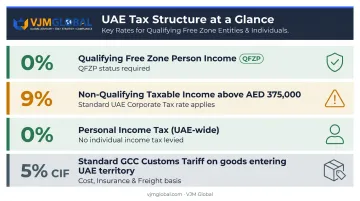
UAQ Free Zone companies can potentially qualify as a Qualifying Free Zone Person (QFZP) under the UAE Corporate Tax Law (effective June 2023). The tax structure works as follows:
- 0% on qualifying income for entities that meet QFZP criteria
- 9% on non-qualifying taxable income above AED 375,000
- 0% personal income tax — this is a UAE-wide rule, not specific to UAQ
- No withholding tax on relevant UAE-sourced income distributions
- Goods stored in the free zone for re-export generally remain outside customs duty; however, goods entering UAE customs territory are ordinarily subject to the standard GCC tariff (typically 5% of CIF value)
QFZP status is not automatic. As the FTA's Corporate Tax Guide for Free Zone Persons makes clear, an entity must maintain adequate economic substance, derive qualifying income, satisfy transfer-pricing requirements, and maintain audited financial statements.
Non-qualifying revenue must stay within the lower of 5% of total revenue or AED 5 million. Exceeding this threshold can strip QFZP status for the current period plus four subsequent tax periods.
For Indian, UK, or US-based businesses, the UAE's network of 137 Double Taxation Agreements — confirmed by the UAE Ministry of Finance — can reduce the tax burden on cross-border income. Accessing these treaties requires a UAE Tax Residency Certificate, which in turn requires documented substance and at least 12 months of incorporation.
This benefit matters most for: Trading companies, consultancies, and digital service businesses with cross-border revenue streams who can structure operations to meet QFZP qualifying income criteria.
KPIs affected: Effective tax rate, net profit margin, customs cost on imports/exports, cash repatriation timeline.
Benefit 2: 100% Foreign Ownership with Fast, Low-Friction Setup
UAQ Free Zone officially permits 100% ownership by a foreign individual or corporate entity — with no UAE national sponsor, no NOC requirement, and no mandatory physical presence during incorporation for most cases.
Post-2021 mainland reforms have also expanded foreign ownership rights in many commercial categories. UAQ's advantage is not uniqueness on this point — it's the combination of ownership clarity with low administrative friction.
What the setup timeline actually looks like:
- Licence issuance: typically one working day after documents and payment are complete
- Full incorporation (including visa and bank account applications): additional days beyond licence issuance
For comparison across free zones:
| Free Zone | Documented Speed |
|---|---|
| UAQ Free Zone | One working day (post-documents/payment) |
| DMCC | Approximately 10 working days |
| RAKEZ | Minutes for an instant licence; broader setup takes additional days |
| IFZA | Approximately 5 working days (after all papers) |
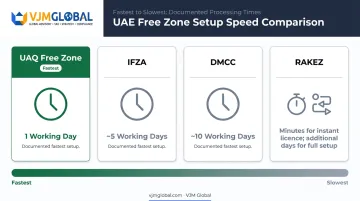
The one-day clock starts only when all documents are submitted and fees paid — not from initial enquiry. Documentation requirements include standard KYC materials: passport copies, proof of address, and entity details.
Every QFZP must maintain audited financial statements. Entities with revenue above AED 50 million also fall under a separate federal audited-statement requirement — treating audits as optional creates compliance risk.
This matters most when opening a corporate bank account. UAE banks conduct thorough due diligence on ownership structure, business purpose, and financial records before approving accounts.
This benefit matters most for: Solo founders, first-time UAE market entrants, and established multinationals that need a clean, fast UAE presence without complex restructuring.
KPIs affected: Time-to-launch, annual compliance cost, ownership structure clarity, documentation burden.
Benefit 3: Affordable, Scalable Licensing Options
UAQ's official 2025 pricing provides a clear starting point. Packages differ in inclusions, so headline prices are not directly interchangeable across zones:
| Package | Published Price | Key Inclusions |
|---|---|---|
| UAQ LYTE | AED 5,500 | Registration, licence, co-working lease, bank account assistance; no residence visa |
| UAQ no-visa package | From AED 8,000 | Separate package without visa eligibility |
| UAQ START | AED 12,500 | Licence, one investor visa, Emirates ID, workspace |
| UAQ two-visa package | AED 13,500 | Two-visa inclusion |
| DMCC Jump Start | AED 39,402 | One-year licence, flexi-desk, one residency visa |
| RAKEZ Biz Starter | AED 6,000 | Current promotional package |
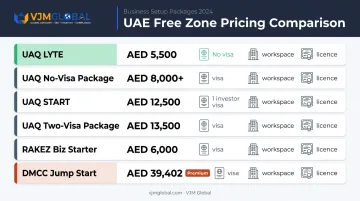
Source: UAQ's June 2025 package guide and DMCC/RAKEZ official pages.
The gap between UAQ's AED 5,500 LYTE entry and DMCC's AED 39,402 starter package is substantial. For early-stage businesses testing UAE market entry, that difference can fund several months of operations.
Here's how the scalability actually works: A commercial licence holder can obtain a consultancy or service licence within the same entity without forming a new company. Commercial licences can cover up to 10 similar activities or 3 different categories, and activities can be amended during the licence term. Businesses can expand their operational scope as they grow without restarting the incorporation process.
Note: UAQ's official documentation references a stated minimum company capital of AED 300,000, divided into AED 1,000 shares. Prospective incorporators should confirm current capital requirements directly, as agency-published figures vary.
This benefit matters most for: Indian entrepreneurs, NRIs, and global SMEs in consulting, e-commerce, or digital services who want a UAE foothold without over-committing capital at entry.
KPIs affected: Setup cost (AED), annual renewal cost, visa quota count, flexibility to add activities, break-even timeline.
What Happens When You Choose the Wrong Free Zone
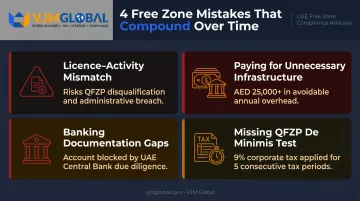
Free zone selection mistakes are common — and the consequences compound over time. Most fall into four predictable categories:
Licence–activity mismatch is the most frequent error. Selecting a commercial licence but operating as a consultancy — or the reverse — creates an administrative breach with the free zone authority and risks QFZP disqualification if the revenue mix stops aligning with qualifying income rules.
Paying for infrastructure you don't need is equally damaging. Choosing DMCC or DAFZA for a solo consultancy adds AED 25,000+ in annual overhead with no operational return. UAQ's entry packages exist precisely to close that gap.
Banking complications hit under-documented entities regardless of free zone. UAE Central Bank rules require banks to verify legal persons, beneficial ownership, business purpose, expected activity, and source of funds before account approval. Inconsistent activity descriptions or unexplained fund sources can block an account entirely.
Missing the QFZP de minimis test carries the steepest cost. Standard corporate tax treatment applies not only for the current period but for the following four tax periods — a five-year consequence triggered by a single year of non-qualifying revenue crossing the threshold.
How to Get the Most Value from Your UAQ Free Zone Company
The formation decision sets the ceiling on what you can extract from UAQ's benefits. Getting it right from the start matters more than optimising later.
Match the Licence to the Actual Activity
Trading businesses belong on commercial licences. Consultants belong on consultancy licences. E-commerce operations have a dedicated route. Activity mismatches are the most common reason businesses fail to access the full tax benefits available to them.
Build the Substance for DTAA Access
The UAE's 137 tax treaties don't automatically apply to every UAE-registered entity. To access treaty benefits, businesses need a Tax Residency Certificate (TRC), which the FTA issues only after the entity has been incorporated for at least 12 months and can demonstrate adequate UAE operational presence.
Qualifying for a TRC requires:
- Documented financial records showing genuine business activity
- A credible UAE address with evidence of actual use (not just a flexi-desk booking)
- Demonstrable management activity conducted from within the UAE
Maintain Records from Day One
QFZP status requires audited financials regardless of whether the free zone authority mandates them for general licence renewal. Businesses that skip financial recordkeeping in early years find themselves scrambling to reconstruct evidence when they need to apply for a TRC or demonstrate substance to a UAE bank.
For foreign entrepreneurs based in India, the US, or the UK, the licensing strategy, entity structure, and compliance setup interact with home-country tax obligations in ways that aren't always obvious. VJM Global's advisory team works with international businesses on cross-border tax structuring, DTAA planning, and multi-jurisdiction compliance — making early advisory engagement far cheaper than fixing structural errors post-formation.
Conclusion
UAQ Free Zone offers a specific combination that few UAE zones match at this price point: government-operated infrastructure, one-day conditional licence issuance, and the flexibility to expand licence scope within an existing entity. The tax benefits are equally concrete:
- 0% corporate tax on qualifying income under QFZP status
- 137 double taxation agreements reducing withholding exposure across key markets
- No personal income tax, keeping founder distributions clean
Each of these benefits, however, depends on sustained QFZP compliance — not just initial registration.
Formation is the starting point, not the finish line. As UAE corporate tax rules evolve and business activities change, schedule an annual review of licence type, revenue classification, and substance documentation — that's what keeps the structure delivering the benefits it was built for.
Frequently Asked Questions
What are the benefits of registering a company in a UAE free zone?
Key benefits include 100% foreign ownership, 0% corporate tax on qualifying income, no personal income tax, access to the UAE's 137 Double Taxation Agreements, and simplified setup processes. Specific benefits vary by free zone, licence type, and whether the entity qualifies as a QFZP under UAE Corporate Tax Law.
What is company formation in the UAE?
UAE company formation is the legal process of incorporating a business entity (free zone, mainland, or offshore) with a valid trade licence, defined ownership structure, and registered business activities. Free zone companies offer full foreign ownership within zone restrictions; mainland companies provide wider UAE market access under different ownership and tax rules.
What are the benefits of forming an LLC in the UAE?
A UAE mainland LLC allows unrestricted trading across the UAE market, without the geographical limits that apply to free zone entities. LLCs require a physical office and are subject to UAE corporate tax, making them most suitable for businesses serving domestic UAE consumers or government clients.
How long does it take to set up a company in UAQ Free Zone?
UAQ Free Zone issues licences in typically one working day after all documents and payment are complete. The full operational timeline extends beyond that once bank account opening and visa processing are factored in, but the licence-issuance step is one of the fastest in the UAE.
Can a foreigner own 100% of a UAQ Free Zone company?
Yes. UAQ Free Zone permits 100% foreign ownership with no requirement for a UAE national as a local sponsor or partner. This applies to both individual foreign investors and corporate entities incorporating an FZE or FZC.
What types of licences are available in UAQ Free Zone?
The main licence types are Commercial (trading/import-export), Consultancy, Service, Industrial, and a Freelance Permit for solo operators. UAQ LYTE (from AED 5,500, no visa) and UAQ START (AED 12,500, includes one investor visa) are the current all-inclusive entry packages. A commercial licence holder can add consultancy or service activities without forming a separate entity.