Search interest in "starting a business in the Philippines" is high, yet most explanations skip the parts that actually slow down a UAE-based founder: embassy attestation queues, proof-of-remittance requirements, and coordinating a bank signatory visit from thousands of miles away. More than 700,000 Filipinos live and work in the UAE, and that community alone creates real demand for properly registered Philippine entities supporting trade, family businesses, and back-office operations.
This guide covers the structures available to foreign founders, the step-by-step registration process, real costs, and the factors specific to the UAE-Philippines corridor - plus when incorporating isn't actually your best option.
Key Takeaways
- UAE-based founders can fully own many Philippine entities, subject to FINL sector caps
- SEC/DTI, LGU, BIR, and social-agency registration still takes 2–3 months remotely
- Budget from low DTI fees up to high paid-up capital for foreign-owned corporations
- PH Embassy/Consulate authentication in the UAE adds lead time founders often miss
- Test the market first with a rep office, branch, or Employer of Record
What Is Involved in Setting Up a Business in the Philippines from the UAE?
Setting up a business in the Philippines from the UAE means establishing a Philippine-registered entity —typically a domestic corporation, a One Person Corporation (OPC), or a branch office— while you, as investor or director, remain based in or operate primarily from the UAE.
The end result is a fully recognised Philippine entity holding:
- SEC or DTI registration confirming its legal existence
- A Mayor's Permit from the local government unit covering your business address
- A BIR Certificate of Registration, tax identification number, and invoicing authority
Once these are in place, the entity can legally trade, hire staff, open a corporate bank account, and invoice clients within the Philippines.
Here's what changes when a UAE resident registers versus a resident Filipino founder:
- Sole proprietorships are reserved for Filipino citizens, so foreign investors default to a corporation, OPC, or branch
- These structures face Foreign Investment Negative List (FINL) sector checks and, in many cases, higher minimum paid-up capital
- Cross-border document authentication—notarising and legalising board resolutions, passport copies, and corporate documents through the Philippine Embassy or Consulate in the UAE—adds steps a domestic founder never faces
The underlying Philippine law doesn't change because you're in Dubai instead of Manila. Only the logistics do.
Why UAE-Based Entrepreneurs Are Choosing the Philippines
Growing Trade Ties Between the Two Countries
The UAE and the Philippines have been deepening economic ties for years. A Comprehensive Economic Partnership Agreement signed in January 2026 formalises that direction.
Philippine data puts 2024 bilateral trade at close to USD 1.83 billion, while UAE reporting shows non-oil trade climbing 22.4% year-on-year through the first nine months of 2025. Either way, the trend points the same direction: more trade, and more reason for a formally registered presence on both sides.
A Built-In Talent and Customer Base
More than 700,000 Filipinos live and work in the UAE - a community large enough to sustain remittance-linked trade, family businesses, and back-office operations that benefit from a properly registered Philippine entity on the other end.
The Philippines also offers:
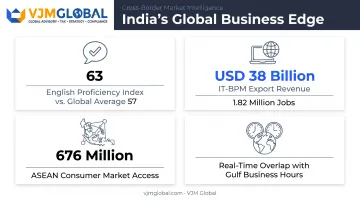
- A young, English-proficient workforce - Filipino employees scored 63 on average English assessments versus a global average of 57
- An IT-BPM sector that generated USD 38 billion in export revenue in 2024, up 7% year-on-year and supporting 1.82 million jobs
- ASEAN membership, giving a Philippine entity indirect access to a bloc of over 676 million consumers
- A time zone that overlaps practically with Gulf business hours for handovers and live support
For UAE businesses in IT services, customer support, or outsourcing, that combination makes the Philippines a natural delivery base alongside a Middle East and Africa-facing UAE headquarters.
Incentives That Can Offset Remote Coordination Costs
Qualifying export enterprises registered with the Board of Investments (BOI) or PEZA can access an income tax holiday of four to seven years. After that, many qualify for a 5% special corporate income tax or enhanced deductions, plus tax- and duty-free imports of qualifying equipment.
These incentives won't fix a fundamentally wrong entity choice, but they can improve the economics of running a Philippine operation from Dubai or Abu Dhabi.
What Goes Wrong Without the Right Groundwork
The costliest mistake is treating Philippine ownership rules like a UAE free zone and assuming 100% control is automatic. It isn't.
A foreign-owned corporation in a restricted sector, or one capitalised below the required threshold, can face rejected SEC filings or a forced restructuring months after capital and staff time are already committed. Checking Foreign Investment Negative List (FINL) eligibility before reserving a company name saves far more time than fixing it afterwards.
How to Register a Company in the Philippines from the UAE: Step-by-Step
Registration runs on two parallel tracks: documentation and attestation handled from the UAE, and in-country filing with Philippine government agencies. Get the inputs right and you exit with a legally registered entity that can hire, invoice, and bank locally.
Typical UAE-side inputs include:
- Passport copies and proof of UAE address
- Notarised corporate documents and board resolutions
- Evidence of inward capital remittance
Step 1: Choose Your Structure and Confirm Sector Eligibility
Choose one of these structures (sole proprietorships are reserved for Filipino citizens):
- Domestic corporation
- One Person Corporation (OPC)
- Branch office
- Representative office
Before you lock a name or structure, check your target sector against the current FINL (Twelfth Regular Foreign Investment Negative List, EO 175). Some activities cap foreign equity at 0%, 25%, 30%, or 40%.
Step 2: Reserve Your Name and Prepare Documents from the UAE
Search name availability through the SEC's eSPARC portal and submit up to three preferred names. In parallel, get board resolutions, passport copies, and corporate documents notarised and authenticated—either through the Philippine Embassy or Consulate in the UAE, or via apostille where applicable. Start this early; authentication queues are often the slowest part of the entire process.
Step 3: Register with SEC or DTI and Secure the Mayor's Permit
File your Articles of Incorporation through eSPARC. SEC's stated review benchmark is 7 working days after acceptance, though foreign-owned applications with capital-remittance proof typically take longer. Once registered, apply for a Mayor's Permit with the LGU covering your business address—requirements vary by city, so confirm the checklist directly with that office.
Step 4: Complete BIR, Employee Benefit, and Banking Registration
With SEC registration in hand, finish the statutory and banking setup:
- BIR: Tax Identification Number, Certificate of Registration, and VAT if gross annual sales will exceed PHP 3 million
- Employee benefits: Enrol staff with SSS, PhilHealth, and Pag-IBIG when you hire
- Banking: Open a Philippine corporate account—this step usually still needs at least one in-person signatory visit, so plan around it even if everything else runs remotely
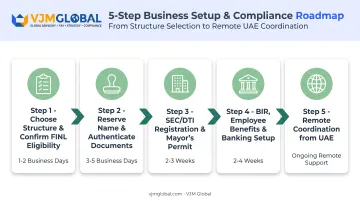
Step 5: Coordinate What's Left from the UAE
You do not need to be in Manila for every remaining visit. Many UAE-based founders use a licensed Philippine consultant or a cross-border corporate services provider for in-person government errands while approvals and remittances stay online.
VJM Global coordinates entity formation and compliance across 100+ countries and is often engaged here to keep SEC filings, LGU permits, and BIR registration moving across time zones without the founder flying in for each appointment.
Costs, Structures & Key Factors to Get Right
Comparing the Structures Available to You
| Structure | Ownership & Liability | Best For |
|---|---|---|
| Corporation / OPC | Limited liability; foreign ownership subject to FINL | Standalone Philippine operations earning local revenue |
| Branch Office | Extension of the UAE/parent company; parent bears full liability | Parent-led market entry without a separate legal entity |
| Representative Office | No Philippine income allowed; funded entirely by the parent | Market research, liaison, and promotional activity only |
What to Budget For
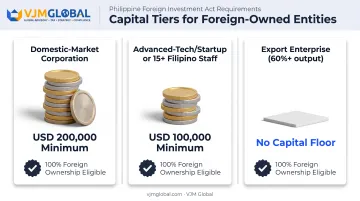
DTI and SEC filing fees are relatively modest and assessed per application through SEC's Payment Assessment Form. The real cost driver for foreign-owned entities is paid-up capital, not government fees:
- USD 200,000 minimum paid-up capital for a domestic-market foreign corporation
- USD 100,000 where the venture qualifies as an advanced-technology or startup enterprise, or employs at least 15 Filipino staff as the majority of its workforce
- Often no domestic-market capital floor for export enterprises shipping at least 60% of output (typically eligible for 100% foreign ownership)
On top of that, budget for notarisation, UAE embassy or DFA authentication fees, translation where required, and professional fees if you engage a consultant for in-country filings.
Tax and VAT Obligations
Philippine corporate income tax is 25%, reduced to 20% for companies with net taxable income under PHP 5 million and total assets under PHP 100 million. VAT registration becomes mandatory once gross annual sales pass PHP 3 million.
The UAE-Philippines tax treaty caps source-country withholding at:
- 10-15% on dividends
- 10% on interest and royalties
- 10% on branch-profit remittance
Factor those caps in before you decide how profits move back to the UAE.
Authentication and Banking Practicalities
Document authentication through the Philippine Embassy or Consulate in the UAE (or the DFA, for documents already in the Philippines) can add real time to your timeline. Sequence it early rather than treating it as a formality to squeeze in later.
For capital remittance and ongoing payments between AED and PHP (initial capital injection, supplier payments, or payroll), transparent, well-documented FX channels matter more than chasing the best exchange rate. SEC and BIR both expect clean proof of inward remittance, and informal transfer channels can create verification headaches exactly when you need capital confirmed fastest.
Common Mistakes and When a Different Approach Makes Sense
Two Assumptions That Cause the Most Delay
Two assumptions create the most delay:
- Unrestricted ownership carries over from a UAE free zone. Foreign Investment Negative List (FINL) limits follow the activity, not the founder's nationality or UAE residency. A 100%-owned tech consultancy is straightforward; retail below the capital threshold or mass media is not.
- A representative office can act as a revenue channel. It is limited to research, liaison, and promotional work funded by the parent. Invoicing Philippine clients through it puts you outside its licence.
When Incorporation Isn't the Right Call Yet
Full incorporation brings ongoing compliance overhead (audits, annual SEC filings, permit renewals) that only pays off once Philippine activity justifies it.
If you are only testing demand, hiring one or two local staff, or running occasional sourcing and short-term contracts, an Employer of Record (EOR) is usually faster and cheaper than a premature entity. EOR lets you hire and pay compliant staff without incorporating—coverage VJM Global provides for cross-border hiring across 100+ countries.
If your footprint is a handful of contracts or a small team, confirm you need an SEC-registered company before you commit capital to one.
Conclusion
Setting up a business in the Philippines from the UAE follows the same core registration path any foreign investor faces: SEC or DTI, LGU, BIR, and social benefit agencies. The corridor adds attestation, remittance evidence, and remote coordination on top of that base process.
What actually determines your timeline and cost isn't your location in Dubai or Abu Dhabi. It's whether you've correctly identified your FINL sector exposure, capitalised your entity at the right threshold, and sequenced document authentication early enough to avoid it becoming your bottleneck.
Get the structure and sector-eligibility check right before you file. Correcting a mismatched entity type after registration costs far more time and money than getting specialist input upfront. VJM Global helps UAE-based founders with Philippine entity formation, document coordination, and post-registration compliance so those early choices don’t turn into rework later.
Frequently Asked Questions
How much does it cost to set up a business in the Philippines?
Costs vary by structure. DTI/SEC filing fees are relatively low, but foreign-owned corporations need USD 200,000 (or USD 100,000 in qualifying cases) in paid-up capital, plus notarisation, UAE attestation, and professional fees.
Which business is most profitable in the Philippines?
BPO/IT services, e-commerce, tourism, and real estate consistently perform well, especially activities eligible for BOI or PEZA incentives. Profitability still depends on execution and FINL compliance in your sector.
Can a foreign national based in the UAE start a business in the Philippines?
Yes. Foreign nationals, including UAE residents, can own corporations, OPCs, or branch offices in most non-restricted sectors, subject to FINL limits and minimum capital rules - nationality doesn't change the underlying process.
Do I need to travel to the Philippines to register my company?
Much of the process - document prep, SEC filing, BIR registration - can be coordinated remotely from the UAE. Opening a corporate bank account typically still needs one in-person signatory visit or a locally appointed representative.
Can a UAE-registered company open a branch office in the Philippines?
Yes, through SEC's License to Operate. It's generally faster than a subsidiary, but the UAE parent remains fully liable for the branch's Philippine obligations.
How long does the whole registration process take from the UAE?
Expect 2-3 months end-to-end. Build in time for Philippine Embassy or DFA document authentication from the UAE.