Vietnam allows 100% foreign ownership in most sectors, which sounds straightforward until you're staring at a two-stage licensing process, notarised documentation, consular legalisation, and statutory deadlines that don't bend for unprepared applicants.
This guide walks through the exact registration steps, what UAE investors need ready beforehand, how to pick the right entry structure, and the mistakes that trip up otherwise well-funded projects.
Key Takeaways
- Vietnam permits 100% foreign ownership in most sectors via a two-stage licensing process
- Appoint a Vietnam-resident legal representative and secure a registered address before licensing starts
- Most sectors have no fixed minimum capital, but declared capital must be credible and funded within 90 days
- Choose from five entry routes: WFOE, Joint Venture, Representative Office, Local Distributor, or Employer of Record
How to Set Up a Business in Vietnam from the UAE: Step-by-Step Process
Vietnam's registration process is sequential, not concurrent. Skipping ahead or assuming steps overlap is where most delays begin.
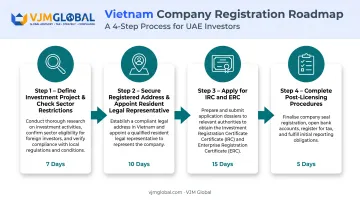
Step 1 – Define Your Investment Project and Check Sector Restrictions
Vietnamese law requires a defined investment project before any registration can move forward. That means before you file anything, you need to confirm whether your sector is open, conditional, or restricted for foreign ownership under Decree 31/2021/ND-CP and Vietnam's WTO commitments.
This research determines two things:
- Whether a wholly foreign-owned structure is even legally possible for your business line
- Whether a local partner is mandatory, and if so, at what ownership split
Some examples worth knowing upfront:
- Advertising requires a Vietnamese partner through a joint venture or business cooperation contract
- Education has allowed 100% foreign-invested institutions since 2009, subject to licensing
- Road freight transport currently caps foreign equity at 51%, with Vietnamese drivers required
- Banking caps aggregate foreign ownership of a joint-stock commercial bank at roughly 30%
Check for sector-specific minimum capital or licensing conditions — finance, education, and logistics all carry their own thresholds — before you finalise the project proposal.
Step 2 – Secure a Registered Address and Appoint a Resident Legal Representative
Every Vietnamese company needs a legal business address with a determinable location, phone number, and email. Manufacturing and retail businesses typically need a physical office; many service businesses can operate from a virtual office. Residential addresses don't qualify.
You'll also need at least one legal representative residing in Vietnam. If that person leaves the country, they must authorise another Vietnam resident in writing to act in their place.
Non-Vietnamese representatives generally need a work permit. The Law on Enterprises is explicit on the residency requirement, with limited exemptions (for example, an LLC member contributing at least VND3 billion).
This isn't a title on paper. The legal representative carries personal liability for compliance, which is why many UAE investors either relocate a trusted executive or appoint a temporary local nominee while the business gets established.
Step 3 – Apply for the Investment Registration Certificate (IRC) and Enterprise Registration Certificate (ERC)
Your application package typically includes:
- Investment proposal outlining the project, capital, and timeline
- Proof of financial capacity for the foreign investor
- Lease agreement for the registered office
- Passport copies of all investors and the legal representative
Every foreign-language document in that pile — certificates of incorporation, financial statements, passports — must be translated into Vietnamese and notarised or consular-legalised before submission. This is the stage where most UAE applications stall, simply because translation and legalisation take longer than expected.
On timelines, recent reforms allow either the IRC first, followed by entity registration, or entity registration first with the IRC obtained within 12 months.
The IRC review is generally around 15 working days. ERC processing is faster: the Enterprise Law sets a statutory 3 working days once a valid dossier is submitted. Regulated sectors can add separate review stages, so build in buffer time rather than assuming the fastest scenario.
Step 4 – Complete Post-Licensing Procedures
Getting the ERC isn't the finish line. Post-licensing steps include:
- Registering a company seal (physical or digital)
- Opening capital and current bank accounts
- Registering for organisational e-ID access, mandatory for tax, invoicing, and licensing procedures
- Setting up tax registration and e-invoicing before issuing your first invoice
The 90-day rule matters here: registered capital must be injected via bank wire within 90 days of establishment, excluding time needed to transport or transfer contributed assets. Miss that window without a valid reason, and you risk penalties or forced capital adjustment.
Don't assume the ERC covers everything either. Food production, food service, and certain construction activities require sector-specific sub-licences even after the ERC is issued.
What You Need Before Setting Up a Business in Vietnam from the UAE
Preparation before filing determines how smoothly the licensing stages actually go.
Documentation and Translation Requirements
UAE corporate documents (certificate of incorporation, financial statements, passport copies) need three things before submission: notarisation, consular legalisation, and translation into Vietnamese by an authorised translator. Each step adds time, and Vietnamese authorities won't accept shortcuts on this. Start the legalisation chain in the UAE well before you plan to file.
Capital and Financial Readiness
Most sectors carry no fixed minimum capital requirement. That doesn't mean you can declare an arbitrary figure. The amount must be realistic against your business plan, and licensing officers scrutinise it. If you underestimate and need more later, increasing capital requires a formal amendment, an extra step you avoid by setting the figure correctly first time.
Compliance and Local Support Readiness
Two things determine whether your registration stays on schedule:
- Cross-border compliance partner familiar with Vietnamese procedure and Gulf-side documentation. VJM Global coordinates entity formation and compliance across jurisdictions and can manage the documentation trail with local counsel.
- Legal representative readiness: confirm they can obtain an e-ID and work permit before licensing begins, not during or after.
Choosing the Right Market Entry Structure for Vietnam
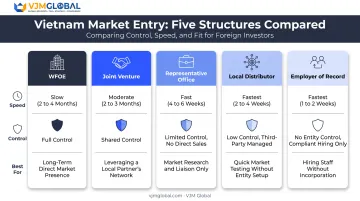
Not every UAE business needs a full subsidiary. Five structures cover most scenarios, each with a different risk and speed trade-off.
Wholly Foreign-Owned Enterprise (WFOE)
When it's better: You want full operational control — hiring directly, invoicing locally, owning 100% of the business — in a sector open to foreign ownership.
Key trade-offs: Highest compliance burden and the longest setup timeline of the five options. You own everything, but you also carry everything.
Joint Venture with a Local Partner
When it's better: Your sector legally requires a Vietnamese partner, or local relationships genuinely speed up approvals and market access.
Key trade-offs: Shared control and shared profit. Disputes are common when governance terms aren't locked down before the partnership starts, so a clear shareholder agreement isn't optional.
Representative Office (RO)
When it's better: You want to research the market, build relationships, and scope demand before committing capital.
Key trade-offs: An RO cannot generate revenue, issue invoices, or sign commercial contracts. Use it for research and relationship-building only.
Local Distributor or Agent
When it's better: You want the fastest, cheapest way to test demand without setting up any legal presence in Vietnam.
Key trade-offs: You lose brand control and become dependent on the distributor's performance and integrity. Quality control is only as good as the partner you pick.
Employer of Record (EOR) for Testing the Market Without an Entity
When it's better: You want to hire Vietnam-based staff or run a pilot operation without incorporating anything yet.
Key trade-offs: You can put sales, support, or operations staff on the ground without incorporating, but you still have no local trading entity. The EOR handles payroll, contracts, and statutory contributions. VJM Global's EOR network spans 100+ countries and supports Vietnam-based hiring when a full entity is premature.
At a glance, the five options compare like this:
| Structure | Speed | Control | Best For |
|---|---|---|---|
| WFOE | Slowest | Full | Long-term, sector-open businesses |
| Joint Venture | Moderate | Shared | Restricted or relationship-driven sectors |
| Representative Office | Fast | None (no revenue) | Market research phase |
| Local Distributor | Fastest | Low | Quick demand testing |
| EOR | Fast | Operational only | Hiring before incorporation |
Compliance Obligations and Common Mistakes to Avoid
Getting the ERC is only the start. Ongoing filings and contributions decide whether the business stays in good standing.
Ongoing Compliance Obligations After Setup
Once the ERC is issued and operations begin, recurring obligations include:
- Corporate income tax at the standard 20% rate, with quarterly provisional payments and annual finalisation
- VAT filings, monthly or quarterly depending on eligibility, at the standard 10% rate (a temporary 8% rate applies to eligible supplies through end of 2026)
- Social insurance contributions once local staff are hired: employers generally pay around 17% of salary across sickness, maternity, pension, and survivor funds
- Recurring advisory costs for translation, notarisation, registered agent services, and compliance support (budget these beyond one-time registration fees)
Common Mistakes UAE Businesses Make
- Underestimating translation and legalisation timelines: this alone delays more IRC/ERC filings than any other factor
- Choosing a structure for speed or cost alone, instead of a 3-to-5-year Vietnam strategy
- Appointing a legal representative who cannot meet residency rules or secure an e-ID and work permit in time
- Skipping sector-specific ownership checks, then restructuring after registration is already underway
Each of these is avoidable with earlier preparation. Build translation timelines, ownership checks, and representative eligibility into the plan before you file.
Conclusion
Vietnam's openness to full foreign ownership, its CEPA tariff benefits, and a fast-growing consumer base make a compelling case for UAE businesses looking beyond the Gulf. Licensing itself rarely sinks a setup. Underestimated translation and legalisation timelines, plus legal representative requirements, cause most delays.
Before you file, lock down three things:
- Get your documentation chain moving early
- Pick a structure that matches your strategy, not only the fastest option on the table
- Confirm your legal representative can meet residency requirements
An experienced cross-border partner can take much of that pressure off your team. VJM Global handles entity formation, compliance, and ongoing tax and accounting across multiple jurisdictions while your Vietnam entity gets off the ground.
Frequently Asked Questions
Can foreigners set up a business in Vietnam?
Yes. Vietnam permits 100% foreign ownership in most sectors, including manufacturing, trading, IT, and services. Sectors like tourism, advertising, and finance may require a local partner or carry ownership caps.
How long does it take a UAE company to set up a business in Vietnam?
Investment Registration Certificate (IRC) and Enterprise Registration Certificate (ERC) approvals each take a few weeks once a valid dossier is filed. End-to-end setup, including document preparation, translation, and bank account opening, generally runs 2 to 4 months.
What is the minimum capital required to register a company in Vietnam from the UAE?
Most sectors have no fixed minimum capital requirement. The declared amount still needs to be credible against your business plan, and certain regulated sectors (banking, education) set specific thresholds.
Do UAE companies need a local legal representative in Vietnam?
Yes. Every Vietnam-registered company needs at least one Vietnam-resident legal representative, who may be a relocated UAE national or a temporary local appointee. This person carries personal compliance liability.
Is there a free trade agreement benefiting UAE businesses setting up in Vietnam?
Yes. The UAE-Vietnam CEPA eliminates tariffs on more than 95% of qualifying goods and includes investment cooperation provisions. Preferential rates still require meeting origin rules.
Which Vietnamese city should UAE businesses choose for company registration?
Ho Chi Minh City suits most retail, services, and consumer-facing businesses given its commercial openness. Hanoi tends to suit businesses prioritising government relations or industrial manufacturing.