Introduction
Germany's direct investment position in Thailand reached a net EUR 3.61 billion at the end of 2024, with German investment assets in the country climbing to over EUR 4 billion, according to Deutsche Bundesbank data.
That figure is growing for a reason: Thailand's push into semiconductors, EVs, and advanced manufacturing is pulling German industrial and automotive supply chains further into Southeast Asia.
Here's the problem many German founders run into. Incorporating in Thailand looks like a standard checklist online, but the process hides structural nuances that US and UK guides simply don't cover.
Foreign ownership caps, BOI eligibility, and Thai-language filings work differently for German investors than for Americans.
This article covers the registration steps, ownership structures that apply to German companies, realistic costs, common setup mistakes, and how a partner such as VJM Global supports the process.
Key Takeaways
- 49% foreign equity cap applies in restricted sectors unless you secure BOI promotion or a Foreign Business Licence
- Germany has no Treaty of Amity equivalent; that 100% ownership route is exclusive to US nationals
- Registered capital, sector classification, and BOI eligibility jointly decide how much equity you retain
- The Germany-Thailand tax treaty can cut withholding tax on profits if structured correctly from day one
- Nominee schemes, undercapitalisation, and poor Thai documentation are the top reasons German setups stall
How to Register a Company in Thailand: Step-by-Step Process
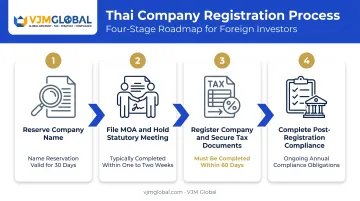
Step 1: Reserve Your Company Name
Name reservation happens online through the Department of Business Development (DBD). You submit one preferred name plus alternates, since duplicate or conflicting names get rejected automatically.
A few practical points:
- Approved names stay valid for 30 days; register within that window or start again
- Names resembling existing registrations, government bodies, or restricted words will be bounced
- All forms are in Thai, which makes a bilingual attorney or local agent essential for German founders unfamiliar with the script
Step 2: File the Memorandum of Association and Hold a Statutory Meeting
Thai company registration requires at least two founders to prepare and sign the Memorandum of Association (MOA), which must be filed within 30 days of name approval. Promoters can be foreign nationals; there is no Thai residency requirement at this stage.
The MOA must specify:
- Company objectives and business scope
- Registered capital and share value
- Registered capital levels required for the activity, including higher thresholds where the business is Foreign Business Act (FBA)-restricted
Once the MOA is filed, a statutory meeting follows to appoint directors and auditors and approve the Articles of Association. If the MOA filing and meeting happen separately, notice must go out at least 7 days before the meeting.
Step 3: Register the Company and Secure Tax Documents
Company registration must be filed with the DBD, either online or in person, within three months of the statutory meeting. The BOI's 2026 setup guide also outlines a same-day route where the MOA and registration application are submitted together.
Once registered, three deadlines matter:
- Corporate Tax ID: obtain within 60 days of incorporation
- VAT registration: required once annual turnover is expected to exceed THB 1.8 million
- Social Security employer registration: due within 30 days of hiring your first employee
Missing these windows doesn't void the registration, but it does create compliance gaps that surface later during audits or work permit applications.
Step 4: Complete Post-Registration Compliance
This is where German companies often hit friction. Thai banks apply strict KYC checks and, when every director is foreign, frequently request a Thai-resident signatory or evidence of BOI approval before opening a corporate account.
Staffing brings its own sequence:
- German employees need a Non-Immigrant "B" visa
- The Thai employer then files the work permit application (Form WP3)
- Work cannot legally start before the permit is granted
- Standard companies must keep a 4 Thai-to-1 foreign employee ratio (BOI-promoted companies are exempt)
Finally, sector-specific licences (factory licences, a Foreign Business Licence, or similar) must be secured before operations begin in restricted categories.
Choosing the Right Ownership Structure: Why the Rules Differ for German Companies
This is the section most German founders skip past, and it's the one that causes the most delays later.
Under the FBA's three-list system, restricted-sector companies are capped at 49% foreign equity unless the entity holds BOI promotion, a Foreign Business Licence, or a qualifying exemption. A Thai company becomes classified as "foreign" once foreign shareholders hold 50% or more of the capital.
One misconception needs a direct correction. The US-Thailand Treaty of Amity lets American companies own 100% of a Thai business in most sectors, but it does not extend to Germany or any other EU country. Coverage is limited to US nationals and companies.
German investors sometimes assume a similar EU-Thailand mechanism exists. It doesn't.
BOI Promotion: The Practical German Route to Full Ownership
For German firms, BOI promotion is the realistic path to 100% ownership. That path maps closely to where German capital already clusters in Thailand:
- Automotive supply chain and component manufacturing
- Electric vehicle production and battery technology
- Advanced manufacturing and automation
- Digital and technology services
Foreign Business Licence: The Fallback Option
If a business activity doesn't qualify for BOI promotion but still falls under FBA restrictions, a Foreign Business Licence (FBL) is the alternative route. Expect a longer timeline and considerably lower approval certainty compared to BOI.
Comparing Structures
| Structure | Foreign Ownership | Best Fit |
|---|---|---|
| Thai-majority Co., Ltd. (JV) | Up to 49% | Restricted sectors without BOI/FBL |
| BOI-promoted subsidiary | Up to 100% | Manufacturing, EV, digital, automotive supply chain |
| Foreign Business Licence (FBL) | Up to 100% if approved | Restricted activities outside BOI scope |
| Representative/Branch Office | N/A (no local shareholding) | Market scouting before capital commitment |
A representative or branch office suits German companies still scouting Thai suppliers or customers when you want market signal before locking in registered capital.
Costs, Capital Requirements and Tax Obligations for German Investors
Capital requirements hinge entirely on sector classification:
- Non-restricted, foreign-majority business: minimum THB 2 million registered capital
- FBA-restricted activity: the higher of 25% of average annual operating costs over three years, or THB 3 million minimum
- Per foreign work permit: an additional THB 2 million in registered capital, per the BOI's guidance
Beyond registered capital, German founders should budget for:
- Government registration fees
- Legal or agent costs for Thai-language filings
- Translation and notarisation of German incorporation documents
Timelines typically stretch from a few weeks for straightforward Thai-majority JVs to several months where BOI promotion or an FBL is involved.
Tax Obligations
- Corporate income tax: standard rate of 20% on net profit
- VAT: 7%, registration required once turnover crosses THB 1.8 million
- Withholding tax on dividends: Germany-Thailand DTA (1967) caps rates at 15–25%, depending on shareholding
- Withholding tax on royalties: 5% for copyright; 15% for patents, trademarks and know-how
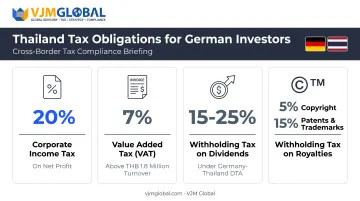
The DTA only helps if the entity is structured correctly from incorporation. Get sector-specific, treaty-aware tax advice before finalising your shareholding structure, not after.
Common Mistakes and Practical Considerations for German Companies
Legal and Compliance Pitfalls to Avoid
Nominee shareholder arrangements (using a Thai national as a paper majority owner to bypass the 49% cap) are illegal and actively prosecuted.
In May 2024, Thailand's Central Investigation Bureau arrested 231 suspects in a Phuket nominee crackdown, including 98 foreign nationals and 37 alleged Thai nominees. Charges were pending against 96 juristic persons. The FBA allows up to three years' imprisonment and fines up to THB 1 million for Thai nationals who assist in these schemes.
Two other recurring issues:
- Undercapitalisation relative to planned foreign headcount: every work permit needs THB 2 million in backing capital, so companies that under-fund at registration stall their own visa applications later
- Assuming German or EU documents transfer directly: they don't. Thai statutory filings must be prepared, and often notarised, in Thai, regardless of what is already notarised in Germany
Visas, Local Hiring and Business Etiquette
Beyond the standard Non-B visa and work permit sequence, skilled specialists may qualify for the SMART Visa, which grants up to four years' stay and exempts holders from the work permit requirement entirely. BOI-promoted companies also skip the standard 4:1 staffing ratio through the Single Window system.
Visas and headcount rules are only part of the setup. Thai business practice leans heavily on hierarchy and indirect communication, which contrasts with the directness common in German negotiating style. That gap shows up most in supplier discussions and joint venture talks, where a blunt German counteroffer can read as confrontational rather than efficient.
Before serious negotiations, review market entry guidance and sector reports from the Thai-German Chamber of Commerce (AHK) and Germany Trade & Invest (GTAI).
Alternatives to Full Incorporation and How VJM Global Supports Your Thailand Entry
Full incorporation isn't always the right first move. A few alternatives worth weighing:
- Employer of Record (EOR): Hire Thai staff and test the market before committing registered capital. Covers employment only, not commercial operations, invoicing, or Thai customer contracts
- Representative office: Suited to market research and liaison; no revenue-generating operations
- Branch office: Allows limited commercial activity under the parent company's name
- BOI-promoted subsidiary: Supports full Thai operations with retained foreign ownership when you are ready to commit
Choosing between these depends on your growth stage. A German auto-parts supplier scouting Thai buyers might start with EOR-based hiring or a representative office. A German manufacturer ready to build production capacity is better served going straight for BOI promotion.
VJM Global's cross-border practice spans entity formation, tax compliance, and EOR-based hiring across 16+ markets, including Germany. Multi-jurisdiction reporting helps parent companies keep home-market obligations aligned as they expand.

For German companies weighing Thailand against other markets, map ownership route, capital plan, and German reporting impact before you file a single Thai form.
Thailand rewards German entrants who lock in the right ownership route (BOI, FBL, or a Thai-majority JV) before registration. Most failures trace back to capital shortfalls, documentation gaps, or founders chasing a Treaty of Amity shortcut that doesn't exist for them. Get ownership, capital, and reporting aligned first—registration moves faster when those decisions are already settled.
Frequently Asked Questions
How much does it cost to set up a business in Thailand?
Expect a minimum of THB 2 million in registered capital for a non-restricted foreign-majority company, rising to THB 3 million or more for restricted activities. Add government fees and legal or agent costs for Thai-language filings on top.
Can a foreigner set up a business in Thailand?
Yes, but foreign ownership is generally capped at 49% in FBA-restricted sectors unless you secure BOI promotion or a Foreign Business Licence. Non-restricted activities allow full foreign ownership without these approvals.
How long will $100,000 last in Thailand?
For personal living costs, a Bangkok-based family of four spends roughly THB 87,666 per month excluding rent, according to Numbeo. That means $100,000 stretches considerably further there than in most European cities. Keep this separate from registered capital and setup costs, which are budgeted independently.
Does the Treaty of Amity apply to German companies in Thailand?
No. The Treaty of Amity is exclusive to US nationals and US-incorporated companies. BOI promotion is the practical equivalent route for German companies seeking full ownership.
Do German companies need a Thai shareholder to register a company in Thailand?
Only for restricted-sector activities without BOI promotion or a Foreign Business Licence. Non-restricted businesses can be 100% German-owned without any Thai shareholder requirement.
Is there a double taxation treaty between Germany and Thailand?
Yes, signed in 1967. It reduces withholding tax on dividends and royalties repatriated to Germany, though the exact rate depends on shareholding percentage and payment category.