But Thailand isn't a plug-and-play market. Many founders assume they can register a company and operate the way they would in Delaware or Texas. Then they run into the Foreign Business Act and discover most sectors cap foreign ownership at 49% unless an exemption applies.
Here's the good news for American companies specifically: the US-Thai Treaty of Amity, signed in 1966, gives US-owned businesses a path to majority or full ownership that almost no other foreign investor gets. It's a genuine edge, but only if the entity structure and certification process are handled correctly from day one.
This guide covers the legal framework, entity options, registration steps, and compliance obligations US businesses need to plan for before committing capital to Thailand.
Key Takeaways
- Use the Treaty of Amity to hold up to 100% of a Thai entity as a majority US-owned firm, bypassing the 49% cap.
- Check the Foreign Business Act lists before you pick a sector—List 1 activities are fully closed to foreigners.
- Pursue BOI promotion for 100% ownership plus tax holidays in manufacturing, tech, and other priority industries.
- Budget two to four months for full registration once Treaty of Amity or BOI steps are included.
- Plan for work permits, social security, and annual filings the moment you hire your first employee.
Why US Businesses Are Expanding into Thailand
The US and Thailand aren't new trading partners. In 2025, bilateral goods trade between the two countries reached $110.8 billion, according to U.S. Census Bureau trade data. The US imported $91.26 billion from Thailand and exported $19.59 billion in return. That's a substantial, established relationship, not a speculative one.
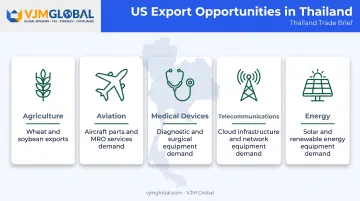
The U.S. Commercial Service flags several sectors where American companies have a genuine opening in Thailand:
- Agriculture - wheat, soybeans, dairy, and food ingredients, with steady year-over-year growth in US exports
- Aviation - airport infrastructure, MRO services, and ground-support equipment as Thailand's air-travel capacity expands
- Medical devices - a growing export sector with strong demand for US suppliers and technology partners
- Telecommunications - cloud infrastructure, data centers, and secure payment systems tied to Thailand's expanding digital economy
- Energy - renewable equipment, battery storage, and smart grid technology
Beyond bilateral trade, Thailand's membership in ASEAN and the Regional Comprehensive Economic Partnership positions the country as a regional manufacturing and re-export base. RCEP entered into force for Thailand on January 1, 2022. Qualifying for preferential tariff treatment still depends on meeting product-specific rules of origin, though. Incorporating in Thailand alone doesn't automatically unlock those benefits.
The Foreign Ownership Catch
Here's where the opportunity gets complicated. Thailand's Foreign Business Act restricts foreign ownership across a wide range of sectors, from retail to construction to most professional services. Get the entity structure wrong, and you could find yourself unable to hold majority equity or repatriate profits the way you expected.
That's exactly why local regulatory expertise matters before capital moves. The rest of this guide breaks down how the FBA works, and how the Treaty of Amity changes things for US businesses specifically.
Legal Framework for US Businesses: The Foreign Business Act and the Treaty of Amity
The Foreign Business Act (FBA) of 1999 determines who counts as a "foreigner" in Thailand, and it's broader than most people expect. Under Section 4, foreigner status attaches to:
- Any non-Thai individual
- Any foreign-registered legal entity
- A Thai-registered company where foreigners hold 50% or more of the capital
- A registered partnership managed by a foreign national
That 50%-or-more threshold is where the commonly cited "49% foreign ownership cap" comes from. It isn't a blanket rule for every industry in Thailand. It's the practical ceiling that kicks in once a company conducting a restricted activity crosses into "foreign" territory under the Act.
The FBA sorts restricted activities into three lists:
- List 1 - Activities completely closed to foreigners, including rice farming, forestry, fisheries in Thai waters, and land trading.
- List 2 - Activities tied to national security, culture, or natural resources, such as domestic transport, mining, and silk production. These require Cabinet-level approval.
- List 3 - Activities where Thai businesses are considered "not yet ready to compete," covering accounting, legal services, construction, brokerage, and most retail and hospitality. These need a Foreign Business License.
The US-Thai Treaty of Amity Advantage
This is where American companies get a real structural edge. The 1966 Treaty of Amity and Economic Relations grants US nationals and majority US-owned companies national treatment in Thailand. A Thai company that's majority American-owned and controlled can hold up to 100% ownership and, for most covered activities, skip the Foreign Business License in favor of a Foreign Business Certificate.
It's not unconditional, though. Treaty companies still cannot engage in:
- Communications and transportation
- Fiduciary services
- Banking involving deposit-taking
- Land ownership or exploitation
- Exploitation of natural resources
- Domestic trade in indigenous agricultural products
To qualify, a company generally needs:
- Majority American shareholding at every ownership tier, not just the top layer
- A majority of American or Thai directors
- Two-step certification: the U.S. Commercial Service in Bangkok verifies ownership, then Thailand's Ministry of Commerce issues the Foreign Business Certificate
Miss either step, or structure ownership incorrectly at a subsidiary layer, and Treaty protection doesn't apply. This is the single most common mistake we see US founders make when they try to handle this alone.
Alternative Pathways When the Treaty Doesn't Apply
Not every US business fits neatly into Treaty status, and not every activity is covered even when it does. Two other routes exist:
- BOI (Board of Investment) promotion — For manufacturing, tech, and R&D. Allows up to 100% foreign ownership, tax holidays (3–8+ years), and duty-free machinery imports. Minimum investment: THB 1 million (excluding land and working capital).
- Foreign Business License (FBL) — Fallback when Treaty or BOI do not apply. Requires foreign capital of at least 25% of three-year average operating expenses, never below THB 3 million. Decision within 60 days.
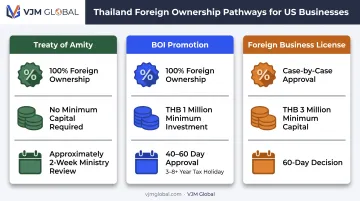
Both routes involve more paperwork and higher capital thresholds than the Treaty pathway, which is why most American SMEs pursue Treaty of Amity status first.
Choosing the Right Business Entity for Your Thailand Market Entry
Everything above—the FBA restrictions, the Treaty exemption, and the BOI alternative—feeds into one decision: which legal entity fits your Thailand operation. Entity choice sets your ownership ceiling, tax treatment, and whether you can hire staff and open a bank account without friction.
Private Limited Company
This is the default structure for most businesses in Thailand, treaty status or not. Since amendments to the Civil and Commercial Code took effect in February 2023, incorporation requires just two promoters (down from three), at least two shareholders, and one director. Without a Treaty of Amity certification or BOI exemption, foreign ownership caps at 49%.
Treaty of Amity Company
This isn't a separate legal entity type. It's a certified status layered onto a standard Thai limited company. Once certified, a majority US-owned and controlled limited company can hold up to 100% ownership while operating under the same corporate framework as any other Thai company. For most American SMEs, this is the structure worth aiming for.
Branch Office and Representative Office
These two get confused constantly, and they serve very different purposes:
- Branch Office — Extension of the US parent, not a separate Thai entity. Can trade and earn revenue under FBA limits (FBL required for reserved activities); the parent keeps full liability.
- Representative Office — Cannot generate revenue. Limited to sourcing, quality control, or market reporting for the US head office, and funded entirely by the parent.
BOI-Promoted Company
Best suited to US businesses in tech, manufacturing, or R&D that want full ownership plus tax incentives, rather than just ownership flexibility. The trade-off is a more involved application tied to specific promoted activities.
| Structure | Foreign Ownership | Revenue Generation | Best Fit |
|---|---|---|---|
| Private Limited Company | Up to 49% without exemption | Yes | General entry without Treaty/BOI eligibility |
| Treaty of Amity Company | Up to 100% | Yes | Most American SMEs and trading businesses |
| Branch Office | Extension of US parent | Yes, within FBA limits | Testing Thai operations under the US entity |
| Representative Office | Not applicable | No | Sourcing, quality control, liaison functions |
| BOI-Promoted Company | Up to 100% | Yes | Manufacturing, tech, and R&D-focused businesses |
Step-by-Step Process to Register a Company in Thailand
Once you've settled on Treaty of Amity, BOI, or standard limited company status, the registration mechanics follow the same core sequence through the Department of Business Development (DBD).
- Reserve your company name. DBD review typically takes 2-3 working days. Approval is valid for 30 days with no extension, so submit two or three backup names in case your first choice gets rejected for similarity to an existing company.
- Draft the Memorandum of Association. This outlines your objectives, registered capital, and promoters, and must be filed within the 30-day name reservation window. Current rules require a minimum of two promoters.
- Hold the statutory meeting. Promoters and shareholders adopt the Articles of Association and appoint directors. If shares are fully subscribed and at least 25% of share value is paid up, this step and incorporation can happen the same day.
- Submit registration to the DBD. Once approved, you'll receive your company affidavit and tax ID. The DBD is offering a 50% reduction on covered registration fees through December 2026; exact fees still scale with registered capital, so confirm the current schedule before budgeting.
- Open a corporate bank account. Thai banks generally require all directors to be physically present, and most expect your DBD registration and tax ID first. Build extra time in here; it trips up more remote founders than any other step.
- Register for corporate income tax and VAT. VAT registration becomes mandatory once annual turnover exceeds THB 1.8 million.
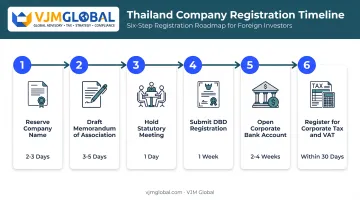
Realistic timeline: Name reservation and incorporation can finish within a couple of weeks once documentation is ready. Layer on pathway approvals as needed:
- Treaty of Amity: Ministry of Commerce review typically completes within two weeks of submission
- BOI approval: About 40 days for investments up to THB 200 million; 60 days up to THB 2 billion
For most US businesses, the full process runs two to four months.
Post-Registration Compliance US Businesses Must Plan For
Registering the company is the easy part. Year-round compliance is where most foreign-owned entities get penalized if they treat registration as the finish line.
Ongoing tax obligations include:
- Corporate income tax at a standard rate of 20% of net profit
- Withholding tax on dividends and repatriated branch profits, generally 10%
- VAT at 7%, mandatory once turnover crosses the THB 1.8 million threshold
Rates and thresholds shift periodically, so verify current figures with the Revenue Department before filing.
Work permits are tied to headcount and capital. Sponsoring a foreign employee generally means maintaining a Thai-staff ratio and adequate registered capital.
A common benchmark is about four Thai staff per foreign permit holder, though the exact requirement can vary by application. Confirm your ratio with the Department of Employment before you lock headcount plans.
Two deadlines that catch people off guard:
- Social security registration is due within 30 days of your first hire
- Annual filings (balance sheet, shareholder list, auditor appointment) are due every year—miss them and penalties compound
None of this runs on autopilot after registration. Build tax, permit, and filing calendars into your operating plan from day one.
Why US Businesses Rely on a Cross-Border Formation Partner Like VJM Global
Classifying your business correctly under the FBA, pursuing Treaty of Amity certification, and choosing the right entity structure, all before generating a dollar of Thai revenue, is where most US founders either lose months or lock themselves into a structure they later have to unwind.
That's the gap experienced cross-border advisors fill. VJM Global has spent over 30 years on entity formation, tax, payroll, and compliance, supporting clients across 100+ countries with CPAs, Chartered Accountants, and multi-jurisdiction compliance professionals. The firm has already guided 500+ American business owners through market entry elsewhere—experience that helps you avoid the same structuring mistakes when entering Thailand.
If you are still deciding whether Thailand warrants a full entity, VJM Global's Employer of Record network (100+ countries) lets you hire and test local operations first. A legal employer handles contracts, payroll, and statutory contributions without the cost of a Thai company you may not need yet.

Formation is only the starting point. The work that keeps a US-owned Thai entity in good standing year after year includes:
- Monthly bookkeeping and management reporting
- Corporate tax filings and statutory returns
- Payroll processing and local contributions
- Annual audit coordination
Most founders underestimate that layer until the first compliance deadline arrives.
Frequently Asked Questions
Can a US citizen set up a company in Thailand?
Yes. US citizens can register a standard Thai limited company subject to the 49% foreign ownership cap, or use Treaty of Amity status to secure majority or full ownership in most sectors.
Can a US citizen own 100% of a company in Thailand?
Yes, through Treaty of Amity certification for majority US-owned and controlled companies, BOI promotion in eligible industries, or certain manufacturing-only businesses. A standard limited company without one of these exemptions cannot exceed 49% foreign ownership.
Is DBD registration mandatory for all businesses in Thailand?
Yes. Limited companies, partnerships, branch offices, and representative offices all must register with the Department of Business Development, though required documentation varies by entity type.
What is the minimum capital required to register a company in Thailand?
There's no fixed statutory minimum beyond nominal share value for a private limited company. In practice, though, THB 2 million in registered capital is a common benchmark tied to sponsoring a foreign employee's work permit.
How long does it take to register a company in Thailand?
Basic DBD registration can move in a couple of weeks once documents are ready. Add Treaty of Amity or BOI certification and bank account setup, and expect two to four months for the full process.
Do US citizens need a work permit to run their Thailand company?
Yes, if they're actively working in the business day-to-day. Sponsorship generally ties back to maintaining an adequate ratio of Thai employees and registered capital.