Introduction
German manufacturers have been moving parts of their supply chains into Thailand for years. The AHK Thailand network now counts almost 600 member companies with German ties.
BMW's 2024 high-voltage battery assembly project in Rayong, reportedly worth more than THB 1.6 billion, around EUR 42 million, shows why Thailand's EV and automotive supply chain keeps pulling German capital.
But most "how to register a company in Thailand" guides skip the details that actually matter to a German investor: the foreign ownership cap, whether BOI promotion applies to your sector, and the Thai-language filing steps that catch first-time founders.
This article walks through the private limited company structure, the registration process, your ownership options, realistic costs, and the mistakes German investors most often make.
Key Takeaways
- A Thai Co., Ltd. needs at least two shareholders and caps foreign ownership at 49% in restricted sectors
- Germany has no Treaty of Amity; that 100% ownership shortcut is reserved for US nationals
- BOI promotion is the practical route to full German ownership in manufacturing, EV, and digital sectors
- Registered capital of THB 2-3 million affects whether your German staff can get work permits
- The 1967 Germany-Thailand DTA can lower withholding tax on profits repatriated to Germany
What is a Private Limited Company in Thailand?
A private limited company (Co., Ltd.) is Thailand's equivalent of a German GmbH. It's governed by the Civil and Commercial Code and offers shareholders limited liability, meaning personal assets stay protected if the business runs into debt.
Since February 2023, the minimum shareholder requirement dropped from three to two shareholders. Ignore any older guidance still quoting three; that rule no longer applies.
Key structural facts:
- Every share must carry the same nominal value, with a floor of THB 5 per share
- There's no general statutory minimum registered capital for ordinary incorporation
- Practical minimums still apply once foreign ownership or work permits enter the picture (more on that below)
Director Requirements
You need at least one director, and there's no Thai residency requirement for that role. Foreigners can serve as directors freely.
If a foreign director wants to work actively inside the company, the picture changes. That triggers a work permit requirement, which brings capital and staffing rules into play, covered later in this guide.
Step-by-Step Registration Process for German Companies
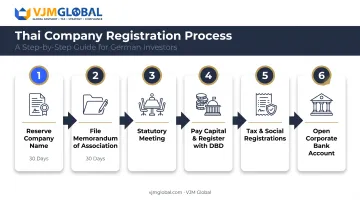
Thai incorporation moves fast once filing starts. German founders should lock the company name, capital figures, and director details before the DBD clock begins.
- Reserve your company name. Submit three name options through the DBD's online portal. Approval is valid for 30 days with no extension, so have your Thai-language transliteration checked in advance. Names that read awkwardly in Thai script get rejected.
- File the Memorandum of Association. This must happen within 30 days of name approval. It sets out your objectives, registered capital, and promoter details. Promoters don't need Thai residency.
- Hold the statutory meeting. This approves the Articles of Association and appoints directors and auditors. If held separately from the MOA filing, give at least 7 days' notice.
- Pay in capital and register. Pay at least 25% of subscribed share value, then register with the DBD within three months of the statutory meeting. A same-day filing route is available if every statutory step is complete in advance.
- Complete tax and social registrations. Apply for a corporate tax ID within 60 days. Register for VAT once turnover passes THB 1.8 million. Register for Social Security within 30 days of your first hire under current SSO rules.
- Open a corporate bank account. Thai banks apply strict KYC checks. If every director is a foreign national, expect the bank to ask for a Thai-resident signatory or proof of BOI approval before opening the account.
Ownership Structures: Why Germany's Options Differ from the US and UK
Here's the misconception German founders run into most often: assuming an EU equivalent to the US Treaty of Amity exists. It doesn't.
Under the Foreign Business Act, a company becomes classified as "foreign" once foreigners hold at least half its capital, and restricted activities then cap practical foreign equity at 49%. That cap only disappears for US nationals under the Amity Treaty, which Germany was never party to.
Your realistic routes to full ownership
- BOI promotion. The most viable path for German manufacturers. Qualifying sectors include automotive supply chain, EV and battery production, advanced manufacturing, and digital services.
- Foreign Business Licence (FBL). A fallback for restricted activities outside BOI scope. Statutory review is 60 days, but approval isn't guaranteed and timelines often run longer.
- Thai-majority joint venture. Keeps you under the foreign-ownership threshold, but requires genuinely funded, non-nominee Thai shareholders.
| Structure | Foreign ownership | Best fit |
|---|---|---|
| Thai-majority JV | Below 50% | Restricted activities without BOI eligibility |
| BOI-promoted subsidiary | Up to 100% | Automotive, EV, advanced manufacturing, digital |
| Foreign Business Licence | Up to 100% | Restricted activities, discretionary approval |
| Representative/branch office | 100% (limited activities) | Market research, liaison, non-revenue functions |
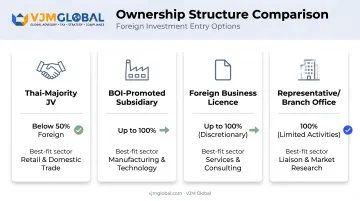
Map your exact business activity against BOI's eligible-activities list before you fix your shareholding structure. Getting this sequence backwards is how companies end up incorporated but unable to legally operate as planned.
Costs, Capital Requirements and Tax Obligations
Capital requirements fall into two layers founders often conflate: registered capital the company must hold, and capital commonly linked to each foreign work permit.
Registered capital tiers:
- THB 2 million minimum for foreign-majority companies in non-restricted activities
- For FBA-restricted activities: the higher of 25% of three-year average operating costs or THB 3 million
- THB 2 million per foreign work permit is commonly cited — confirm against current Ministry of Labour guidance before you budget
Other budget items to plan for:
- DBD government filing fees
- Thai-language legal and registered-agent costs
- Translation and notarisation of German corporate documents
- BOI application fees, if applicable
Tax obligations:
- 20% corporate income tax on net profit
- 7% VAT once turnover exceeds THB 1.8 million
- Reduced withholding tax on dividends and royalties under the Germany-Thailand DTA, if ownership and payment flows are structured correctly from day one
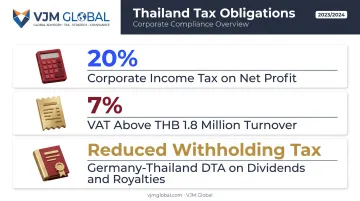
Get the DTA structuring right at incorporation. Retrofitting a tax-efficient structure after the company is already operating is far harder than building it in from the start.
Common Mistakes German Investors Should Avoid
German founders incorporating in Thailand hit the same three traps repeatedly.
Using nominee shareholders to bypass the 49% cap. This is the single riskiest shortcut. In 2024, Thai authorities investigated 419 suspected nominee companies across Bangkok, Chiang Mai, Surat Thani, and Chon Buri, according to Nishimura & Asahi's 2024 review, with 313 required to submit further documentation.
Penalties include up to three years' imprisonment and a THB 1 million fine.
Undercapitalising relative to headcount. Each foreign work permit needs capital backing. Plan your staffing before you set your registered capital, not after.
Assuming German notarisation transfers directly. It doesn't. German or EU-notarised documents don't automatically satisfy Thai filing requirements. Thai statutory documents typically need separate preparation, and often separate notarisation, in the Thai context.
How VJM Global Supports German Companies Entering Thailand
Cross-border entity formation always involves the same underlying challenge: matching your home-market expectations against a completely different regulatory system. VJM Global works with companies expanding from Germany and other markets into new jurisdictions, handling entity formation, tax compliance, and payroll using each market's own regulators and statutory instruments.
For a German company weighing Thai incorporation, that means a team that understands German documentation requirements on one side and can coordinate Thai filings on the other—without you building in-house legal capacity for a single market entry.
Support typically covers:
- DBD company registration filings and post-registration compliance
- BOI application preparation where investment promotion applies
- Tax compliance and payroll setup after incorporation
If you're not ready to incorporate yet, an Employer of Record (EOR) arrangement lets you hire staff locally and test the market before full entity formation. VJM Global's EOR/PEO service covers employment contracts, payroll, and statutory contributions across 100+ countries. Confirm current Thailand coverage and pricing directly, since availability is quoted per country.
Frequently Asked Questions
How much does it cost for a foreigner to register a company in Thailand?
Expect registered capital in the THB 2-3 million range, depending on your sector and foreign-ownership level, plus government filing fees and Thai legal or agent costs. Translation and notarisation of German documents add further expense.
Can a foreigner own a company in Thailand?
Foreign ownership is generally capped at 49% in restricted sectors, but BOI promotion or a Foreign Business Licence can unlock up to 100% ownership. Germany has no Amity-style exemption; that route is reserved for US nationals.
What is a private limited company in Thailand?
A Co., Ltd. is Thailand's standard limited-liability entity, similar to a German GmbH. It requires a minimum of two shareholders and protects shareholders' personal assets from company debts.
How can I check if a company is legitimate in Thailand?
Use the DBD's public Business Datawarehouse (datawarehouse.dbd.go.th) to verify a company's registration status, filings, and financial statements. English certificate checks are also available through DBD's online portal.
What is the Department of Business Development (DBD) in Thailand?
The DBD sits within Thailand's Ministry of Commerce and acts as the company registrar. It handles name reservation, MOA filing, and company registration for all new Thai entities.
Is there a double taxation treaty between Germany and Thailand?
Yes, signed in 1967. It caps withholding tax on dividends at 15-20% and royalties at 5-15%, depending on the payment type and ownership structure, reducing the effective tax drag on repatriated profits.