Introduction
India-Canada trade hit CAD 10.9 billion in 2025—CAD 3.9 billion in Canadian exports to India and CAD 7.0 billion in imports from India—according to Global Affairs Canada.
That corridor is pulling more Indian founders to Canada to serve North American clients, hire local talent, or support longer-term business plans. Many still stumble early on entity type, paperwork, and province choices that raise their tax bill.
Here's the first thing to get right: "Private Limited Company" is an Indian legal term under the Companies Act, 2013. Canada doesn't use it. The equivalent structure there is a privately-held Corporation, registered with the suffix Inc., Ltd., or Corp.
This guide covers incorporation steps, the documents you need as an Indian applicant, province and CCPC choices that affect tax, costs, and the mistakes that trip up first-time founders.
TL;DR
- Indian nationals can incorporate in Canada without citizenship, residency, or (in most provinces) a resident director.
- Choose federal vs provincial incorporation based on name protection and filing rules.
- Core documents: notarised/apostilled ID and address proof, a Canadian registered office, and Articles of Incorporation.
- CCPC status, India–Canada DTAA rates, and RBI ODI rules set your tax cost and India-side reporting.
- Annual filings and a working Canadian bank account are non-negotiable after incorporation.
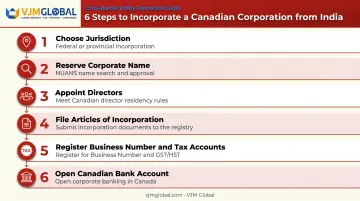
Step-by-Step Process to Incorporate a Corporation in Canada from India
Step 1: Choose Your Incorporation Jurisdiction
You have two paths:
- Federal incorporation (through Corporations Canada under the CBCA) protects your name across all of Canada and signals credibility to partners in multiple provinces.
- Provincial incorporation (Ontario, British Columbia, Alberta, etc.) is faster to set up but only protects your name and registration within that one province.
Federal and single-province corporations both need extra-provincial registration the moment they conduct business in another province. Base your choice on where your first customers, office, or bank relationship will actually be, not just where incorporation feels cheapest.
Step 2: Reserve Your Corporate Name
A federal or provincial word name must clear a NUANS (Newly Upgraded Automated Name Search) report, which checks it against existing corporate names, business names, and trademarks. A federal NUANS report costs CAD 13.80 and stays valid for 90 days.
Naming rules require a legal element (Inc., Ltd., or Corp.) and prohibit names that are misleading or too similar to existing entities.
Faster alternative: Register a numbered company, such as "12345678 Canada Inc." Corporations Canada assigns the number automatically, so you skip the name search entirely. Many foreign founders use this route to cut days off the timeline, then operate under a separate registered trade name.
Step 3: Appoint Directors and Confirm Residency Requirements
India requires at least one resident director. Canada's rules are different, and they vary by jurisdiction:
- Federal (CBCA): At least 25% of directors must be Canadian residents. With fewer than four directors, at least one must be resident.
- British Columbia: No residency requirement for directors at all.
- Ontario: Also dropped its resident-director quota back in 2021.
This means a single Indian national can often act as sole director and sole shareholder in provinces like BC or Ontario. Federal incorporation is trickier for a 100% India-based board. Check current rules for your target province before filing, since these requirements have shifted more than once in recent years.
Step 4: Draft and File Articles of Incorporation
Your Articles need to spell out:
- Authorized share structure (classes, rights, and restrictions)
- Registered office address in Canada
- Any restrictions on the business the corporation can carry on
Filing happens online through Corporations Canada or the relevant provincial registry. If you don't have anyone physically in Canada, a cross-border formation firm such as VJM Global can guide you through the filing sequence and arrange a local registered office.
Step 5: Register for a Business Number and Tax Accounts
Incorporation triggers a Business Number (BN) from the CRA, which links to your corporate tax account and, when needed, payroll and GST/HST program accounts.
GST/HST registration becomes mandatory once your worldwide taxable supplies exceed CAD 30,000 over four consecutive calendar quarters. Below that, you're a small supplier and registration is optional, though many B2B founders register early anyway to claim input tax credits.
Step 6: Open a Canadian Corporate Bank Account
This is where non-resident directors hit friction. Most Canadian banks still want in-person verification before opening a corporate account, which isn't practical if you're filing from Mumbai or Noida.
Documents typically required include:
- Certificate of Incorporation
- Director identification (passport, and often a second ID)
- Corporate minute book or director resolution authorising the account
Some digital-first and international-friendly banking platforms now support remote account opening for foreign-owned Canadian corporations. Budget time for this step; it's often the longest part of the whole process, not the incorporation filing itself.
Documents and Eligibility Requirements for Indian Applicants
Identity, Address, and Registered Office Proof
As an Indian founder, expect to provide:
- Notarised and apostilled passport copy for every proposed director and shareholder
- Recent address proof (utility bill or bank statement, typically under 2-3 months old)
- Photographs of all directors/shareholders
Canada also mandates a registered office address inside the country where legal notices and regulatory correspondence can be served. A physical PO box does not qualify.
If you have no Canadian presence yet, a registered agent or office service can meet this requirement. Provider scope varies (mail handling, notice forwarding), so confirm exactly what is included before you sign up.
Shareholding and Capital Structure
Unlike India's historical paid-up capital norms, Canada has no statutory minimum share capital for an ordinary business corporation. Most founders set a nominal number of shares (say, 100 common shares) and adjust later as investment comes in.
Key ownership rules for Indian applicants:
- 100% foreign ownership is generally permitted
- New businesses face the Investment Canada Act, usually via simple notification rather than full review
- Full review applies mainly to large acquisitions or sensitive sectors (critical minerals, sensitive technology, interactive digital media)
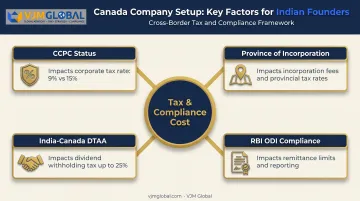
Key Factors That Affect Your Canada Company Setup
A handful of structural decisions made at incorporation shape your tax bill and compliance load for years afterward.
CCPC (Canadian-Controlled Private Corporation) Status
Why it matters: A CCPC must be private, Canadian-resident, and not controlled by non-residents, public corporations, or a mix of the two. If Indian founders hold controlling ownership, the corporation typically won't qualify as a CCPC, even though it's incorporated on Canadian soil.
Impact on tax: A qualifying CCPC pays a federal rate of just 9% on eligible active business income within its small-business limit, versus the general federal rate of 15% for everyone else, according to CRA's 2025 corporation tax rate schedule.
Indian-controlled corporations should plan around the general rate, not the lower CCPC rate, when modelling returns.
Province of Incorporation and Extra-Provincial Registration
Why it matters: Fees, filing calendars, and provincial tax rates all differ by jurisdiction.
| Province | Online Incorporation Fee | General Provincial Rate |
|---|---|---|
| Ontario | CAD 300 | 11.5% |
| British Columbia | CAD 350 (+CAD 30 for a named company) | 12% |
| Alberta | Registry-agent quote | 8% |
Impact on operations: Operating outside your incorporation province without registering extra-provincially creates real compliance exposure, including fines and unenforceable contracts in that province.
India-Canada DTAA and Tax Residency
Why it matters: The Double Taxation Avoidance Agreement caps withholding tax on dividends paid out of Canada. Where the beneficial owner is a company holding at least 10% of voting power, the treaty rate is capped at 15% of the gross dividend. For everyone else, including an individual founder receiving dividends directly, the treaty ceiling sits at 25%, which happens to match Canada's standard non-treaty rate.
Impact on repatriation: Structuring share ownership through a corporate entity, rather than holding shares personally, can meaningfully reduce the tax drag when profits flow back to India.
RBI Compliance for Outbound Investment from India
Why it matters: When an Indian resident invests in an unlisted Canadian corporation, it counts as Overseas Direct Investment (ODI) under RBI rules. Individuals can remit up to USD 250,000 per financial year under the Liberalised Remittance Scheme, and must file Form FC with their designated bank at the time of remittance.
Impact on reporting: An Annual Performance Report (APR) is due by December 31 each year the investment is held, based on audited financials. Founders holding under 10% with no control and no financial commitment beyond equity capital are exempt from the APR requirement.
Private Limited Company vs Other Business Structures in Canada
A Canadian corporation isn't automatically the right first move for every Indian founder. It depends on whether you need a full local entity or a lighter way to test the market.
When a Canadian Corporation Makes the Most Sense
Incorporate when you plan to:
- Scale operations and eventually raise outside capital
- Hire employees locally in Canada
- Separate personal and business assets with limited liability
- Sign contracts, open credit lines, or build a long-term Canadian presence
Alternatives to Consider
Sole Proprietorship or Partnership
- Better for: Testing a small Canadian operation cheaply, without formal structure
- Trade-off: Requires Canadian work authorisation to operate directly, and offers no liability protection—personal assets stay exposed
Extra-Provincial Registration of an Existing Indian Company
- Better for: Testing the Canadian market without creating a brand-new legal entity
- Trade-off: The Indian parent stays fully liable for Canadian activities, and each active province still needs its own registration
Costs, Compliance, and Common Mistakes to Avoid
Costs to Budget For
| Item | Typical Cost (CAD) |
|---|---|
| Federal online incorporation | $200 |
| Federal express service (4-hour) | +$100 |
| Ontario online incorporation | $300 |
| BC incorporation (named company) | $350 + $30 name fee |
| Federal NUANS name search | $13.80 |
| Registered office/agent service | Quote-based |
| Professional filing assistance | Quote-based |
Ongoing Compliance Obligations
Once incorporated, you need to keep up with:
- Annual returns filed with Corporations Canada or the provincial registry
- Corporate income tax filing (T2) every year, regardless of profitability
- Statutory minute book and an active registered office address
VJM Global can coordinate these Canadian filings with your India-side FEMA and RBI reporting so both ends stay covered.
Common Mistakes Indian Entrepreneurs Make
- Skipping RBI ODI reporting before or after remitting funds, including Form FC and the annual performance report
- Picking a province on fees alone, ignoring later extra-provincial registration when you expand
- Underestimating bank account friction, assuming a Canadian corporate account opens as easily as an Indian one remotely
Frequently Asked Questions
How do you qualify as a CCPC?
A corporation qualifies as a CCPC if it is incorporated in Canada, is resident in Canada, and is not controlled by non-residents, public companies, or both. Majority Indian ownership typically disqualifies a corporation from CCPC status.
Can I work remotely for an Indian company from Canada?
That depends entirely on your immigration status, work permit, or study permit conditions in Canada. Physical presence in Canada can also trigger Canadian tax residency, potentially creating dual reporting obligations.
Do I need a Canadian resident director to incorporate a company in Canada?
It depends on jurisdiction. British Columbia and Ontario don't require one, while federal incorporation requires at least 25% resident directors. Verify current rules for your chosen province before filing.
How long does it take to incorporate a company in Canada from India?
Federal online incorporation is typically same-day, with a 4-hour express option available. Provincial online filings, like Ontario's, are often immediate too, though mail-based provincial filings can take around 15 business days.
Can an Indian citizen be 100% owner of a Canadian corporation?
Yes, generally. Full foreign ownership is allowed under the Investment Canada Act, with review reserved mainly for large acquisitions or sensitive sectors like critical minerals or digital media.
Do I need RBI approval to set up a company in Canada from India?
Outbound investment falls under RBI's Overseas Direct Investment framework and the Liberalised Remittance Scheme. Most individual investments need post-facto reporting rather than prior approval, subject to the USD 250,000 annual LRS limit.