That said, Canadian founders still run into the same friction points: getting passports properly certified, finding a Sri Lanka-resident Company Secretary, figuring out which sectors actually allow 100% foreign ownership, and coordinating document signing across a 9.5-hour time difference.
This guide walks through eligibility, documentation, the step-by-step eROC process, realistic timelines and costs, and the mistakes Canadian applicants make most often.
Key Takeaways
- Sri Lanka allows 100% foreign ownership in most sectors; one Canadian can be sole director and shareholder
- Registration runs entirely through eROC; no physical presence in Sri Lanka is required
- A Sri Lankan registered office and a company secretary are mandatory for every company
- Statutory fees stay modest: Rs. 2,600 for name approval and Rs. 5,200 for registration
- Cross-border advisors such as VJM Global can coordinate documentation and filings from Canada
Can Canadians Register a Private Limited Company in Sri Lanka?
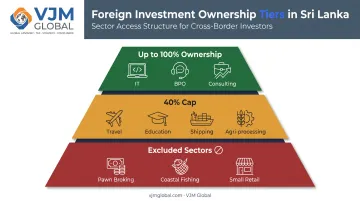
Yes, and in most industries you can own the entire company yourself. Sri Lanka's Foreign Exchange Regulations No. 2 of 2021 sets out three ownership tiers for non-resident investors:
- Up to 100% — most activities, including IT, BPO, professional services, and consulting
- 40% cap — travel agencies, mass communication, education, freight forwarding, shipping agencies, and primary processing of tea, rubber, coconut, rice, or spices (higher stakes need Board of Investment approval)
- Excluded — pawn broking, coastal fishing, and retail trade with foreign capital below USD 5 million
Under the Companies (Amendment) Act No. 12 of 2025, a company can legally have just one shareholder, whether a person or a body corporate. So if your business fits into the unrestricted category, you can be the sole director and sole shareholder without a local partner.
Two things you cannot skip, though:
- A registered office address physically located in Sri Lanka
- A company secretary, as required under Section 221 of the Companies Act No. 7 of 2007
One more structural note: sole proprietorships aren't available to foreign nationals in Sri Lanka. If you're incorporating as a non-resident, the Private Limited Company is your standard and only route.
Sector Eligibility Check for Canadian Investors
Before you reserve a name, confirm which ownership tier your activity falls into. Canadian founders in software, consulting, or export-oriented BPO usually qualify for 100% ownership.
If you sit near a capped or excluded sector—travel, shipping agencies, education, mass communication, freight forwarding, or smaller retail—verify classification before you draft Articles. Getting this wrong after a name reservation wastes weeks.
Documents and Requirements Needed From Canada
Preparing your paperwork before you open the eROC portal cuts avoidable delays. Have these ready:
- Certified passport copies for every director and shareholder, notarized by a Canadian notary or lawyer before you apply
- Proof of Canadian residential address, such as a recent utility bill or bank statement
- Company details prepared in advance: your proposed name (with two or three backups), business objectives, share structure, and full director/shareholder information
One detail that trips up a lot of applicants: the Registrar of Companies requires the company name to appear on the Articles' first page in English, Sinhala, and Tamil. This is often misunderstood as requiring the entire Articles of Association to be trilingual (see the Registrar of Companies guidance). Only the name needs the three-language treatment; the rest of the document can be in English.
The registered office must be a genuine Sri Lankan address. A Canadian address, virtual office, or PO Box will not meet the requirement. Many Canadian founders use their company secretary's office or a local service provider's address—both are common and accepted.
Step-by-Step Process to Register From Canada
Here's how the process unfolds when you're filing from Toronto, Vancouver, or anywhere else in Canada.
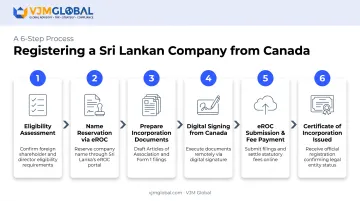
Initial eligibility assessment — Confirm your sector's foreign-ownership rules and whether Board of Investment approval is needed before you commit to a name or structure.
Reserve your company name via eROC — Submit your proposed name (and backups) through the portal. Approval typically comes back within a few business days, though exact turnaround varies with eROC's current load.
Prepare your incorporation documents — This includes Form 1 (the incorporation application), Form 18 (director consent), Form 19 (secretary consent), and your Articles of Association.
Digitally sign from Canada — You sign documents electronically, which is where the Canada–Sri Lanka time gap matters most. Build in a day or two of buffer for back-and-forth signatures rather than expecting same-day turnaround.
eROC submission and fee payment — Your company secretary or advisor submits everything online, pays the statutory government fees, and follows up with the Registrar on any queries.
Receive your Certificate of Incorporation — The Registrar issues this in digital form only, downloadable directly from your eROC dashboard. From there, you'll move on to opening a Sri Lankan corporate bank account.
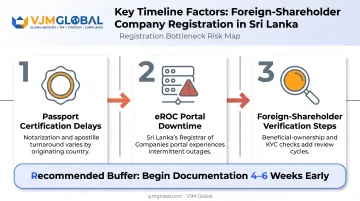
Heads up: Foreign-shareholder incorporations can take longer than domestic ones, partly because of extra verification steps and partly because eROC downtime does happen from time to time.
Timeline and Costs for Canadian Applicants
Let's be direct about costs first, since these are confirmed by the current gazette.
| Fee Item | Amount (excl. VAT) |
|---|---|
| Company name approval | Rs. 2,600 |
| Private limited company registration | Rs. 5,200 |
These figures come from ROC Gazette No. 2496/03, published in July 2026. On top of these statutory fees, expect professional fees from whoever handles your secretarial and filing work — these vary by provider and scope.
On timelines: be wary of any source promising an exact day count for foreign-applicant registration. There isn't a current official benchmark from the Registrar, the Board of Investment, or the Central Bank confirming a fixed range. What we do know, from practitioners in the field, is that:
- Foreign-shareholder cases generally take longer than domestic ones
- eROC portal downtime is a real, recurring factor
- The biggest bottleneck for Canadian applicants specifically is passport certification delays
If your notary appointment gets pushed back a week, or your certified documents need re-scanning because of a formatting issue, that ripples through the entire timeline. Book your Canadian notary early and confirm exactly what certification format Sri Lankan authorities expect before you submit anything.
Common Mistakes Canadian Investors Make
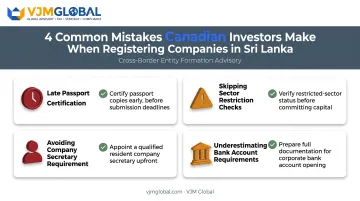
A few patterns show up again and again with Canadian applicants:
- Skipping passport certification until the last minute. Canadian notarization takes time to schedule, especially outside major cities. Start this in week one, not week three.
- Reserving a name before checking sector restrictions. A 40%-capped sector with you as sole shareholder means restructuring or Board of Investment approval—both add delay.
- Trying to avoid the local Company Secretary requirement. Under Section 221 of the Companies Act, every company must have one. There's no workaround, so budget for this from the start.
- Underestimating bank account requirements. Banks want certified Articles, board resolutions, beneficial-ownership declarations, and full KYC. Investment funds also need a separate Inward Investment Account—confirm your bank’s foreign-owned company policy early.
How VJM Global Supports Canadian Entrepreneurs Entering Sri Lanka
For Canadian founders setting up a private limited company in Sri Lanka, the hard part is rarely a single form—it is coordinating documents, filings, and regulator follow-ups across time zones. VJM Global delivers entity formation, accounting, tax, and compliance in more than 100 countries, backed by 30+ years of experience and a 95% client retention rate.
Chartered Accountants and corporate-compliance specialists handle the paperwork, answer regulator queries, and update you during your business hours while filing work runs overnight in another zone.
Typical support includes:
- Coordinating certified passports, Articles drafting, and eROC submission
- Managing registrar queries and resubmissions when documents need correction
- Keeping Canadian clients current without requiring them to chase overnight emails
- Accounting, tax, and corporate compliance after the company is registered
If your time is better spent on the business than on cross-border paperwork, outside formation support can carry that coordination load end to end.
Frequently Asked Questions
How do I register a private limited company in Sri Lanka?
Reserve your company name through eROC, then prepare Form 1, Form 18, Form 19, and your Articles of Association. Sign digitally, submit through eROC with the statutory fee, and the Registrar issues your Certificate of Incorporation digitally once approved.
What documents are needed to register a private limited company in Sri Lanka?
You'll need certified passport copies for all directors/shareholders, proof of residential address, Form 1, Form 18, Form 19, and the Articles of Association with your company name in English, Sinhala, and Tamil.
How can I check if a company is registered in Sri Lanka?
You can verify company status through the eROC portal or by conducting a file search directly with the Registrar of Companies.
Can a Canadian be the sole director and shareholder of a Sri Lankan company?
Yes, in sectors permitting 100% foreign ownership. Sri Lankan law allows a single-shareholder company, whether that shareholder is a natural person or a body corporate.
Do I need to visit Sri Lanka to complete registration?
No. The entire process runs through eROC, with digital signing and a digitally issued Certificate of Incorporation. You still need a local registered office and company secretary, but neither requires your physical presence.
How long does it take to register a company in Sri Lanka from Canada?
There's no fixed official benchmark, but foreign-shareholder cases typically take longer than domestic ones. Passport certification delays and eROC portal availability are the two biggest factors affecting your actual timeline.