Incorporation isn't just paperwork. It's the foundation for how your entity operates, pays taxes, and stays compliant for years to come. Choose poorly, and you're looking at rejected filings, tax mismatches between the US and your target market, or penalties that show up long after you thought the job was done. Choose well, and your consultant becomes the difference between a smooth market entry and a six-month bottleneck.
This guide breaks down what a company incorporation consultant actually does, the factors that matter most when evaluating one, red flags that should make you walk away, and how to find a partner who understands both American and local regulatory systems.
TL;DR
- Incorporation consultants handle legal structuring, tax registration, and regulatory filings for India market entry
- Prioritize cross-border expertise, transparent pricing, and post-incorporation support
- Watch for hidden fees, unverifiable credentials, and missing compliance support
- Verify credentials directly with regulatory bodies before signing any engagement
What Is a Company Incorporation Consultant?
A company incorporation consultant is a professional or firm, typically a CPA, Chartered Accountant, lawyer, or business advisory group, who guides companies through legal entity formation, government registration, and initial compliance setup.
For US businesses expanding into a new market, this means something more targeted: a consultant who understands both US regulations and the destination country's legal framework, including corporate law, foreign exchange rules, and applicable tax treaties — for example, the Companies Act 2013, FEMA rules, and the US-India tax treaty. Firms built around cross-border chartered accountants, rather than domestic-only practices, typically bring this dual understanding to the table.
Services Incorporation Consultants Typically Offer
Most consultants bundle several services rather than offering one-off registration:
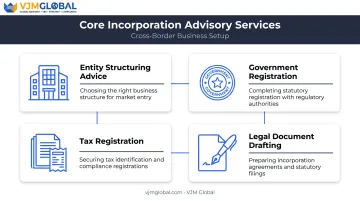
- Entity structuring advice — choosing between a Wholly Owned Subsidiary, Liaison Office, Branch Office, or Project Office
- Government registration — filing with the Ministry of Corporate Affairs (MCA), obtaining DIN and DSC, and coordinating with the IRS or state agencies back home
- Tax registration — securing PAN, TAN, and GST numbers, then handling ongoing filing obligations
- Legal document drafting — preparing your Memorandum of Association (MOA), Articles of Association (AOA), and shareholder agreements
Why US Businesses Need Specialized (Not Generic) Consultants
A local consultant who's never worked with a foreign entity might handle domestic incorporation just fine. But entering a new market as a US company involves layers that domestic-only consultants often miss:
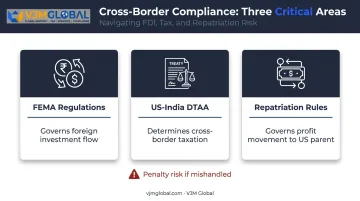
- FEMA regulations governing how foreign investment flows into and out of the destination country
- The US-India Double Taxation Avoidance Agreement (DTAA), which determines how income gets taxed across both jurisdictions
- Repatriation rules dictating how profits move back to the US parent company
Get any of these wrong, and you're not just facing a delay. You're facing compounding penalties under FEMA or double taxation that eats into your margins for years. A DTAA between India and the US exists precisely to prevent this, but only if your consultant knows how to apply it correctly to your entity structure.
Key Factors to Consider When Choosing a Consultant
Picking a consultant isn't just a price comparison exercise. It directly shapes your compliance risk, how fast you reach market, and how efficiently you operate for years afterward. Here's what actually moves the needle.
Cross-Border and Regulatory Expertise
Your consultant needs working knowledge of both US business law and the destination country's regulatory framework, including tax treaties, foreign exchange provisions, and entity-specific rules.
A consultant who only knows one side of the equation will miss things — whether that's a filing requirement under the destination country's companies law (India's Companies Act, 2013 is a good example) governing foreign companies, or a tax treaty provision that could've saved you money. Either way, the gap shows up as:
- Non-compliance penalties down the line
- Rejected filings that push back your timeline
- Tax mismatches between US and local obligations
Range of Services Offered
Getting the regulatory side right is only part of the equation. The scope of services your consultant offers matters just as much, since incorporation is the starting line, not the finish. A consultant who only handles registration leaves you scrambling to find separate vendors for accounting, tax filing, and payroll right when you need continuity most.
End-to-end providers reduce:
- Coordination errors between multiple vendors
- Onboarding time for back-office functions
- The risk of compliance gaps between handoffs
If your consultant can manage entity structuring, incorporation, accounting, and tax compliance under one roof, you're not re-explaining your business to a new firm every quarter. Firms like VJM Global, which handle setup through ongoing compliance under a single team, exist specifically to close that gap.
Credentials and Professional Qualifications
Verify who you're actually hiring. Look for CPAs, Chartered Accountants (CAs), Company Secretaries, or licensed attorneys, not just someone who calls themselves a "business consultant."
Before signing any engagement, verify your consultant's credentials directly with the relevant professional body in your target market. In India, for example, practicing CAs must generate a Unique Document Identification Number (UDIN) for every certificate they issue, and ICAI has flagged real cases of forged signatures and false representation by individuals posing as Chartered Accountants. Use ICAI's Trace a Member tool to confirm credentials before signing anything.
Verified credentials directly affect:
- Accuracy of your filings
- Your exposure to audit or regulatory risk
- Accountability if something goes wrong
Transparent and Predictable Pricing
Ask for an itemized quote, not a flat number. Incorporation costs typically include government fees, professional service charges, and ongoing compliance retainers, and each should be broken out separately.
Itemized pricing matters for budgeting because it:
- Prevents surprise costs mid-setup
- Lets you compare consultants on equal terms
- Sets realistic expectations for ongoing compliance retainer costs
Turnaround Time and Process Efficiency
Speed matters, but not at the expense of accuracy. A rushed filing that gets rejected costs you more time than a careful one done right the first time.
Delays in incorporation ripple outward:
- Bank account opening gets pushed back
- Hiring stalls because you don't have a legal entity to employ people under
- Contract signing with vendors or clients gets delayed
Ask any consultant for realistic timelines based on your specific entity type, not generic promises.
Post-Incorporation Compliance and Support
This is where a lot of businesses get burned. Incorporation is step one. What happens after, annual filings, tax returns, ROC compliance, is what keeps your entity in good standing.
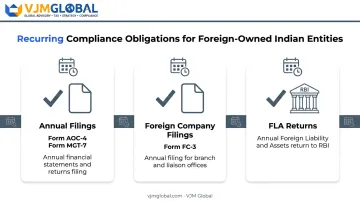
Foreign-owned entities in the destination country typically face recurring post-incorporation obligations. In India, for example, these include:
- Annual filings: Form AOC-4 and MGT-7 for Indian subsidiaries
- Foreign company filings: Form FC-3 for branch and liaison offices
- FLA returns: Required for entities with foreign direct investment, filed with the RBI
Skip these, and you're looking at penalties, or in serious cases, your license getting struck off entirely. A consultant who disappears after incorporation isn't a partner. They're a liability waiting to surface.
Red Flags to Watch Out For
Some warning signs are obvious in hindsight but easy to miss during the sales pitch. Watch for these:
- Unusually low fees with no breakdown. Hidden costs tend to surface after you've already committed, so demand a full itemized quote upfront.
- No verifiable credentials or references. A legitimate consultant won't hesitate to share credentials or connect you with past clients. If they dodge the question, that's your answer.
- No physical or registered office presence. This is especially risky for cross-border engagements where accountability matters.
- Vague answers on FEMA or DTAA. If they can't explain how these rules apply to your specific entity structure, they're likely guessing rather than advising.
A consultant who can't explain cross-border compliance clearly probably can't execute it correctly either.
How VJM Global Can Help US Businesses Incorporate with Confidence
VJM Global brings over 30 years of tax, audit, and advisory experience. : CPAs, Chartered Accountants, and US-compliant professionals who understand both American and Indian regulatory frameworks, not just one side of the transaction
- Proven track record: VJM Global has served 500+ American business owners, with a 95% client retention rate
- End-to-end support: from entity structuring and incorporation through accounting outsourcing, tax compliance, and ongoing back-office operations
- EAI International membership: part of a globally recognized network of independent accounting and tax firms, which keeps service delivery aligned with international standards
- Transparent, upfront pricing: no hidden fees or surprise line items during setup
- 24/7 customer support: quick turnaround times designed to minimize delays in market entry

Rather than handing off your incorporation and disappearing, VJM Global stays involved through the compliance work that follows. That includes filings, tax returns, and the back-office functions that keep your entity — including entities in India — in good standing.
Conclusion
Choosing a company incorporation consultant comes down to finding a partner whose expertise matches your specific market entry goals, entity type, and compliance requirements — not the most recognizable name.
Incorporation is just the first milestone. As your business scales in a new market, your compliance and advisory needs will evolve too. Firms like VJM Global, which has guided 500+ American businesses through market entry into India, can support you well beyond registration, handling tax compliance, FEMA advisory, and ongoing financial reporting as your operations grow.
Frequently Asked Questions
What is the average fee for a company incorporation consultant?
Fees vary widely based on entity type, jurisdiction, and whether you need registration-only or end-to-end compliance support. Always request an itemized quote rather than comparing flat fees across consultants.
Can I hire a company incorporation consultant to help me start a business?
Yes, this is standard practice, especially for cross-border setups. A consultant streamlines legal filings, tax registrations, and compliance from day one, reducing the risk of costly missteps.
How long does company incorporation typically take with a consultant's help?
Timelines vary by country and entity type, but experienced consultants typically complete registration within a few days to a few weeks. Delays usually stem from incomplete documentation, not the consultant itself.
Do I need a local consultant if I'm incorporating a business in another country?
While self-filing is technically possible, a consultant familiar with both jurisdictions significantly reduces compliance risk and processing delays. For US businesses entering markets like India, this matters even more, given FEMA (Foreign Exchange Management Act) rules and cross-border tax treaty provisions specific to that market.
What documents are typically required for company incorporation?
Requirements vary by destination, but typically include identification and address proof for directors, notarized and apostilled documents for foreign shareholders, and foundational legal documents establishing the entity — for example, India requires the MOA and AOA (the equivalent of Articles of Incorporation).
What's the difference between a company incorporation consultant and a lawyer?
Consultants, often CPAs or CAs, typically handle registration, tax, and compliance holistically. Lawyers are usually needed for specific contract drafting or dispute resolution matters outside that scope.