Navigating UAE regulatory bodies, understanding which legal structure fits your business model, and coordinating document authentication across time zones are not straightforward tasks. The wrong consultant can cost you months and significant money. The right one makes remote ownership viable from day one.
This guide walks through exactly what to look for — and what to avoid — when choosing a Dubai company registration consultant from the US.
Key Takeaways
- A qualified consultant manages licensing, structure selection, visa processing, and government approvals on your behalf from the US
- US entrepreneurs need cross-border expertise, not just local Dubai knowledge
- Mainland, Free Zone, and Offshore structures carry fundamentally different tax, ownership, and operational implications for US owners
- Vague pricing, unrealistic timelines, and consultants who cannot explain US tax reporting obligations are immediate red flags
- Confirm post-setup support for corporate tax, VAT, and renewals before signing — this is where remote ownership most often breaks down
Why US Entrepreneurs Are Registering Companies in Dubai
Dubai offers a genuinely attractive combination for US founders:
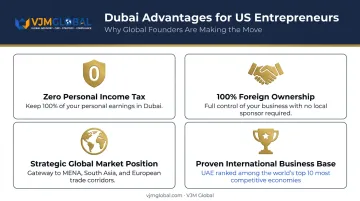
- Zero personal income tax on earnings from UAE-registered entities
- 100% foreign ownership in Free Zones, and increasingly across most Mainland activities following the 2021 commercial companies law reforms
- Strategic market position bridging the US, Europe, South Asia, and Africa
- A proven international business base — Jafza alone hosts over 300 US-owned firms among 11,000+ companies from 157 countries, and the UAE ranked 5th globally in IMD's 2025 World Competitiveness Ranking
The process, though, involves navigating multiple regulatory bodies — the Dubai Department of Economy and Tourism (DET) for Mainland setups, and separate authorities for each Free Zone (DMCC, JAFZA, DIFC, IFZA, and others). These bodies do not share a single registration process, and requirements differ meaningfully across structures.
Choosing the wrong structure — or missing a filing requirement — can delay your launch by months. That's what makes choosing the right consultant a genuinely consequential decision.
What Does a Dubai Company Registration Consultant Do?
A company registration consultant is a licensed advisory firm that guides foreign entrepreneurs through the legal, administrative, and operational steps of incorporating in the UAE. The scope spans entity structure selection, trade license issuance, and corporate bank account coordination.
A full-service consultant typically handles:
- Business activity classification and license type selection
- Legal structure advice (Mainland, Free Zone, or Offshore)
- Trade name reservation and DET or Free Zone authority applications
- Memorandum and Articles of Association drafting
- Document notarization and attestation coordination
- PRO services for government liaison
- Investor and employee visa processing
- Corporate bank account opening support
- Ongoing license renewal and compliance management
Why US clients need more than generic Dubai expertise
US entrepreneurs face specific documentation requirements that local-only consultants often overlook. Certain Free Zone and Mainland setups require notarized and apostilled US-issued documents, but apostille requirements are document-specific, not universal. IFZA, DMCC, and JAFZA each maintain different document checklists.
Beyond formation documents, US citizens owning foreign companies carry ongoing IRS obligations that most Dubai-only consultants never address:
- FBAR reporting for foreign bank accounts exceeding $10,000
- Form 5471 filing requirements for US shareholders in controlled foreign corporations
- Potential GILTI exposure depending on ownership percentage and business income
Confirm upfront whether your consultant can identify these requirements — or refer you to a qualified US tax advisor who can.
Key Factors to Consider When Choosing the Best Dubai Company Registration Consultant from the US
The right Dubai registration consultant does more than file paperwork. They understand your US-based context, navigate cross-border compliance, and structure your setup to match how you actually plan to operate.
Experience with US Clients and Cross-Border Setups
A consultant with genuine experience serving US entrepreneurs will already understand:
- How to coordinate apostille and notarization for US-issued documents
- Which Free Zones support fully digital remote incorporation versus those requiring in-person steps
- How UAE entity ownership interacts with US tax reporting — FBAR, Form 5471 for controlled foreign corporations, and FATCA/Form 8938
Ask directly: how many US-incorporated or US-citizen-owned entities have you helped register in Dubai? Request references. A consultant who cannot answer specifically is likely overstating their cross-border experience.
Clarity on Dubai Business Structures
The three structures have fundamentally different operational implications:
| Structure | Regulator | Market Access | Key Trade-Off |
|---|---|---|---|
| Mainland | Dubai DET | Full UAE market + international | Requires premises approval; sector restrictions may apply |
| Free Zone | Zone authority (DMCC, JAFZA, etc.) | International + zone clients | Direct mainland sales require a licensed distributor or approved permit |
| Offshore | Registered agent (e.g., JAFZA Offshore) | International and holding purposes only | Not a standard UAE operating entity; no employee visa platform |
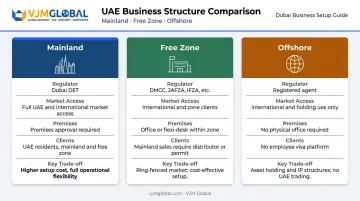
A good consultant maps your expected customers, invoices, and employee needs to the appropriate structure before recommending one. Getting this wrong is one of the costliest early mistakes US founders make — it often requires full re-licensing to fix.
Note: Dubai introduced a Free Zone Mainland Operating Permit in October 2025 — valid for six months, priced at AED 5,000 per period, and activity/eligibility-dependent. This is not a blanket solution; confirm applicability with your consultant.
End-to-End Service Coverage
Fragmented service creates gaps. A consultant who handles licensing but not banking or visa processing leaves you assembling the rest yourself — from a different time zone.
Comprehensive service coverage should include:
- Trade name reservation and license application
- MOA/AOA drafting and execution
- Founder and employee visa processing
- UAE corporate bank account opening support
- Ongoing license renewal coordination
- VAT registration (mandatory threshold: AED 375,000 in taxable supplies)
- Corporate tax registration and filing support
On banking specifically: no consultant can guarantee remote account approval. The UAE Central Bank permits non-face-to-face banking relationships but leaves the final decision to each bank's risk assessment. Be skeptical of any consultant who promises remote bank account approval as a standard outcome.
Transparency in Pricing and Timelines
Unclear pricing creates budget overruns. Vague timelines make remote planning nearly impossible.
What to request:
- An itemized cost breakdown separating government fees, consultant service fees, visa costs, office or flexi-desk fees, and annual renewal estimates
- Realistic, stage-by-stage setup timelines with stated dependencies
As a benchmark: DMCC quotes approximately 10 working days for standard setup once documents are complete and approved. Published DMCC charges include an AED 9,020 registration fee, AED 20,285 annual license fee, and AED 16,000–19,000 annually for a flexi-desk. These are not comparable all-in totals — visas, external approvals, and renewals vary separately.
Any quote that does not reconcile to published authority fees deserves scrutiny.
Track Record, Reviews, and References
US-based entrepreneurs cannot walk into a consultant's office to verify credentials. Documented proof of experience becomes your only reliable filter.
Look for:
- Verified Google or Trustpilot reviews from foreign entrepreneurs (not just UAE-based clients)
- Willingness to provide direct references from US citizens who have completed registrations
- Case studies that describe the full process, not just successful license issuance
A consultant with no US client references has likely not navigated the cross-border complexity you're about to face. Move on.
Post-Registration Compliance and Ongoing Support
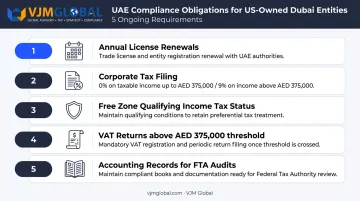
Registration is just the starting point. Once live, UAE businesses must actively maintain:
- Annual license renewals (JAFZA and most zones renew yearly)
- Corporate tax filings — the UAE applies 0% on taxable income up to AED 375,000 and 9% above that threshold
- Free Zone tax status — Qualifying Free Zone Persons access 0% on qualifying income, but non-qualifying income remains subject to 9%
- VAT returns if taxable supplies exceed the registration threshold
- Accounting records sufficient for UAE FTA audit requirements
The best consultants offer ongoing PRO services, compliance monitoring, and accounting support as the regulatory environment evolves. Confirm whether post-setup support is included or billed separately — before you sign anything.
Red Flags to Avoid When Hiring a Dubai Company Registration Consultant from the US
Not every consultant offering Dubai setup services is equipped to serve US clients well. Watch for these warning signs:
- One-size-fits-all packages with no questions about your business activity, target market, or operational model
- Refusal to provide itemized cost breakdowns — government fees are publicly listed by DMCC, JAFZA, and other authorities; any legitimate consultant should reconcile their quote to these figures
- Unrealistic timeline claims such as "24-hour full registration" without specifying what that includes and excludes
- No verifiable client reviews or physical office presence — oral-only agreements with no written engagement terms
- Pressure toward an Offshore structure without explaining that it does not support standard UAE operations or employee visa sponsorship
- Inability to explain US tax reporting obligations — any claim that UAE formation eliminates US filing requirements is a serious red flag. FBAR, Form 5471, and FATCA obligations apply regardless of where your entity is registered
If a consultant can't give straight answers on any of these points, keep looking. The right firm will welcome your questions, not sidestep them.
How VJM Global Can Support US Entrepreneurs in This Process
VJM Global brings 30+ years of experience in cross-border accounting, tax compliance, and business advisory, with a documented track record serving international clients across the US, UK, Australia, and India. The firm's team includes CPAs, Chartered Accountants, and professionals experienced in both US and international regulatory contexts.
VJM Global's cross-border advisory capabilities — international tax planning, FBAR and FATCA compliance, and FDI structuring — apply directly when US entrepreneurs are building a multi-jurisdiction business footprint that includes Dubai. The firm's New York office (447 Broadway, 2nd Floor, NY 10013) provides a US-based point of contact for clients managing cross-border operations.
For US entrepreneurs navigating Dubai company registration, the cross-border piece is often where deals stall — specifically, understanding how foreign entity ownership affects your US tax obligations (FBAR, FATCA, Subpart F rules). That's where VJM Global adds direct value. For UAE-specific regulatory filings and Free Zone applications, reach out at [email protected] to confirm current service scope and available UAE-side partnerships.
Conclusion
Choosing the right Dubai company registration consultant is one of the highest-leverage decisions a US entrepreneur makes in this process. A strong consultant does more than file paperwork. Look for someone who delivers:
- Faster setup through familiarity with UAE free zone and mainland processes
- Structural guidance that matches your US business model and ownership goals
- Early identification of US tax obligations — FBAR, GILTI, Subpart F — before they become costly surprises
- Ongoing compliance support you can manage remotely
The best consultant for your situation understands both the UAE regulatory environment and the cross-border realities of US ownership. Verify that understanding with references from other US-based clients before signing any engagement agreement.
Frequently Asked Questions
Can a US citizen own 100% of a company in Dubai?
Yes. US citizens can own 100% of a Free Zone company, and the 2021 mainland reforms permit full foreign ownership for most commercial activities. However, strategic-impact sectors retain restrictions. Confirm eligibility for your specific business activity with a qualified consultant before proceeding.
Do I need to travel to Dubai to register my company?
Many consultants facilitate remote registration using notarized and apostilled US documents. Some Free Zones such as IFZA offer fully digital incorporation. However, certain bank account openings may require at least one in-person visit. Confirm this with your consultant before setting your timeline.
How long does company registration in Dubai take for US-based entrepreneurs?
Free Zone registrations typically complete in around 10 working days once documents are submitted and approved (DMCC's published benchmark). Mainland setups can take 2–4 weeks depending on activity approvals. Document preparation, notarization, and attestation from the US adds additional time to both timelines.
What are the tax implications for US citizens owning a Dubai company?
Dubai offers no personal income tax and a 9% corporate tax rate on profits above AED 375,000. However, US citizens remain subject to US tax obligations globally. Owning a foreign company may trigger FBAR reporting and Form 5471 requirements for controlled foreign corporations. Work with a US-qualified tax advisor alongside your Dubai consultant.
How much does it typically cost to hire a Dubai company registration consultant from the US?
Consultant fees are charged separately from government and license fees. Total first-year costs vary significantly based on structure, number of visas, and office requirements. Always request an itemized breakdown that separates authority fees (such as DMCC's published AED 20,285 annual license fee) from consultant service fees before signing any agreement.
What documents do US citizens typically need to register a company in Dubai?
Standard requirements include a valid US passport, recent proof of address, completed application forms, and UBO information. Mainland setups and banking typically require notarized and apostilled documents. The exact checklist varies by structure and Free Zone authority — your consultant should provide a tailored document list specific to your chosen setup.