For over five decades, this Act was the backbone of Indian corporate law. Enacted on 18 January 1956, it consolidated a fragmented, colonial-era legal structure into one uniform code governing how companies were formed, run, and wound up.
Many NRIs, foreign promoters, and business owners still stumble across it in legacy filings, old shareholder agreements, or pending litigation. If you've inherited a company structure that predates 2013, or you're untangling a dispute referencing 1956-era provisions, this guide breaks down exactly what the Act covered, how it worked, and how it compares to the Companies Act, 2013 that replaced it.
Key Takeaways
- The Companies Act 1956 spanned 658 sections across 13 parts and 15 schedules
- It introduced the Memorandum of Association (MoA) and Articles of Association (AoA), concepts still central to Indian company law today
- Formally repealed on 30 January 2019, though savings provisions still protect certain accrued rights
- Old company records referencing the 1956 Act require careful interpretation alongside current Companies Act 2013 rules
- Legacy businesses should verify compliance status with advisors familiar with both frameworks
What Was the Companies Act 1956 and Why It Mattered
Parliament enacted the Companies Act, 1956 (Act No. 1 of 1956) to "consolidate and amend" the law relating to companies in India. Before this, company law relied on the Indian Companies Act, 1913, along with a patchwork of amendments that had accumulated over decades under colonial rule.
The 1956 Act repealed that older framework entirely under Section 644, replacing it with a single, unified code.
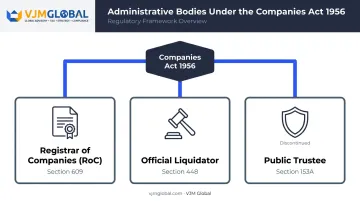
Key administrative bodies created or empowered under the Act:
- Registrar of Companies (RoC) – appointed under Section 609, responsible for registering incorporation documents and certifying company formation under Sections 33-34
- Official Liquidator – established under Section 448, tasked with managing winding-up proceedings
- Public Trustee – authorized under Section 153A to oversee declarations related to shares or debentures held in trust (this role ceased after the Companies (Amendment) Act, 2000)
The Act made registration legally mandatory. No business could operate as a recognized legal entity in India without incorporating under its provisions.
Defining Roles and Liabilities
Beyond registration, the Act built the governance framework that made incorporation meaningful: it structured the relationship between three parties — promoters, directors, and shareholders. This framework covered:
- Director liability and disqualification – conditions under which directors could be held personally accountable or barred from holding office
- Shareholder rights – protections around voting, information access, and minority interests
- Promoter obligations – responsibilities tied to forming and launching the company
This structure, while heavily revised since 1956, still echoes through India's current corporate governance model under the Companies Act, 2013.
Key Regulations and Provisions Under the Companies Act 1956
The Act's 13 parts covered the entire lifecycle of a company, from the moment of incorporation to final dissolution. Understanding a few core provisions makes the rest of the framework much easier to follow.
The Memorandum of Association (MoA)
Section 13 required every company's memorandum to state:
- The company's name
- The state where its registered office would sit
- Its objects (what the business was actually formed to do)
- The liability of its members
- Share capital details, where applicable
Think of the MoA as the company's constitutional boundary — it defined what the company could do, not how it would run day-to-day operations.
The Articles of Association (AoA)
While the MoA set external boundaries, the AoA governed internal operations. Sections 26-30 required companies to register articles specifying governance procedures, and many companies simply adopted "Table A," a standard set of articles provided in the Act itself. Section 31 allowed companies to amend their articles by special resolution.
Share Capital, Directors, and Prospectus Rules
Part IV of the Act governed share capital and debentures. Section 85 distinguished between preference and equity share capital, setting the tone for how companies could structure ownership.
Structuring share capital was only half the picture — the Act also held directors accountable for how that capital and the company at large were managed. Section 274 outlined disqualification grounds for directors, including:
- Being of unsound mind as adjudged by a court
- Insolvency
- Specified criminal convictions or statutory defaults
Note that Section 274 dealt with disqualification, not a comprehensive duties framework. Directors' disclosure obligations appeared separately under Section 299.
Beyond internal governance, companies raising capital from the public faced a separate layer of scrutiny: prospectus rules. Section 56 required prospectuses to include matters and reports specified in Schedule II. Section 60 went further, mandating registration with the Registrar of Companies (RoC) before any prospectus could be issued — a safeguard meant to protect prospective investors before money changed hands.
Types of Companies Recognized Under the Companies Act 1956
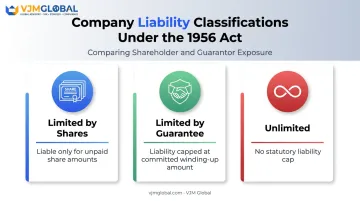
The Act classified companies primarily by liability structure:
| Classification | Liability Rule |
|---|---|
| Limited by shares | Members liable only for unpaid amounts on their shares |
| Limited by guarantee | Liability capped at the amount members committed to in the memorandum for winding up |
| Unlimited | No statutory cap on member liability |
Private vs. Public Companies
A private company, defined under Section 3(1)(iii), had to restrict share transfers, cap membership, and prohibit public invitations for securities. A public company, under Section 3(1)(iv), faced no such restrictions.
The minimum member requirements sat separately, under Section 12:
- Private companies: minimum of 2 members
- Public companies: minimum of 7 members
The "Deemed Public Company" Rule
One of the more unusual classifications was the deemed public company under Section 43A. A private company could be reclassified as public if:
- At least 25% of its capital was held by qualifying bodies corporate
- Its turnover crossed a prescribed threshold
- It held at least 25% of a public company's capital
- It accepted or renewed advertised public deposits
This provision largely stopped applying after 13 December 2000, though its saving clauses (Section 43A(2A)) had lingering effect.
Holding and Subsidiary Companies
Beyond liability and public status, the Act also classified companies by ownership structure. Section 4 defined holding-subsidiary relationships using board composition control and voting/equity control tests. A company could qualify as a subsidiary even through a chain of other subsidiaries, a concept that carries through largely unchanged into the Companies Act 2013.
Companies Act 1956 vs. Companies Act 2013: Key Differences
The Companies Act 2013 didn't just tweak the old framework. It rebuilt it, aiming for stronger governance, more transparency, and closer alignment with global corporate standards.
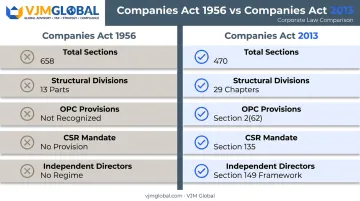
Structural comparison:
| Feature | 1956 Act | 2013 Act |
|---|---|---|
| Sections | 658 | 470 |
| Structural divisions | 13 Parts | 29 Chapters |
| OPC provision | Not recognized | Section 2(62) recognizes One Person Companies |
| CSR mandate | None | Section 135 mandates CSR spending and committees |
| Independent directors | No comprehensive regime | Section 149(4) and 149(6) define composition and independence |
New Concepts the 2013 Act Introduced
Three additions stand out for foreign businesses evaluating Indian entry options:
- One Person Company (OPC) – allows a single individual to incorporate a company with limited liability, something the 1956 Act never permitted
- Corporate Social Responsibility (CSR) – mandates qualifying companies to spend a percentage of profits on social initiatives
- Independent director norms – imposes stricter composition requirements for listed public companies
Commencement of Business Certificate: A Complicated History
Under the 1956 Act, Section 149 restricted public companies with share capital from commencing business or borrowing until they met certain statutory conditions and obtained an RoC certificate. Private companies were exempt under Section 149(7).
The 2013 Act initially dropped this requirement (original Section 11), then omitted it entirely from 29 May 2015. Section 10A brought it back through a 2018 Ordinance, formally enacted via Act 22 of 2019 and effective 2 November 2018. This time, the requirement applied more broadly to companies with share capital, regardless of public or private status.
Compliance Burden: What Actually Changed
Not every 2013 requirement is stricter than its 1956 counterpart. The verifiable changes are:
- Private company exemptions that existed under the 1956 Act were substantially withdrawn
- Filing requirements expanded, including specified board resolutions under Section 179(3)
- Fraud and repeat-default provisions became more stringent
For companies operating internationally, particularly in tech and services sectors, this meant tighter board-level accountability and expanded disclosure obligations that simply didn't exist before 2013. Navigating this shift is exactly where firms like VJM Global support foreign businesses, translating these compliance changes into practical filing and governance steps.
Company Formation Process Under the Companies Act 1956 (For Historical Reference)
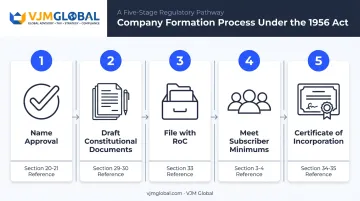
If you're reviewing an older Indian entity's incorporation history, this is roughly how it would have been formed:
- Name approval – Section 20 barred the RoC from registering undesirable or confusingly similar names
- Draft constitutional documents – MoA under Sections 13-15, and AoA under Sections 26-30 where required
- File with the RoC – Section 33 required submission of the memorandum, articles, related agreements, and a compliance declaration
- Meet subscriber minimums – Section 12 required at least 2 subscribers for private companies, 7 for public companies
- Certificate of Incorporation – issued under Section 34, giving legal effect to the company's existence
Incorporation alone didn't clear public companies to start operating, though. Public companies faced one extra hurdle before allotting shares: if they hadn't issued a prospectus (or hadn't proceeded to allotment under one), Section 70 required filing a "statement in lieu of prospectus."
Private companies, by contrast, could commence business immediately after incorporation, with no separate commencement certificate required, thanks to the Section 149(7) exemption.
Is the Companies Act 1956 Still Relevant Today?
Short answer: barely, and only in specific legacy situations.
The Companies Act 2013 received presidential assent on 29 August 2013. Its rollout happened in phases: 98 sections were notified on 12 September 2013, followed by another 183 sections from 1 April 2014. The 1956 Act's formal repeal didn't happen until much later, through S.O. 560(E), dated 30 January 2019, which commenced Section 465 of the 2013 Act.
Section 465 doesn't just repeal the old law. It also saves prior actions, appointments, incorporations, accrued rights, liabilities, penalties, and pending proceedings that arose under the 1956 Act.
That's why legacy disputes sometimes still require applying a 1956-era rule, even years after the repeal took effect.
Practical implications for foreign investors and NRIs:
- Old shareholder agreements or MoAs referencing 1956 section numbers don't automatically need to be redrafted, but should be reviewed for consistency with current filings
- Pending litigation involving pre-2013 corporate actions may still hinge on 1956 Act interpretations
- Any unresolved compliance gap from the 1956 era should be addressed against current Companies Act 2013 standards to avoid penalties
If your company still carries 1956-era documentation, structural quirks, or unresolved filings, it's worth getting a professional review. VJM Global regularly helps foreign companies and NRIs review legacy documentation and resolve outstanding 1956-era gaps against current Companies Act 2013 filing standards.
Frequently Asked Questions
Is the Companies Act, 1956 still valid?
No. It was formally repealed on 30 January 2019 through Section 465 of the Companies Act, 2013. Only limited savings provisions for past actions and pending cases remain relevant today.
What was the main focus of the Companies Act, 1956?
It created a uniform legal structure for registering and governing companies across India, replacing fragmented colonial-era rules. It also defined the roles, responsibilities, and liabilities of promoters, directors, and shareholders.
What are the types of companies under the Companies Act, 1956?
The Act recognized private and public companies, along with companies limited by shares, limited by guarantee, and unlimited companies. It also introduced the "deemed public company" classification for qualifying private companies.
What is the difference between the Companies Act, 1956 and the Companies Act, 2013?
The 1956 Act had 658 sections across 13 parts, while the 2013 Act condensed this into 470 sections across 29 chapters. The 2013 Act also introduced OPCs, CSR mandates, and stricter independent director and compliance requirements.
When was the Companies Act 1956 fully repealed?
The repeal took formal effect on 30 January 2019. However, the shift wasn't instant: the transition began in phases starting 2013-2014, as provisions of the 2013 Act were notified gradually.
Do foreign companies need to worry about the Companies Act 1956 when setting up in India today?
No. New company setups follow the Companies Act 2013 exclusively. VJM Global helps foreign businesses and NRIs navigate current registration and compliance requirements, so legacy provisions from the 1956 Act don't factor into new setups.