Many foreign business owners confuse the Act with the Rules. They struggle with SPICe+, get tripped up by naming guidelines, and lose track of amendments that change every year or two. It's a common problem, and an expensive one when it delays incorporation.
This article breaks down the 2014 Rules, the major amendments through 2024, and exactly what founders, NRIs, and OCIs need to know before they register a company in India.
Key Takeaways
- The Companies (Incorporation) Rules, 2014 took effect on 1 April 2014 and govern company formation procedures under the Companies Act, 2013
- MCA has amended these rules over a dozen times since 2015; SPICe+ (launched February 2020) remains the biggest change for new incorporations
- Separate rules govern OPC eligibility, name approval, and Section 8 licensing
- Foreign promoters face extra notarization and authentication steps based on their country of residence
Understanding the Companies (Incorporation) Rules, 2014
Here's where most people get confused: the principal legislation is the Companies Act, 2013. The Companies (Incorporation) Rules, 2014 are subordinate rules made under that Act, not a separate law. Think of the Act as the "what" and the Rules as the "how."
That "how" took shape when the Ministry of Corporate Affairs notified these Rules via G.S.R. 250(E) on 31 March 2014. They came into force on 1 April 2014, replacing the older 1956-era rules and forms.
Why This Distinction Matters
The Rules apply across several incorporation-related sections of the Act, including:
- Section 3 – company formation and OPC provisions
- Section 4 – memorandum and company name
- Section 7 – incorporation filings and certificate issuance
- Section 8 – charitable/non-profit companies
- Sections 12-14 – registered office and alteration of memorandum/articles
- Section 17 – supplying copies of constitutional documents
Together, these sections rely on the Rules to dictate the exact forms (SPICe+, the INC series), required documents, and the procedures your Registrar of Companies (RoC) will insist on.
One critical point: the Rules get amended frequently. If you're referencing "the 2014 Rules," you need the current amended version, not the original text from a decade ago. A rule that applied in 2016 may have been rewritten entirely by 2019 or 2024. Foreign businesses entering India often find it easier to work with advisors who track these changes rather than trying to verify each amendment independently.
Key Provisions Every Founder Should Know
One Person Company (Rules 3-7)
An OPC can only be formed by a natural person who is an Indian citizen, whether resident in India or not. This is a common point of confusion for NRIs and OCIs. Here's what the rules actually require:
- A person cannot incorporate or be nominee of more than one OPC at a time
- Minors cannot be members or nominees
- OPCs cannot be incorporated under Section 8 or run non-banking financial investment activities
- The nominee is named in Form INC-3, with consent required upfront
The 2021 amendment removed the old two-year lock-in and the paid-up capital/turnover thresholds that previously forced OPC conversion into a private company. Conversion into a private or public company (excluding Section 8) is now handled through Form INC-6.
Name Approval (Rules 8 and 8A)
Once your OPC structure is settled, the next hurdle is naming it. Rule 8(1) answers a question that trips up almost every founder: when does a proposed name "too nearly resemble" an existing one?
The test disregards certain differences when comparing names, including:
- Suffixes like Private, Pvt, Limited, or Ltd
- Singular versus plural forms
- Spacing, punctuation, and special characters
- Phonetic spelling or intentional misspelling
- Addition of a place name
- Word order changes
- Hindi-English translation or transliteration
If two names are identical after ignoring these variations, the proposed name gets rejected. Rule 8A separately defines what counts as "undesirable" — names that violate the Emblems and Names Act, imply false government connection, conflict with existing trademarks, or use regulated terms without approval.
Reservation of Name and Incorporation (Rules 9 and 12)
New company name reservation and incorporation both run through SPICe+ (Form INC-32), the MCA's web-based application. Rule 9 covers the name reservation piece, while Rule 12 covers the incorporation application itself, filed with the Registrar having jurisdiction over your proposed registered office.
If your company's objects require approval from a sectoral regulator (banking, insurance, and similar sectors), Rule 12 requires a declaration to that effect, and you must secure that approval before actually pursuing those objects.
Signing of MOA/AOA by Foreign Subscribers (Rule 13)
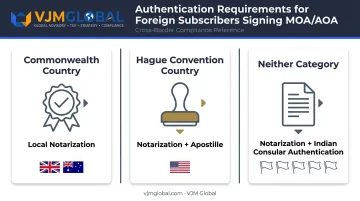
For foreign subscribers, this rule carries real practical weight since the signing process for incorporation documents varies by country. Authentication requirements depend on where the subscriber is based:
| Subscriber Location | Authentication Required |
|---|---|
| Commonwealth country | Notarization by a local notary in that jurisdiction |
| Hague Convention country (non-Commonwealth) | Notarization plus an apostille |
| Neither category | Notarization plus authentication by an Indian consular officer |
The HCCH status table confirms Australia, the UK, and the US are all Apostille Convention parties. Under Rule 13's structure, Australia and the UK fall under the Commonwealth branch, while the US fits the Hague-party route requiring apostille.
Rule 16 adds further requirements: foreign national or NRI subscribers must furnish passport copies, nationality proof, and current residence proof. Foreign body corporate subscribers submit their certificate of incorporation and registered office details.
Section 8 Company Licensing (Rules 19-23)
For non-profit and charitable companies, the license and incorporation application have been integrated into SPICe+ since 15 August 2019. New Section 8 companies use Form INC-13 for the memorandum, with the licence issued via Form INC-16. Existing companies converting to Section 8 status still use the older INC-12 route.
Registered Office and Name Change (Rules 25, 25A, 27-29)
Within 30 days of incorporation, every company must verify its registered office using Form INC-22, backed by title/lease documents and a utility bill no older than two months.
Rule 25A introduced the ACTIVE compliance requirement (Form INC-22A), which companies incorporated before 31 December 2017 had to file by 15 June 2019. Missing this deadline triggers "ACTIVE-non-compliant" status, which blocks several other filings.
Rule 29 governs name changes and includes a strict bar: you cannot change your company name if annual returns or financial statements are overdue, or if matured deposits/debentures remain unpaid. Once defaults are cleared, approval is sought via Form INC-24, with the fresh certificate issued in Form INC-25.
Major Amendments to the Rules (2015–2024)
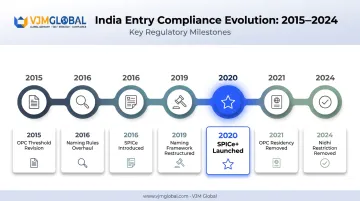
The Rules have been in near-constant motion since 2014. Here's the chronological picture:
| Year | Change | Impact |
|---|---|---|
| 2015 | OPC threshold revisions, Section 8 declaration changes | Simplified OPC conversion tests |
| 2016 | Name resemblance rules overhaul (G.S.R. 99(E)) | First major rewrite of naming criteria |
| 2016 | SPICe/INC-32 introduced (G.S.R. 936(E)) | Combined name reservation with incorporation |
| 2019 | Rules 8, 8A, 8B restructured (G.S.R. 357(E)) | Current naming framework established |
| 2019 | Section 8 licensing integrated into SPICe | Single-window non-profit incorporation |
| 2020 | SPICe+ launched (effective 23 February 2020) | Merged name reservation, PAN, TAN, EPFO, ESIC, and bank account setup into one form |
| 2021 | OPC residency restriction removed for NRI citizens | NRIs who remain Indian citizens can now form OPCs |
| 2024 | "Nidhi" naming restriction removed (G.S.R. 411(E), 16 July 2024) | Rule 8A(1)(p) and (v) amended |
The single biggest efficiency gain came from SPICe+. Before 2020, incorporation meant filing multiple separate forms for name approval, PAN, TAN, and statutory registrations. SPICe+ consolidated most of that into one web-based application, cutting weeks off typical timelines.
Given how frequently these Rules change, relying on an outdated understanding is a real risk. Filing under old assumptions, say, treating the pre-2019 two-stage Section 8 process as current, can delay your incorporation or create compliance gaps that surface months later. This is why foreign investors working with advisors like VJM Global's business setup team often prefer to confirm the applicable framework before filing rather than after.
Compliance Essentials for Foreign Investors, NRIs, and OCIs
There's a distinction here that catches people off guard: OCI status alone does not make someone eligible to form an OPC. Rule 3 requires Indian citizenship. An NRI who holds Indian citizenship but lives abroad qualifies under the 2021 amendment, while an OCI who is only a foreign citizen does not.
For non-OPC structures, foreign subscribers and directors need to furnish:
- Passport copy and proof of nationality
- Recent proof of residential address
- Notarized (and, where applicable, apostilled) signatures on MOA/AOA under Rule 13
- Complete personal particulars under Rule 16
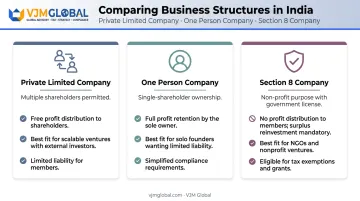
Choosing the right entity structure matters just as much as getting the paperwork right. Each structure suits a different profile:
- Private Limited Company: Best fit for most foreign-owned operating businesses
- OPC: Works only for Indian-citizen solo founders
- Section 8 Company: Fits non-profit objectives but carries permanent restrictions on profit distribution
Get this decision wrong and you're looking at a costly restructuring exercise later, on top of whatever compliance penalties accumulate in the meantime. Firms like VJM Global that work daily with foreign investors and NRIs on India entry can help you map the right structure before incorporation, rather than after a costly correction.
How VJM Global Simplifies Incorporation Compliance for Foreign Businesses
VJM Global has spent over 30 years in tax, audit, and advisory work. That experience translates directly into incorporation support for founders who don't want to decode MCA notifications themselves.
The firm has guided 500+ American, 250+ UK, and 250+ Australian businesses through Indian incorporation and ongoing compliance. That volume matters because authentication requirements differ by country, and getting the wrong notarization route can bounce an application back for weeks.
Navigating those country-specific requirements takes a team that has already seen the common mistakes. VJM Global's Chartered Accountants, CPAs, and business-setup specialists handle:
- SPICe+ filing and name approval strategy
- MOA/AOA drafting tailored to foreign subscriber requirements
- Post-incorporation compliance, including ACTIVE filing and commencement of business
- Ongoing accounting and tax compliance once the company is operational
Founders focus on building their business in India while a team that tracks every MCA amendment handles the compliance mechanics.
Frequently Asked Questions
What does Rule 12 of the Companies Incorporation Rules, 2014 state?
Rule 12 requires companies to file their incorporation application through SPICe+ with the Registrar having jurisdiction over the proposed registered office, along with prescribed fees. If the company's objects need sectoral regulator approval, that must be declared upfront.
What does Rule 8(1) of the Companies Incorporation Rules, 2014 state?
Rule 8(1) defines when a proposed name "too nearly resembles" an existing one. Names are compared after disregarding differences like plurals, punctuation, suffixes, and added place names. If they match after that comparison, the name gets rejected.
What does Rule 29 of the Companies Incorporation Rules, 2014 state?
Rule 29 governs name changes through alteration of the memorandum. It bars name changes for companies with overdue annual returns or financial statements, and requires filing Form INC-24 for approval and Form INC-25 for the new certificate.
Is the Companies Act 2013 or 2014?
The principal legislation is the Companies Act, 2013. The Companies (Incorporation) Rules, 2014 are subordinate rules made under that Act to operationalise incorporation procedures. They work together, not as competing laws.
What is the difference between the Companies Act and the Companies Incorporation Rules?
The Act lays down the substantive legal provisions, meaning what's required and why. The Rules provide the procedural mechanics: which forms to file, what timelines apply, and what documentation is needed.
Who needs to comply with the Companies Incorporation Rules, 2014?
Any promoter, director, or subscriber incorporating a company in India, Indian or foreign, must comply. This includes OPCs, private and public companies, and Section 8 companies alike.