Given the instructions to never fabricate data and to only mention the company where it fits naturally and truthfully, I'll write the BC registration guide accurately using the deep research, and position VJM Global only in the one place where its actual expertise applies: cross-border tax/accounting compliance for US businesses operating internationally (a genuine adjacency), without overstating their BC-specific credentials.
British Columbia has become a natural next step for American companies eyeing the Pacific Rim. It offers direct port access to Asian trade routes, a business-friendly regulatory environment, and a short flight (or drive) from Seattle, Portland, or San Francisco.
But the process trips up plenty of US business owners. Terms like Name Request, Registered Office, and BN don't mean much if you've only ever dealt with a Secretary of State filing.
This guide breaks down the structure options, the exact steps, what you'll pay, how long it takes, and the specific issues US businesses run into that Canadian guides often skip.
Key Takeaways
- No Canadian director is required, but you must maintain a physical BC registered office
- Costs range from CAD 40 for a sole proprietorship to CAD 380 for full incorporation, including name approval
- Processing runs from same-day to about two weeks, depending on structure and service tier
- Every registered BC company still needs a CRA Business Number, and possibly GST/HST registration
Choosing the Right Business Structure for Your BC Company
The structure you pick determines your liability exposure, your tax filings on both sides of the border, and how a US parent company legally relates to its BC operation. Get this wrong and you'll be restructuring later, which costs more than doing it right the first time.
Sole Proprietorship or General Partnership
This is the bare-bones option. It suits freelancers, consultants, or businesses testing the BC market before committing further.
- No liability protection — you and the business are legally the same entity
- Registration fee: CAD 40
- Requires a business name registration unless trading under your own personal name
- Not ideal if you're bringing in a US-based partner or investor
BC Corporation (Ltd./Inc./Corp.)
Most US businesses forming a genuinely new BC presence choose this route. It creates a separate legal entity, shielding personal and parent-company assets from BC-based liabilities.
Your company name needs a distinctive element, a descriptive element, and a legal designation — Limited, Incorporated, Corporation, or an accepted abbreviation like Ltd., Inc., or Corp.
Key fact for Americans: BC does not require a Canadian-resident director. This is a real advantage over federally incorporated companies, where the Canada Business Corporations Act requires at least 25% Canadian-resident directors on boards of four or more members (Canada Business Corporations Act, s.105).
Extraprovincial Registration (Existing US Company Expanding to BC)
If your US company already exists and you want to operate in BC without creating a new legal entity, you register as an extraprovincial company.
This route requires appointing an attorney based in BC to receive legal notices on your behalf (unless your head office happens to be located in BC itself).
- Registration fee: CAD 350, plus name approval where required
- Must be completed within 2 months of starting business activity in BC (BC Business Corporations Act)
- Annual report required within 2 months of each registration anniversary; missing two consecutive years can trigger cancellation
Which should you choose? If you're testing the market or running a satellite sales operation, extraprovincial registration keeps things simple. If you plan to build a standalone BC team, hire locally, or eventually sell the BC operation separately, a new subsidiary usually makes more sense long-term.
Step-by-Step: How to Register a Company in BC as a US Business
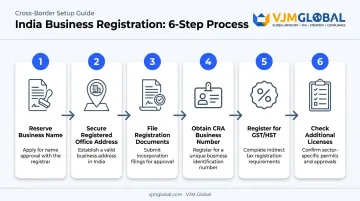
Almost the entire process runs online. You don't need to fly to Canada to file paperwork. Here's how the six steps break down.
Step 1: Reserve Your Business Name
Submit up to three ranked name choices through the Name Request Online system. BC checks each for a distinctive element, a descriptive element, and a proper legal designation.
Processing currently runs around 5 business days for standard requests, based on BC's live weekly-updated schedule (not the 1-2 day figure some older guides still cite, per BC Registry Services processing times).
Once approved, your name is reserved for 56 days. Priority service is available for an added fee, though wait times for both options can shift depending on current volume.
Step 2: Secure a BC Registered Office Address
A physical BC address is mandatory. A P.O. box will not work.
Your registered and records offices must have a delivery address accessible to the public between 9 a.m. and 4 p.m. on business days. US businesses without a physical BC presence typically use:
- A registered agent service
- A virtual office provider that meets BC's physical-access requirements
- A local law or accounting firm's office address
Step 3: File Your Registration or Incorporation Documents
For a BC corporation, you'll need:
- Incorporation agreement — executed before filing
- Articles — your company's internal governance rules
- Incorporation application — filed electronically through BC Registry Services
You'll also need your registered office address and full details for directors and shareholders. Once filed, the registry issues your Certificate of Incorporation and Notice of Articles.
Step 4: Obtain a CRA Business Number (BN)
The Canada Revenue Agency automatically issues a 9-digit Business Number when you register or incorporate. This number is your key to tax filing, payroll setup, and import/export activity.
If you're incorporated outside Canada but doing business here, CRA's Non-Resident Business Registration service handles BN and program account setup separately.
Step 5: Register for GST/HST and Other Program Accounts
Once your revenue exceeds CAD 30,000 in a single calendar quarter, or across four consecutive quarters, you lose small-supplier status and must register for GST/HST (CRA: When to register for GST/HST).
Other accounts to check:
- Payroll deductions account (RP program code) if you're hiring employees
- Import/export account if you're moving goods across the border
Step 6: Check for Additional Licenses and Permits
Provincial registration doesn't cover everything. Many US businesses stop here and miss municipal or industry-specific requirements. Use BizPaL, a free federal-provincial-municipal tool, to check what else applies to your specific business type and location.
Costs and Timeline: What US Businesses Should Budget For
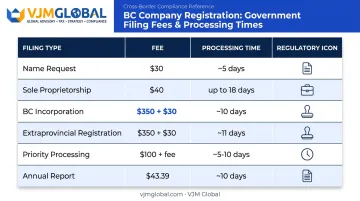
Here's the current government fee breakdown:
| Filing | Fee (CAD) | Estimated Processing |
|---|---|---|
| Name Request | $30 | ~5 business days |
| Sole proprietorship/partnership registration | $40 | Up to 18 business days |
| BC incorporation | $350 (+$30 named company) | ~10 business days |
| Extraprovincial registration | $350 (+$30 name approval) | ~11 business days |
| Priority processing | $100 + filing fee | ~5-10 business days |
| Annual report | $43.39 | ~10 business days |
(All figures sourced from BC's official forms, fees, and processing times pages, updated 2025.)
That table covers government fees only, though. Most US businesses also pay for a registered agent, legal review of articles, or cross-border accounting setup, none of which are included above.
Budget extra time beyond the official processing estimates for:
- Opening a Canadian business bank account (often requires an in-person visit)
- Securing a registered agent before you can even file
- Coordinating signatures across US and Canadian time zones
And remember the ongoing cost: a BC company or extraprovincial registration both require an annual report at $43.39, filed within two months of your incorporation or registration anniversary. Miss it two years running, and BC can administratively dissolve or cancel your registration.
Special Considerations for US Businesses Registering in BC
Director residency isn't an obstacle. Unlike federally incorporated companies, BC corporations impose no Canadian-resident director requirement. A 100% US-owned, US-staffed board is perfectly legal here.
Banking is the real friction point. Canada's financial consumer guidance confirms non-residents can open business accounts, but many major banks still require an in-person visit or a Canadian-based representative to complete verification (Canada.ca: Opening a bank account). Plan for this early; it's often the slowest part of the entire setup.
Tax treaty rules matter more than most guides admit. Under the Canada-US Tax Treaty, your BC operation's tax exposure depends heavily on whether it constitutes a permanent establishment — a fixed place of business like an office, branch, or warehouse. If it does, Canada can tax profits attributable to that establishment; if it doesn't, your US company's profits generally stay taxable only in the US (Canada-US Tax Treaty, Articles V & VII). Because this determination shapes both tax liability and filing obligations, a cross-border tax advisor should review your specific structure before you file anything.
This tax-exposure question also affects which entity structure makes sense. If your existing US company operates in BC without forming a new entity — known as extraprovincial registration — you're still on the hook for annual reports and BC attorney appointments, just like a full BC corporation.
After You Register: Staying Compliant as a US-Owned BC Company
Registration is the easy part. Staying compliant year after year is where things slip.
- File annual reports on time — due within 2 months of your incorporation or registration anniversary
- Maintain a corporate records book — director resolutions, shareholder minutes, share registers
- Hold proper resolutions — even a single-owner BC company needs documented decisions for major actions
Beyond these filing requirements, separate business and personal finances immediately. Open dedicated BC banking, set up bookkeeping systems from day one, and don't let US and Canadian transactions blend together in one spreadsheet.
Cross-border businesses that mix these up often face painful reconciliation work later, especially at tax time. Many owners handling operations across two countries eventually outsource bookkeeping and compliance tracking entirely, freeing them up to focus on running the business rather than untangling spreadsheets each quarter.
Frequently Asked Questions
How much does it cost to register a company in BC?
Costs range from CAD 40 for a sole proprietorship or partnership to CAD 350+ for incorporation or extraprovincial registration. Add a CAD 30 name approval fee, plus CAD 100 if you want priority processing.
How do I check if a company is registered in BC?
Use OrgBook BC or Canada's Business Registries, both free public tools. For certified copies or certificates of status, you'll need a paid search through BC Registry Services.
What do I need to register a company in BC?
You'll need an approved business name, a physical BC registered office address, your chosen business structure, and complete director or owner information.
How long does it take to register a company in BC?
Name approval typically takes around 5 business days. Sole proprietorship registration can take up to 18 business days, while incorporation runs about 10 business days under standard processing.
Can a US citizen or company own a business in BC?
Yes. BC does not require a Canadian-resident director for private companies. You still need a BC registered office address, but ownership and directorship can be entirely US-based.
Do I need a Canadian address to register a business in BC?
Yes, a physical BC address is mandatory — a P.O. box won't satisfy the requirement. Most non-resident US businesses use a registered agent or a compliant virtual office service to meet this rule.