The online process looks straightforward at first glance. Then the questions start piling up. Does she need Canadian residency? Will her US business structure even qualify? What happens to her banking and tax setup once she's operating across two countries?
US entrepreneurs face a layer of complexity Canadian applicants simply don't encounter. This guide walks through exactly who needs to register, what to prepare beforehand, the five-step filing process, naming rules that trip people up, and what comes after you're approved.
Key Takeaways
- Non-residents can register a BC sole proprietorship or partnership name remotely
- Registration runs through two stages: Name Request (NR) approval, then formal filing
- Sole proprietorship registration costs $70-$90 CAD; incorporation costs more
- A registered trade name is not trademark protection — they're separate legal processes
Do US Businesses Need to Register a Business Name in BC?
Registration isn't automatic for everyone. BC only requires it in specific situations.
You need to register a business name if you're:
- Operating under any name other than your exact personal or corporate legal name
- Opening a BC-based bank account under that trade name
- Signing contracts, leases, or vendor agreements as that business name
If Sarah operates simply as "Sarah Chen," no separate registration is required. But her brand, say "Pacific Glow Skincare," needs a formal Name Request and registration before she can use it commercially in BC.
Important nuance for Americans: even if your parent company is already incorporated in the US, testing the Canadian market under a distinct operating name (essentially a Canadian DBA) still requires that name to be registered with BC Registries. Your US incorporation doesn't carry over automatically.
There's also a structural fork worth understanding early:
- Registering a trade name for sole proprietor or partnership use is relatively simple and doesn't require Canadian residency
- Incorporating a BC company is more involved—it still requires a registered office physically located in BC, even though directors no longer need to be Canadian residents
Most US entrepreneurs testing the waters start with a trade name. It's cheaper, faster, and doesn't lock you into a separate legal entity before you know the Canadian market is worth pursuing.
What US Business Owners Need Before Registering
Preparation prevents delays, especially when you're filing from outside Canada with no local contacts to lean on if something goes sideways.
Business Structure Decision
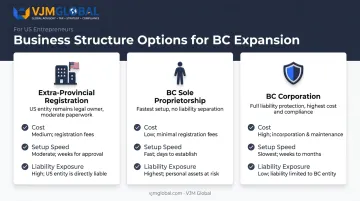
Americans expanding into BC generally choose one of three paths:
- Extra-provincial registration of their existing US entity, which keeps the US company as the legal owner
- A new BC sole proprietorship, treating the Canadian operation as a separate personal venture
- A new BC corporation, creating an entirely distinct legal entity
Each option carries different liability exposure and paperwork. A sole proprietorship is fastest to set up but offers no separation between you and business debts. Incorporation protects personal assets but adds cost and ongoing compliance.
Identification and Address Requirements
Whichever structure you choose, address requirements come next: you'll need a physical BC business address for a sole proprietorship filing — a PO box won't satisfy this requirement. Corporations need a registered office in BC, even for non-resident owners.
Here's some good news: a Canadian SIN (the equivalent of a US SSN) is not required to register a sole proprietorship name. The official registration form doesn't even include a field for it.
Name Options, Payment, and Business Number Planning
With your address and identification questions settled, three more items belong on your prep checklist before starting your application:
- Three name choices, ranked by preference, each following a distinctive-plus-descriptive naming formula
- A valid credit card or accepted online payment method through the BC Registries portal
- A plan for a CRA Business Number if you'll be collecting GST/HST, hiring BC staff, or importing/exporting goods
Non-resident businesses can register for a Business Number through CRA's dedicated web form, which issues the BN alongside eligible program accounts like GST/HST and payroll.
Step-by-Step Guide to Register a Business Name in BC
The entire process happens online through BC Registries. You won't need to travel to Canada to complete it.
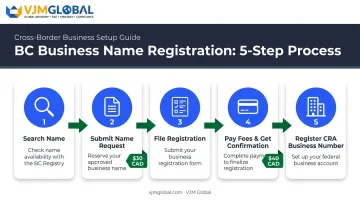
Step 1: Choose and Search Your Business Name
Use the BC Registries Name Request search tool to confirm your preferred name isn't already taken or confusingly similar to an existing one. A preliminary search doesn't guarantee approval, but skipping it is the fastest way to waste time. BC also restricts certain words, such as "Trust," "Royal," or "Chartered," which require special government consent before approval.
US applicants should take one extra step here: run a quick check against both the Canadian Trademarks Database and the USPTO trademark search. This won't affect your BC registration approval, but it will save you from building a brand around a name someone else already owns.
Step 2: Submit a Name Request (NR)
Submit up to three name choices online in order of preference, along with a brief description of your business activity. The filing fee is $30 CAD.
You'll choose between:
- Standard processing: typically several weeks
- Priority processing: usually 1-2 business days for an additional fee, though wait times fluctuate with registry volume
Once approved, BC issues a Name Request number that's valid for 56 days. You need that number to move to registration.
Step 3: File the Business Registration
With your NR number in hand, complete the registration form on BC Registries. You'll need:
- Your approved NR number
- Chosen business structure (sole proprietorship, partnership, or corporation)
- Your BC business address
- Owner or partner identification details
Non-resident applicants can typically finish this entirely online. Corporations are the exception — they still need a registered office address physically located in BC.
Step 4: Pay Registration Fees and Receive Confirmation
Sole proprietorships and general partnerships pay $40 CAD for online registration. Incorporation runs considerably higher, closer to $350 CAD. Confirmation arrives through your BC Registries account dashboard and email, usually within a few business days.
Step 5: Register for a CRA Business Number (If Applicable)
If you're planning to hire BC employees, collect GST/HST, or import and export goods, you'll need a CRA Business Number. This gets issued automatically in some cases, but non-resident businesses often need to apply separately through CRA's registration portal.
Naming Rules and Common Mistakes to Avoid
Most name rejections come down to a handful of predictable errors. Know these upfront and you'll skip a frustrating resubmission cycle.
Naming Rules
BC requires every business name to contain:
- A distinctive element: something unique to your business
- A descriptive element: words indicating what the business actually does
- A legal suffix (Ltd., Inc., Corp.) if you're incorporating, but note that corporate suffixes are inappropriate on sole proprietorship names
Certain terms trigger automatic rejection or require special consent:
- Words implying government affiliation, such as "British Columbia" or "BC" used as your distinctive element
- Regulated terms like "bank," "trust," or "insurance" without proper authority
- Misleading claims about what your business does
- Offensive or objectionable language
Common Mistakes US Applicants Make
- Skipping the availability search, then having a top-choice name rejected and losing weeks of processing time
- Confusing trade name registration with trademark protection: registering with BC Registries doesn't stop competitors from using similar names, since trademark protection is a separate process
- Letting the 56-day reservation lapse by not completing registration in time, forcing a fresh Name Request
- Assuming registration handles tax and banking automatically: a BC trade name won't set up your US tax reporting, Canadian banking, or cross-border compliance
After Registration: Next Steps for US Businesses
Getting your name registered is the starting line, not the finish. A few practical moves come next.
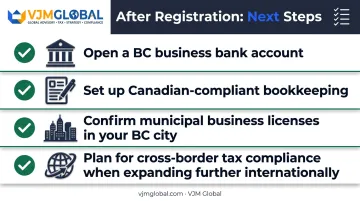
Immediately after registration:
- Open a BC business bank account under your registered name
- Set up bookkeeping that accounts for Canadian tax rules, which differ meaningfully from US GAAP conventions
- Confirm any municipal business licenses your specific BC city requires — Vancouver, Surrey, and Victoria all have their own local permit rules layered on top of provincial registration
Some US businesses don't stop at Canada. If your BC expansion is one piece of a broader international growth plan, and India is on that roadmap, the compliance layers multiply fast. Managing transfer pricing between a US parent, a Canadian operation, and an Indian subsidiary is a different challenge than registering a single trade name.
This is where firms like VJM Global come in on the India side of that equation. They specialize in cross-border tax compliance for US businesses entering the Indian market, covering Double Tax Avoidance Agreement advisory and FEMA compliance for capital moving between jurisdictions.
If your BC registration is step one of a larger US-Canada-India structure, that kind of focused expertise fills a real gap on the India end.
Frequently Asked Questions
How much does it cost to register a business name in BC?
Expect $30 CAD for the Name Request plus $40 CAD for sole proprietorship or partnership registration, totaling roughly $70-$90 CAD. Incorporation runs closer to $350 CAD, and priority processing adds an extra fee on top.
Do I need to register my business name in BC?
Registration is required if you're using any name other than your exact legal name, hiring staff under that name, or collecting GST/HST. Operating strictly under your own personal name doesn't require it.
How do I check if a business name is available in BC?
Use the BC Registries Name Request search tool before submitting your application. This preliminary check reduces your chances of rejection, though final approval still comes from a BC Registries examiner.
Can a US citizen register a business name in BC without living in Canada?
Yes. Non-residents can register a sole proprietorship or partnership name entirely online. BC corporations are different: they require a registered office physically located in BC, even though director residency is no longer restricted.
Do I need a Canadian bank account or address to register a BC business name?
You need a registered business address in BC, which a virtual address or registered agent service can typically satisfy. A Canadian bank account isn't required to register, though opening one afterward is strongly recommended.
What's the difference between registering a trade name and incorporating a company in BC?
A trade name is simply an operating name tied to you as the existing owner, and it doesn't create legal separation. Incorporation forms a distinct legal company with its own liability protections, separate from you personally.