But "no residency requirement" doesn't mean "no requirements." Incorporating under BC's Business Corporations Act comes with its own paperwork, registered office rules, and cross-border tax coordination that domestic Canadian founders simply don't deal with.
This guide walks through the exact steps, current government fees, and the specific hurdles US businesses run into so you can incorporate in BC without expensive surprises.
Key Takeaways
- BC lets non-residents own shares and serve as directors, with no Canadian residency required
- The core process spans five to six steps, from company structure to post-filing setup
- Government filing fees run CAD$350 to CAD$1,030, with name approval in 1-5 business days
- US owners face extra layers: registered office rules, Canadian banking, GST/HST, and possible Investment Canada Act filings
- Dual-country bookkeeping and tax coordination become critical fast, making cross-border accounting support a smart investment
What Is BC Incorporation and Why US Businesses Choose It
Incorporating in BC creates a legal entity separate from its owners. Under the Business Corporations Act, that entity gains its own rights and liabilities, plus continuous existence, meaning it doesn't dissolve if a shareholder leaves or dies.
For US businesses, BC offers a specific mix of advantages:
- No residency requirement for directors or shareholders, unlike some other provinces
- Direct market access into Canada without needing a separate Canadian parent company
- Credibility with Canadian suppliers, partners, and government contracts that often favor locally incorporated entities
- Competitive corporate tax structure relative to other jurisdictions in North America
These advantages matter most once you weigh BC against its main alternative: incorporating federally instead of provincially.
BC vs. Federal Incorporation
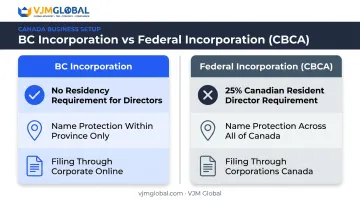
Federal incorporation under the Canada Business Corporations Act protects your company name across all of Canada. BC incorporation only protects it within the province. That sounds like federal wins by default, but there's a catch for American owners.
The CBCA requires that at least 25% of directors be Canadian residents, and if the board has fewer than four directors, at least one must reside in Canada. BC has no such rule. For a US business without a resident Canadian on the leadership team, that difference alone often settles the decision in favor of BC.
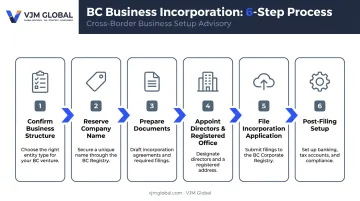
Step-by-Step Process to Incorporate a Business in BC
The path runs from picking your structure to holding a Certificate of Incorporation in hand, and most of it happens online through Corporate Online, BC's official registry filing system.
Step 1: Confirm Your Business Structure Fits BC Incorporation
Before filing anything, confirm a BC corporation actually matches your goals. A sole proprietorship or partnership might suit a small pilot project, while a federal corporation might make more sense if you're planning operations across multiple provinces immediately.
Talk to a cross-border advisor before you file. Getting the structure wrong at this stage means unwinding paperwork later, which costs more time and money than doing it right the first time.
Step 2: Choose and Reserve a Unique Company Name
Name reservation happens through BC Registries and Online Services. Here's the fee breakdown:
| Service | Fee | Processing Time |
|---|---|---|
| Standard name request | CAD$30 | 5 business days |
| Priority processing | +CAD$100 | 1-2 business days |
| Numbered company | No fee | Not required |
Once approved, your reserved name stays valid for 56 days. If you don't file your incorporation within that window, you'll need to reserve it again. Skip the name reservation entirely by going with a numbered company, though most US businesses prefer a named entity for branding purposes.
Step 3: Prepare the Incorporation Documents
Three documents anchor your BC incorporation:
- Articles: Your company's governing rules, either the standard Table 1 Articles or a customized version covering share structure and director powers
- Incorporation Agreement: Signed by each incorporator, confirming they're taking on a specific number and class of shares
- Notice of Articles: Generated by the registry from your online application, listing your company name, addresses, directors, and share structure
The Articles and Incorporation Agreement stay in your records office. They aren't filed directly, but they need to exist and be accurate before you submit your application.
Step 4: Appoint Directors and Establish a BC Registered Office
Directors don't need to live in BC or anywhere in Canada. That said, your company must maintain a registered office and records office with a physical BC street address, accessible to the public from 9 a.m. to 4 p.m. on business days. A P.O. box won't cut it.
Companies without an existing BC office typically solve this through a registered agent service or a law firm offering registered office services. It's a small ongoing cost that keeps you compliant without needing actual office space in Canada.
Step 5: File the Incorporation Application
Filing happens through Corporate Online, and the standard fee runs CAD$350 for a limited company or CAD$1,000 for an unlimited liability company. Once approved, you'll receive:
- A Certificate of Incorporation
- A certified copy of your Incorporation Application
- A certified Notice of Articles
These three documents together prove your company legally exists, and you'll need them for nearly every next step, including opening a bank account.
Step 6: Complete Post-Filing Setup
Incorporation isn't the finish line. Immediately after, you'll need to:
- Confirm your automatically-assigned 9-digit CRA Business Number
- Register for GST/HST if your taxable supplies cross the threshold
- Register for BC PST if you're selling goods, software, or taxable services
- Open a corporate bank account using your incorporation documents
Special Considerations for US Businesses Incorporating in BC
BC's non-residency rule is real: no Canadian citizenship, residency, or even a Canadian mailing address is required to incorporate, hold shares, or sit on the board. That puts BC ahead of provinces that still mandate resident directors.
That flexibility doesn't remove every hurdle, though. A handful of considerations hit US businesses specifically.
The Registered Office Problem
Every BC company needs a physical registered and records office in the province. Without a BC presence, most American owners solve this with a registered agent, virtual office provider, or law firm. This isn't optional, and the registry will reject an application listing a US address for this purpose.
Opening a Canadian Bank Account
Canadian banks generally want to see:
- Your Certificate of Incorporation and Articles
- Government-issued photo ID for each director
- Ownership information for anyone holding 25% or more of shares, per FINTRAC's beneficial ownership rules
- A completed banking package specific to the institution
Some banks accept remote onboarding for non-resident owners; others still expect an in-person visit. Confirm this with your chosen bank before assuming you can complete everything online.
Cross-Border Tax Coordination
Your BC company needs a CRA Business Number (assigned automatically at incorporation) and must file a T2 corporate return every year, even with zero tax owing. GST/HST registration becomes mandatory once your worldwide taxable supplies pass CAD $30,000 in a single calendar quarter or over four consecutive quarters, according to the Canada Revenue Agency.
On the US side, officers, directors, or shareholders of a foreign corporation may need to file IRS Form 5471, and certain property transfers to the new entity can trigger Form 926. The Canada-US tax treaty limits double taxation on business profits, but it doesn't erase these US information-reporting requirements.
Investment Canada Act and Work Authorization
Setting up a new Canadian business as a non-Canadian is typically notifiable under the Investment Canada Act, with notice filed before or within 30 days after implementation. Review thresholds vary by investor type, and private US investors usually fall under the trade-agreement category, according to Innovation, Science and Economic Development Canada.
Incorporating a company doesn't grant you the right to work in Canada. If you plan to physically operate the business day-to-day in BC, you'll likely need proper work authorization beyond a short business-visitor stay.
Managing bookkeeping, tax filings, and compliance across two countries gets complicated fast, especially once CRA deadlines start piling up alongside IRS forms.
Cross-border accounting firms that specialize in supporting American business owners with international entity setup and back-office work can help. VJM Global, for instance, has guided 500+ US-based entrepreneurs through similar cross-border structuring, helping them build reporting systems before small gaps turn into compliance headaches.

Costs, Timelines, and Choosing the Right Structure
Here's what BC incorporation actually costs, based on current government fees:
| Path | Total Cost | Timeline |
|---|---|---|
| Numbered BC Ltd. | CAD$350 | No name approval needed |
| Named BC Ltd. (standard) | CAD$380 | ~5 business days for name |
| Named BC Ltd. (priority) | CAD$480 | 1-2 business days for name |
| Named BC ULC | CAD$1,030 | ~5 business days for name |
These figures cover government filing only. Legal or accounting support for drafting custom Articles or reviewing share structure adds cost on top, typically ranging from a few hundred to a few thousand dollars depending on complexity.
Beyond these baseline government fees, your naming choice determines how fast you can launch. Numbered companies skip the name-approval wait entirely, making them the fastest route if branding can wait. Named companies take longer but give you immediate use of your chosen business name.
If your US business plans to operate beyond BC, extra-provincial registration matters too. Under the New West Partnership Trade Agreement, registering a BC company in Alberta, Saskatchewan, or Manitoba carries no fee beyond any applicable name reservation charge. That makes BC a reasonable home base even for businesses planning multi-province operations.
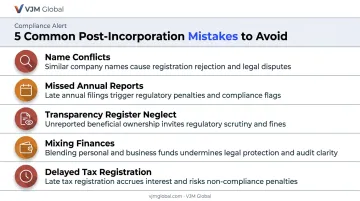
Common Mistakes and Post-Incorporation Compliance
A few missteps show up again and again with first-time BC incorporators, and most are avoidable with a bit of planning.
- Name conflicts: Choosing a name too close to an existing BC business leads to outright rejection. Cross-reference the BC Registry database before submitting your reservation request.
- Missed annual reports: Every BC company files an annual report within two months of its incorporation anniversary, currently costing CAD$43.39. Missing it two years running lets the registrar dissolve your company.
- Transparency register neglect: Private BC companies must maintain an internal Transparency Register for anyone with 25% or more ownership or control, updated within 30 days of new information.
- Mixing finances: Running personal and business transactions through the same account creates a bookkeeping mess and undermines the liability protection incorporation is supposed to provide.
- Delayed tax registration: Waiting too long to register for GST/HST or PST after crossing the threshold creates retroactive penalties. Early bookkeeping support catches these triggers before they become costly.
Frequently Asked Questions
How much does it cost to incorporate a business in BC?
The standard government filing fee is CAD$350 for a numbered company or CAD$380 with a reserved name. Priority name processing adds CAD$100, and optional legal or accounting fees vary by provider.
What do you need to incorporate a business in BC?
You'll need a company name (or numbered company), Articles, an Incorporation Agreement, director details, and a physical BC registered office address. All documents get submitted through Corporate Online.
When should I incorporate my business in BC?
Common triggers include rising revenue, increased liability exposure, plans to hire employees, or entering into major contracts. Incorporating before a big growth event protects personal assets from the outset.
What is the difference between Ltd and Inc in BC?
There's no legal difference. Both are corporate designations permitted under the Business Corporations Act, alongside Corp. Rights, liabilities, and governance rules stay identical regardless of which suffix you choose.
Can a US citizen incorporate a business in BC without living in Canada?
Yes. BC has no residency requirement for directors or shareholders. You'll still need a BC registered office address and may need to file a notification under the Investment Canada Act.
Do I need a Canadian bank account before I incorporate in BC?
No, it works the other way around. You open your Canadian bank account after incorporation, using your Certificate of Incorporation and Articles as part of the required banking package.