Free zone registration fees swing wildly — from around AED 6,000 for a bare-bones licence to AED 31,000+ for specialist packages with coworking space included. That's before visas, banking support, or office upgrades enter the picture.
Most UK founders underestimate the real cost because pricing isn't one flat number. It shifts by free zone authority, licence category, office requirement, and how many visas you need. This guide breaks down what UK businesses actually pay, in AED terms, the factors that push costs up or down, and how to budget without getting blindsided in year two.
Key Takeaways
- Entry-level licences start around AED 6,000, but visas and office space push real costs higher
- DMCC and DIFC cost more than budget zones like RAKEZ but offer stronger banking credibility
- Year-two renewal costs often surprise UK founders who only budgeted for setup
- Free zone incorporation alone doesn't guarantee 0% corporate tax — Qualifying Free Zone Person conditions apply
- UK-UAE tax treaty rules mean profits aren't automatically tax-free back home
How Much Does It Cost to Register a Company in a Dubai Free Zone? (Pricing Overview)
There's no single sticker price for Dubai free zone registration. Costs depend on three variables: the free zone authority you pick, the licence category your business activity falls under, and what's bundled into the package — office space, visas, or neither.
These variables explain why headline prices are so misleading. A "AED 12,000 Dubai company setup" ad rarely tells you what happens once you add a visa or swap a flexi-desk for a private office — and that gap is the single biggest area of confusion for UK founders researching costs online.
Common budgeting mistakes UK founders make:
- Underestimating visa and office add-ons that aren't in the headline price
- Choosing a licence type that doesn't match their actual business activity (this causes banking problems later)
- Ignoring that year-two renewal costs are often higher than the first-year promotional rate
Typical Cost Ranges
Based on verified 2024-2025 pricing from official free zone authorities, here's what real packages look like:
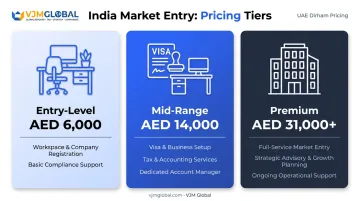
| Setup Level | Example Package | What It Covers |
|---|---|---|
| Entry-level | AED 6,000 (RAKEZ Biz Starter) | Licence within 24 hours, coworking membership, up to 5 shareholders |
| Mid-range | AED 14,000 (RAKEZ one-visa bundle) | Licence, one UAE residence visa, shared workstation |
| Specialist/premium | AED 31,000 (DMCC AI package) | Registration, Articles of Association, establishment card, licence, one coworking desk |
None of these figures are industry averages — they're documented official examples. Your actual quote will depend on your specific activity and free zone choice.
Entry-Level Package
Best suited to UK freelancers, consultants, and holding companies that don't need a physical UAE presence. Typically includes licence registration and a flexi-desk or coworking membership, with no visa attached. If you're running the business remotely from the UK and just need a UAE entity for invoicing or holding IP, this tier usually covers it.
Mid-Range Package
This is where most small UK service businesses land. Expect a licence plus one or two visas and a flexi-desk or basic office. It suits founders building a small team that needs UAE residency status, whether for banking purposes or to actually live and work from Dubai part of the year.
Premium Package
Trading companies, businesses needing multiple staff visas, or firms that want strong local banking credibility typically spend AED 35,000-80,000+ in year one. This tier usually includes a private office (which unlocks a higher visa quota), multiple visa allocations, and sometimes dedicated banking introduction support.
Key Factors That Affect the Cost for UK Businesses
Beyond the base licence fee, several variables — some tied to your business, some tied to the jurisdiction — determine what you'll actually pay. Note that all figures below are quoted in AED or USD, the UAE's official currencies, since no GBP-denominated pricing exists for free zone registration.
Free Zone Authority Chosen
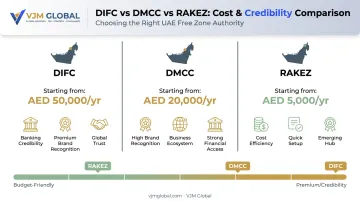
Premium zones cost more, and for good reason. Here's how the major authorities compare:
- DIFC: ~USD 8,000 for non-retail incorporation, plus USD 12,000 annually for the licence (published directly in USD)
- DMCC: AED 20,285/year for standard trading or service licences; general trading licences run AED 50,265 plus a AED 29,000 registration fee
- RAKEZ: entry packages start from AED 6,000
DMCC and DIFC carry brand recognition that matters for banking relationships and client-facing credibility, particularly in finance, commodities, or regulated sectors. RAKEZ, IFZA, and SAIF, by contrast, are built for cost efficiency, popular with UK consultants, e-commerce sellers, and smaller trading operations that don't need the premium address.
Licence Type and Business Activity
Your licence category directly shapes your fee structure:
- Consultancy/service licences — generally the cheapest, lowest compliance burden
- Trading licences — DMCC charges AED 20,285 annually for standard trading; extra activities cost AED 1,500 each
- General trading licences — jump to AED 50,265 annually plus a separate registration fee
- Industrial licences — tied to facility size, ranging from AED 8,265 (50-100 sq m) to AED 25,265+ for larger units
Picking the wrong category to save money upfront is a common trap — banks and auditors will flag it later.
Number of Visas Required
Each visa adds real cost, not just paperwork. A single UAE residence visa involves several separate government fees:
- Medical fitness test: AED 250 plus printing fees
- Emirates ID: AED 100 per year of residence, plus AED 100 smart-service fee
- Residence permit stamping: AED 200
There's no single official "per-visa total" published across the UAE — free zone processing charges, entry permits, and insurance vary by authority. Budget for these as separate line items, not a bundled estimate.
Office or Flexi-Desk Requirement
Your workspace choice controls your visa quota, which is why most UK founders start lean. Using DMCC's published benchmark as a reference point:
| Premises Type | Starting Price | Visa Allocation |
|---|---|---|
| Standard flexi-desk | From AED 16,800/year + AED 1,000 deposit | Up to 3 visas |
| Serviced office | From AED 35,000/year | 4-5 visas |
| Physical office | AED 50-150/sq ft/year | 1 visa per 9 sq m |
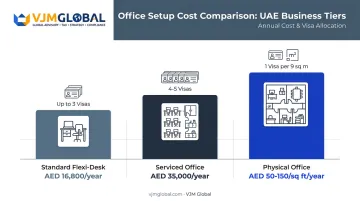
Need more than three staff on visas? You'll likely need to upgrade beyond a basic flexi-desk regardless of free zone.
Share Capital Requirements
Most free zones don't demand capital sitting in a bank account, but many still require a declared share capital figure on the licence. DMCC's benchmark sits at AED 50,000 per company plus AED 10,000 per shareholder, with exceptions for certain activities. RAKEZ's FAQ cites AED 10,000 for a standard FZ-LLC.
This matters for UK founders because it's a figure you may need to show or declare — even if it's not always physically deposited — when opening your UAE bank account.
Banking and Compliance Support
Opening a UAE bank account as a UK-owned entity typically requires extra KYC documentation: source of funds explanations, UK company records, and sometimes a personal visit. Banks scrutinise foreign-owned free zone companies more closely than local ones, which is why many founders bring in professional support for this stage; it's rarely covered in the base registration fee. Firms like VJM Global that specialise in cross-border compliance can help UK businesses prepare the right documentation before approaching a bank.
Full Cost Breakdown: One-Time vs Recurring Expenses
The headline registration fee is just the entry point. Here's what actually shows up across year one.
| Cost Item | Frequency | What It Covers |
|---|---|---|
| Registration/application fee | One-time | Processing your company application with the free zone authority |
| Trade licence fee | Annual (recurring) | Your biggest recurring cost, varies by activity and zone |
| Office/flexi-desk fee | Annual (recurring) | Mandatory workspace, tied directly to visa quota |
| Visa costs (per person) | Periodic | Medical test, Emirates ID, and stamping per visa holder |
| Establishment card/immigration file | One-time + recurring | Required to process visas and labour registrations |
| Accounting, VAT, tax registration | Recurring | Bookkeeping, VAT filing (threshold AED 375,000), potential corporate tax registration |
The last line item is where a lot of UK founders get caught out. UAE corporate tax isn't automatically zero just because you're in a free zone — Qualifying Free Zone Person status requires meeting substance, income, and compliance conditions, and losing that status can cost you the 0% rate for the current period plus the following four tax periods.
Given these stakes, founders typically budget for professional compliance support well before their first tax filing deadline, rather than treating it as an afterthought once the company is already registered.
Free Zone vs Mainland vs LLC — Which Structure Is Right for UK Businesses?
"Free zone" describes a jurisdiction type. "LLC" describes a legal entity structure. These aren't competing options: free zones have their own equivalents, typically called FZE (single shareholder) or FZ-LLC/FZCO (multiple shareholders).
The real comparison is free zone vs. mainland:
- A mainland LLC can trade anywhere in the UAE without restriction, including direct contracts with local government and private UAE clients
- A free zone company is generally built for international trade and operations tied to the zone, though Executive Council Resolution No. 11 of 2025 now allows free zone firms to obtain a permit for limited mainland operations too
| Factor | Free Zone Company | Mainland LLC |
|---|---|---|
| UAE trading rights | Limited to zone; permit needed for mainland work | Unrestricted across UAE |
| Government contracts | Not directly eligible | Directly eligible |
| Setup cost & speed | Generally lower cost, faster setup | Higher cost, more documentation |
| Best fit | International trade, GCC/global clients | UAE-based revenue, local contracts |
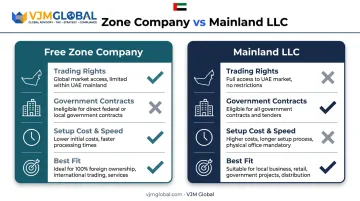
For most UK businesses — consultants, SaaS companies, e-commerce sellers, trading firms targeting GCC and global clients — free zones remain more cost-effective and faster to set up. Choose mainland instead if a meaningful chunk of your revenue will come from direct UAE-based contracts that require local trading rights.
How UK Businesses Can Budget Smartly and Avoid Common Mistakes
Getting the setup cost right the first time saves headaches later. Here's what experienced UK founders do differently:
- Budget the full first-year cost, not just the registration fee. Factor in licence, visas, office space, and banking support together, then check what year-two renewal actually costs before signing.
- Match the licence to your real activity. A mismatched licence causes banking friction and compliance issues down the line, even if it saved you money upfront.
- Factor in GBP-to-AED fluctuation when quoting client contracts or budgeting cash flow, since the AED is pegged to USD, not GBP
- Understand your UK tax exposure — the UK-UAE double taxation treaty caps source-state dividend tax at 15%, but it doesn't make profits automatically tax-free if you remain UK tax resident
Getting the Dubai numbers right is often just the first step. Many UK businesses that set up in a Dubai free zone also look at India for cost-effective back-office operations, outsourced accounting, or a second growth market. Running compliance across both UAE and India at once is where a firm like VJM Global helps: one point of contact for structuring, accounting, and cross-border tax questions, rather than separate advisors in each jurisdiction.
The right Dubai setup isn't the cheapest one. It's the one that balances upfront cost against long-term compliance, banking access, and where your business is actually headed.
Frequently Asked Questions
⚠️ CONTENT-COMPANY SCOPE MISMATCH FLAGGED — See issues_found for details. Inline formatting fixes below assume topic retention pending human review.
How much money do I need to register a company in Dubai?
Licence-only setups start around AED 6,000, while packages with visas and office space typically run AED 14,000-80,000+ depending on the free zone and activity. Get a dated quote from your chosen authority, since promotional pricing changes frequently.
What is the difference between freezone and LLC in Dubai?
"Freezone" refers to the jurisdiction and its governing authority, while "LLC" is a legal entity type. Free zones issue their own equivalents — FZE or FZ-LLC — which face different trading restrictions than a mainland LLC.
How long does it take to open a company in Dubai free zone?
Licence-only setups can take anywhere from 24 hours to two weeks, depending on the authority. Adding visas or a bank account extends the process to several weeks, since bank KYC timelines aren't controlled by the free zone's licence SLA.
Can a UK citizen own 100% of a Dubai free zone company?
Yes. UAE free zones allow 100% foreign ownership for UK nationals, with full rights to repatriate capital and profits, a key advantage over older mainland structures requiring a local partner.
Do UK-owned Dubai free zone companies pay tax in the UK?
UAE free zone profits can still carry UK tax implications, depending on your UK residency status and how the UK-UAE double taxation treaty applies to your situation. Get professional cross-border tax advice before assuming zero UK liability.
Which Dubai free zone is best for UK businesses?
It depends on your activity and goals. DMCC or DIFC suit businesses prioritising credibility and banking ease, while IFZA, RAKEZ, or SAIF work well for cost-efficient service or trading setups.