Wharton is a small Morris County borough (ZIP 07885) covering about 2.2 square miles. Local entrepreneurs, freelancers, NRIs, and small business owners often assume that filing with the state is the finish line. It isn't.
This guide breaks down the exact registration steps, the Wharton-specific requirements that trip people up, and what actually drives your timeline and costs.
Key Takeaways
- Registering in Wharton requires both NJ Division of Revenue filing and Wharton Borough zoning/business approvals.
- Core steps include choosing a structure, reserving a name, filing formation documents, and securing tax IDs and local permits.
- Costs and timelines shift based on structure type, whether you're home-based, and industry licensing needs.
- Skipping Wharton's zoning or Certificate of Occupancy review is the single most common (and costly) mistake.
- Ongoing compliance, bookkeeping, and annual filings matter just as much as getting the initial paperwork right.
What Is Company Registration and Why It Matters in Wharton, NJ
Company registration is the legal process of establishing a business entity, whether that's a sole proprietorship, LLC, or corporation, that's recognized by New Jersey state authorities and, where applicable, by Wharton Borough itself.
The result is straightforward: your business gets a legal identity. That identity lets you:
- Open a business bank account under the company name
- Hire employees and run payroll legally
- Pay state and federal taxes correctly
- Access liability protection (for LLCs and corporations, not sole proprietorships)
Wharton's small size cuts both ways for business owners. At just 2.2 square miles, the borough has fewer municipal departments to coordinate with than a large city, but that compact footprint also means zoning and residential-versus-commercial rules get enforced tightly.
Here's what that means in practice:
- Fewer departments to navigate when filing paperwork
- Stricter enforcement of zoning and commercial-use rules
- Approvals routed directly through Borough Hall under Wharton's Mayor-Council government structure
Operating without proper registration carries real financial risk. New Jersey's Division of Taxation applies late-filing penalties of 5% per month, up to a maximum of 25% of unpaid tax, according to the Division of Taxation's penalties and interest guidance.
The state can also add an additional $100 per month for continued non-filing, on top of separate late-payment and interest charges. Registration isn't optional for anyone hiring staff, opening a business bank account, or applying for local permits in Wharton.
Step-by-Step: How to Register a Company in Wharton, NJ
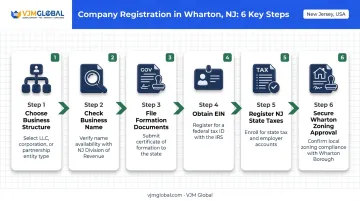
The process moves in a clear sequence: legal structure, name check, state filing, federal tax ID, state tax registration, then local borough compliance. Most of this happens online through New Jersey's Division of Revenue and Enterprise Services (DORES) portal. The local layer, though, requires direct contact with Wharton Borough's Housing and Zoning office.
Step 1: Choose Your Business Structure
Your structure choice determines your liability exposure and how you're taxed.
- Sole proprietorship – Simplest setup, but no liability separation; if operating under a different name, file a Certificate of Trade Name with the Morris County Clerk.
- LLC – Formed by filing a Certificate of Formation with DORES; members generally get liability protection with flexible tax treatment.
- C corporation – A separate legal entity with its own tax obligations; more formal governance required.
- S corporation status – Not a separate NJ entity type. It's a federal tax election filed via IRS Form 2553, and nonresident aliens cannot be shareholders.
Step 2: Choose and Check Your Business Name
New Jersey requires your entity name to be distinguishable from every other active business on file. DORES offers a free Name Availability Look-Up tool, and small details like spacing and punctuation can affect the result. A rejected name means resubmitting your filing, so confirm availability before you submit.
Your name also needs an entity designator:
- Corporations: "Inc.," "Corp.," "Corporation," "Ltd.," "Co.," or "Company"
- LLCs: "Limited Liability Company," "Limited Liability Co.," or "L.L.C."
Step 3: File Formation Documents with New Jersey
LLCs file a Certificate of Formation; corporations file a Certificate of Incorporation. Both go through DORES's Business Formation Service online.
The current filing fee is $100 for either an LLC or a for-profit corporation, according to New Jersey Treasury's official fee schedule. If you've seen a $125 figure floating around online, ignore it. That's outdated.
Expedited processing is available for an added cost, ranging from a $15-25 over-the-counter bump up to $500-$1,000 for two-hour or one-hour turnaround.
Step 4: Obtain an EIN from the IRS
An Employer Identification Number is free and required for taxes, hiring, and opening a business bank account. Applying online requires a U.S. principal place of business and a responsible party with a valid taxpayer ID. If you're applying from outside the U.S., you'll use phone, fax, or mail instead. Most applicants who qualify for the online application receive their EIN immediately, making this one of the fastest steps in the entire process.
Step 5: Register for New Jersey State Taxes and Employer Requirements
Complete NJ-REG at least 15 business days before you start doing business, since late registration can delay your ability to legally collect sales tax or run payroll. This registers you for:
- Sales tax collection (if selling taxable goods or services)
- Employer withholding
- Unemployment, disability, and family-leave insurance if you're hiring staff
Step 6: Secure Wharton Borough Local Approvals
This is the step most founders miss. Before opening your doors, you need zoning verification, and possibly a Certificate of Occupancy, from Wharton's Housing and Zoning department. Submit the New Business Application/Registration form, which asks for your property address, block/lot number, prior and proposed use, employee count, and parking availability. Skipping this step risks fines or a stop-work order after you've already opened your doors.
Local Wharton, NJ Requirements and Business Structures to Consider
Wharton requires zoning confirmation before any business, whether it's a storefront or a home-based operation, can legally start at a given address. This isn't a formality. Wharton's zoning page explicitly states that a review or permit is required before business registration or renovations proceed, per the Borough's New Business Application/Registration form.
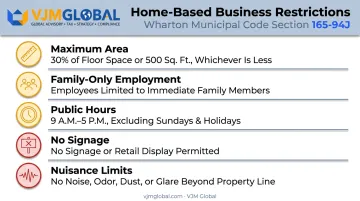
Running a business from home? Wharton's ordinance (Code Section 165-94J) spells out strict limits:
- Maximum area: 30% of total floor space or 500 square feet, whichever applies
- Only immediate family members living in the home can be employed
- Public hours limited to 9 a.m. to 5 p.m., excluding Sundays and holidays
- No signage, no retail display, no storage in garages or yards
- No noise, odor, dust, or glare that spills beyond the property
Because approvals run through Borough Hall directly under Wharton's Mayor-Council structure, there's no multi-department shuffle like you'd find in a bigger city. That's an advantage once you know who to contact: Wharton's Housing and Zoning office at 10 Robert Street.
Once you know where to file, the next decision is choosing the right legal structure. Which structure fits best? Among small Wharton businesses, LLCs are the most common choice for the liability protection they offer, while sole proprietorships remain popular among solo freelancers and small operations.
The structure you pick directly shapes your local paperwork:
| Business Structure | Zoning Paperwork Required |
|---|---|
| LLC | Certificate of Formation |
| Sole Proprietorship | Proof of filed trade name |
Key Factors That Affect Registration Cost, Timeline, and Ongoing Compliance
Your upfront cost depends on a few variables:
| Cost Factor | Detail |
|---|---|
| State filing fee | $100 (LLC or corporation) |
| Expedited processing | $15-$1,000 depending on turnaround speed |
| Registered agent service | Varies by provider; you can serve as your own agent if you meet NJ's address requirements |
| Wharton zoning/permit fees | Not published; confirm directly with Housing and Zoning |
Timeline depends on document accuracy, how backed up DORES is at the time, and how fast Wharton's zoning office can process your application. There's no officially published standard turnaround for state formation, only the paid expedited tiers.
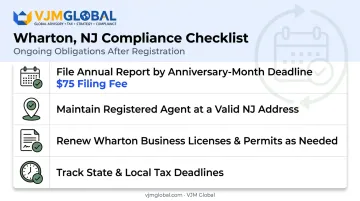
Registration isn't a one-time event. After forming your entity, New Jersey requires an annual report with a $75 fee, due by the last day of your formation-anniversary month, according to Business.NJ.gov's filings and accounting guidance. Miss two consecutive years, and the state can void your charter entirely.
Ongoing compliance essentials:
- File your annual report by your anniversary-month deadline
- Maintain a registered agent at a valid NJ address
- Renew Wharton business licenses or permits as needed
- Track state and local tax deadlines to avoid penalties
Daily bookkeeping brings its own set of challenges. Bookkeeping, tax filings, and financial reporting pile up fast once you're running the business. Firms like VJM Global, which specialize in cross-border accounting and compliance work, can take this off your plate—particularly if your Wharton-based company works with international clients, suppliers, or investors. The goal is transparent, cost-effective support rather than a black box of hourly billing.
Common Mistakes and When to Get Professional Help
A few patterns show up repeatedly among first-time Wharton business owners:
- Registering with the state, then skipping Wharton zoning. Founders assume state formation is the whole process. Then they get a call from Housing and Zoning, or worse, a fine, because they never submitted the New Business Application.
- Confusing a name search with entity formation. Checking name availability on DORES's portal doesn't create a legal entity. You still need to file a Certificate of Formation or Incorporation and pay the fee.
- Underestimating cross-border complexity. NRIs, OCIs, and entrepreneurs planning to operate on both sides of the US-India corridor face added layers: EIN applications from abroad, DTAA considerations, and FEMA compliance if capital moves between countries.
For that last group specifically, this is where specialized guidance pays off. VJM Global brings over 30 years of tax, audit, and advisory experience, with a team that includes both CPAs and Chartered Accountants.
The firm works with entrepreneurs who need their New Jersey registration to align cleanly with Indian compliance obligations. That might mean structuring FDI flows, managing DTAA filings, or setting up parallel entities. This kind of dual-jurisdiction planning is hard to get right without someone who's done it before.
Frequently Asked Questions
Do I need a registered agent to register a company in New Jersey?
Yes. LLCs and corporations must maintain a registered agent with a physical New Jersey street address. You can serve as your own agent, or hire a professional registered agent service.
How much does it cost to register a business in Wharton, NJ?
State filing runs $100 for an LLC or corporation, plus optional expedited fees. Wharton doesn't publish a fixed zoning or permit fee, so confirm the exact amount with Housing and Zoning directly.
How long does the New Jersey company registration process take?
New Jersey doesn't publish a standard processing time; only paid expedited tiers have set turnarounds. Add extra time for Wharton's zoning and Certificate of Occupancy review before you can legally open.
Do I need a separate local business license from Wharton Borough in addition to state registration?
Most businesses need zoning sign-off from Wharton Borough Hall. Some activities also require a Certificate of Occupancy or an activity-specific license, such as a Board of Health permit for food service.
Can an NRI or non-US resident register a company in New Jersey?
Yes. Non-residents can form an LLC or corporation in NJ without a visa. They'll still need an EIN and should expect added tax complexity around foreign ownership reporting, so seeking professional guidance is advisable.
What's the difference between an LLC and a corporation when registering in NJ?
Both offer liability protection, but LLCs have simpler paperwork and flexible pass-through taxation, while corporations require more formal governance and face potential double taxation unless S status applies.