Business confidence surveys have been choppy all year. Yet Americans keep filing paperwork to start companies anyway. High-propensity business applications, those most likely to become actual employers, came in at 149,714 for the same month, up 1.9%. Sentiment and action aren't matching up, and that gap matters if you're trying to time a launch or just make sense of where the market's headed.
This article breaks down what the latest formation data shows, which 2026 regulatory changes actually affect new entities, how to think about structure decisions, and what happens when US founders start eyeing international markets like India.
Key Takeaways
- New business applications hit 531,423 in June 2026, near record territory despite mixed sentiment surveys
- FinCEN's March 2025 rule now exempts all US-created entities from BOI reporting; foreign-registered entities still must file
- Pennsylvania, Texas, and California all adjusted filing fees or thresholds for 2026, changing recurring compliance costs
- These state-level changes mean entity choice and state selection carry more weight than in prior years
- US founders expanding into India face sector-specific FDI rules that shape entity choice long before registration
US Business Formation Trends: What the Latest Data Shows
The Census Bureau's June 2026 release, published July 9, gives the clearest recent snapshot of formation activity. Total business applications reached 531,423 on a seasonally adjusted basis. High-propensity applications, the ones with characteristics suggesting the founder plans to hire, climbed to 149,714.
One caveat: Census revised its methodology in January 2026, removing internet-sale applications from the high-propensity count and shifting to 2022 NAICS codes. Don't compare June 2026 figures directly against pre-2026 releases — the series isn't apples-to-apples anymore.
Which Sectors Are Heating Up
Month-over-month movement in June 2026 showed some clear standouts:
- Utilities — up 8.2%
- Mining — up 6.7%
- Information — up 4.7%
- Manufacturing and transportation/warehousing — both up 3.1%
- Accommodation and food services — up 2.6%
- Retail trade — up 2.0%
- Professional services — up 1.3%
- Construction — up 0.8%
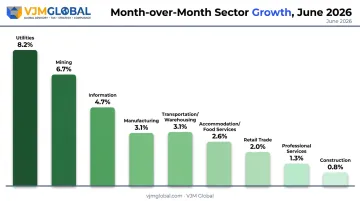
These are one-month movements, not multi-year trends, so treat them as a pulse check rather than a forecast. Sector swings like these only tell part of the story, though — the more reliable signal is whether those new filings actually intend to hire.
Why "High-Propensity" Matters More Than Raw Counts
Not every application turns into a real operating business. Census tags applications as high-propensity when the Form SS-4 shows signals like corporate entity status, a planned first-wages date, or membership in industries with historically strong formation rates (food service, parts of construction, retail, professional services, healthcare).
Raw application totals include plenty of side-hustle filings and entities that never hire anyone. The high-propensity number is the one economists and policymakers actually watch, because it's a forward indicator of job creation.
National figures tell only part of the picture, though. State-by-state, the formation landscape looks quite different depending on where founders choose to incorporate.
State-Level Momentum
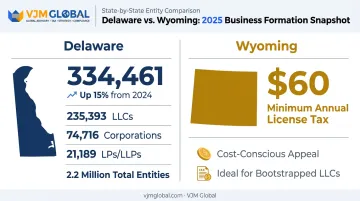
Delaware remains the heavyweight for formal entity formation: 334,461 new entities in 2025, up 15% from 2024, according to the state's Division of Corporations. That breaks down to 235,393 LLCs, 74,716 corporations, and roughly 21,189 LPs/LLPs. Delaware now hosts more than 2.2 million legal entities total, driven by its flexible corporate statute and the Court of Chancery's specialized judges.
Wyoming continues attracting cost-conscious founders. Its annual license tax is the greater of $60 or 0.0002 of in-state assets, meaning most small LLCs pay just $60 a year to stay compliant.
Choosing a state is only half the equation now. How founders actually file has changed just as much as where they file.
The Digital-First Filing Shift
Online registered agent platforms and digital filing services have compressed formation timelines dramatically. What once took weeks of mailed paperwork now often happens same-day or within a few business days, depending on the state.
This speed matters for a specific group too: international entrepreneurs and NRIs (Non-Resident Indians) are increasingly registering US entities remotely, without ever setting foot in the country. There's no citizenship requirement to own an LLC or corporation in the US, and this has fueled a steady stream of cross-border formations. It's the mirror image of the India-expansion trend covered later in this article, and it's exactly where cross-border advisory firms like VJM Global step in to handle the compliance side founders can't manage from overseas.
Regulatory and Compliance Updates Every New Business Should Know in 2026
Compliance rules shifted meaningfully over the past year. Here's what's actually current, not what used to be true.
BOI Reporting: The Rules Changed Again
FinCEN issued an interim final rule on March 26, 2025, that exempts all US-created entities and US persons from Corporate Transparency Act beneficial ownership reporting. If your LLC or corporation was formed in the United States, you're off the hook entirely.
Reporting obligations now apply only to entities formed under foreign law and registered to do business in a US state or tribal jurisdiction, unless another exemption applies.
Foreign entities registered before March 26, 2025 faced an April 25, 2025 deadline, while those registering after that date get 30 calendar days following their effective-registration notice. As of this writing, FinCEN's official BOI page still reflects this March 2025 rule as current guidance.
State Filing Fees Are Moving
Three states show notable 2026 changes:
| State | 2026 Change | Detail |
|---|---|---|
| Pennsylvania | New annual report | $7 fee for LLCs/corps; deadlines vary by entity type |
| Texas | Threshold increase | No-tax-due threshold rose to $2.65M for 2026-2027 |
| California | Fee stays, exemption ends | $800 LLC tax remains; first-year exemption no longer applies |
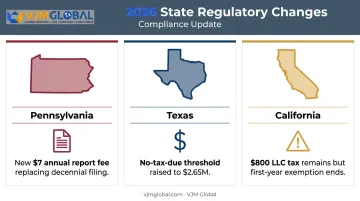
Pennsylvania's shift is the biggest structural change: it replaced its old decennial report with an annual one, meaning PA entities now file every year instead of once a decade.
Federal Tax Provisions Worth Tracking
Two numbers changed for 2026:
- Section 179 deduction ceiling: now $2.56 million, with phaseout starting above $4.09 million
- Bonus depreciation: qualifying property acquired after January 19, 2025 generally gets permanent 100% first-year depreciation under recent legislation
Property acquired before that January cutoff mostly stays under the older 40% phase-down rule, so timing your equipment purchases matters.
EIN Applications and IRS Processing
Getting an EIN is a common early hurdle for founders based outside the US. The December 2025 Form SS-4 instructions remain the latest procedural guidance. Online EIN applications still process immediately for eligible applicants with a US address and a responsible party holding a valid SSN or ITIN.
International founders without an SSN/ITIN aren't locked out. They can:
- Enter "foreign" or "N/A" on line 7b
- Call the IRS international line at 267-941-1099
- Fax the application (roughly four business days for processing)
- Mail it (roughly four weeks)
First-Time Employer Obligations
Once your entity is registered and staffed, wage compliance becomes the next checkpoint. 19 states raised minimum wages effective January 1, 2026, per Forbes. California now sits at $16.90/hour, Washington at $17.13, and Arizona at $15.15. Federal minimum wage remains unchanged at $7.25.
New employers need to: obtain an EIN, collect W-4s, register for state unemployment tax, and start filing Form 941 quarterly once payroll begins.
Foreign Ownership Still Triggers Separate IRS Rules
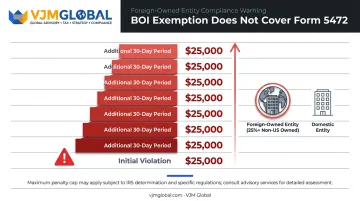
Here's the catch many international founders miss: BOI exemption doesn't mean foreign-owned US entities are off the compliance hook entirely. If a US corporation is 25% or more foreign-owned, Form 5472 filing is still mandatory. Nonfiling penalties start at $25,000 per violation, and continued failure adds another $25,000 for each additional 30-day period. For companies juggling US, UK, and Indian entities, tracking which forms apply where is often the hardest part of expansion.
Choosing the Right Business Structure in Light of These Changes
Structure decisions now carry more weight than they did a few years ago, mostly because compliance costs and tax treatment diverge more sharply by entity type.
Quick comparison:
- LLC — flexible, pass-through taxation by default, minimal formalities. Good default for most single-owner or small partner groups.
- S-Corp — pass-through treatment, avoids double taxation, but capped at 100 shareholders and one class of stock. Domestic ownership only.
- C-Corp — separate taxpayer status, unlimited shareholders, no ownership restrictions. Standard choice for anyone planning to raise venture capital.
That comparison hides one wrinkle: foreign ownership immediately rules out S-Corp status, since only US persons can hold S-Corp shares. This eliminates an entire structure option for many international founders before they even get to tax strategy, including those planning a future expansion into markets like India.
State selection interacts directly with these choices. Delaware's Court of Chancery and investor familiarity make it the default for anything targeting outside capital. Wyoming's low $60 annual tax suits bootstrapped LLCs with no investment plans. Your home state might make sense if you're not planning multi-state operations, since it skips the extra cost of a registered agent in a state where you don't operate.
Before locking in a structure, weigh these questions:
- Outside investment plans — raising capital favors Delaware C-Corp
- Multi-state operations — this affects registered agent and foreign qualification costs
- International expansion, including into markets like India, affects entity flexibility down the line
Common Formation Mistakes That Cost Time and Money
Even with the BOI exemption simplifying one compliance layer, founders still trip over avoidable errors.
The mistakes that show up most often:
- Assuming BOI exemption covers everything. It doesn't apply to foreign-registered entities operating in the US, and Form 5472 obligations for foreign-owned corporations remain fully in force
- Chasing the cheapest formation service without reading what's excluded — registered agent renewal fees, annual report filing support, and compliance alerts often cost extra after the first year
- Delaying the EIN application or business bank account setup after formation, which stalls payroll registration and creates a compliance backlog right when you need to move fastest
That last one compounds quickly. Miss the EIN step and you can't open a business bank account, can't run payroll, and can't file required state tax registrations. Everything downstream stalls until that single number arrives.
For founders managing this from abroad, these are exactly the sequencing errors that firms like VJM Global help clients avoid — coordinating EIN applications, registered agent renewals, and compliance calendars so nothing falls through the cracks during the first year.
Going Global: What US Founders Should Know About Cross-Border Expansion
A growing number of US businesses are looking past domestic formation entirely and eyeing international markets, especially India, for cost-effective operations and talent access. US-India goods and services trade hit $212.3 billion in 2024, up 8.3% year-over-year, according to USTR data.
Setting up in India isn't the same exercise as filing LLC paperwork in Delaware. Key differences US founders need to plan for:
- Entity structuring — private limited companies get the automatic FDI route in most sectors; LLPs only qualify where 100% FDI is allowed without conditions
- FDI compliance — sector caps and government approval requirements vary widely, so the "right" entity depends entirely on your industry
- Tax treaty considerations — cross-border tax treatment between the US and India affects how profits, royalties, and management fees flow back home
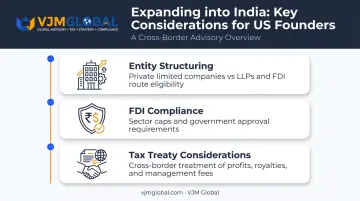
This is where domestic formation experience stops being useful. A Delaware LLC filing takes a few days and a few hundred dollars. An Indian entity setup, by contrast, involves sector classification, FDI route determination, and ongoing FEMA compliance — territory most US-based accountants and formation services haven't touched.
VJM Global fills that gap. Drawing on 30+ years in tax, audit, and advisory work, the firm has guided more than 500 American business owners through Indian market entry, from entity selection through FDI route determination.
That support doesn't stop at filing. It extends to the recurring compliance obligations that follow, the same way domestic formation requires attention well past day one.
Frequently Asked Questions
How will a new company be created?
Founders choose a business structure, register with their state, obtain an EIN from the IRS, and complete required tax and compliance registrations. The exact sequence varies slightly by state and entity type.
What is the current status of BOI reporting for new businesses?
Since March 2025, all US-created entities and US persons are exempt from BOI reporting under FinCEN's interim final rule. Only foreign-registered entities operating in the US still face this requirement.
Which US state is best for forming a new business in 2026?
It depends on your goals. Delaware suits founders planning to raise investment, Wyoming suits low-cost bootstrapped LLCs, and your home state often makes sense if you're not operating across multiple states.
How long does it take to form a company in the US?
Timelines vary by state and filing method, ranging from same-day online filing to a few weeks for mailed paperwork. Digital-first registered agent services have notably sped this up in recent years.
Can a foreign national or NRI form a business in the US?
Yes. There's no citizenship or residency requirement to own an LLC or corporation in the US, though obtaining an EIN without an SSN requires an alternate application process. Firms like VJM Global assist NRIs and foreign nationals through this exact application step.
What ongoing compliance is required after forming a US company?
Expect annual reports, registered agent maintenance, state and federal tax filings, and payroll registrations if you hire employees. Foreign-owned entities also need to track Form 5472 filing requirements separately, an area where cross-border advisory support helps avoid costly penalties.