Lower entry barriers, access to two massive consumer markets, and a well-educated workforce are pulling in a wider mix of founders than ever. Local residents, side-hustlers testing an idea on weekends, out-of-state entrepreneurs, and even foreign companies expanding into the US are all filing paperwork in Trenton right now.
This guide walks through exactly what it takes to start and legally operate a small business in New Jersey, step by step.
Key Takeaways
- Size standards from the SBA determine small business status in NJ, varying by industry
- Six core steps: entity structure, name registration, state filing, EIN, licensing, and banking
- NJ requires two-part registration (formation plus tax) that trips up many first-timers
- Total state filing costs are modest, but licenses and services add up
- Budget several weeks, not days, from idea to fully compliant launch
What Qualifies as a Small Business in New Jersey?
There's no single New Jersey definition of "small business." Instead, federal SBA size standards decide it, based on a business's six-digit NAICS industry code and either average annual receipts or employee count, including affiliates. A retailer, a trucking company, and a consulting firm each face different thresholds.
A few things to know:
- New Jersey itself doesn't issue a separate small-business certification for everyday operation
- Size standards mostly matter when applying for grants, government contracts, or SBA-backed loans
- Most NJ small businesses use one of four structures: sole proprietorship, general partnership, LLC, or corporation
LLCs remain the most popular pick among New Jersey founders. They offer liability protection without the formal overhead of a corporation, which explains why they show up so often in the state's small business count. For founders weighing structures against SBA thresholds, an entity-formation specialist like VJM Global can simplify the decision.
Why Start a Small Business in New Jersey? (When It Makes Sense)
New Jersey works especially well when your business benefits from proximity to major metro buyers without paying Manhattan-level rent. Consider the numbers:
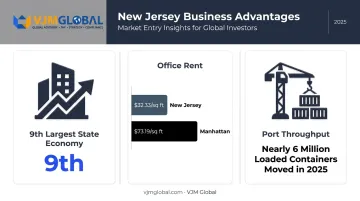
- New Jersey's economy ranked 9th among all US states by current-dollar GDP, per the Bureau of Economic Analysis
- Office space in New Jersey averaged $32.33 per square foot in Q4 2025, compared to $73.19 per square foot in Manhattan, according to Cushman & Wakefield
- The Port of New York and New Jersey moved nearly 6 million loaded containers in 2025, according to Port Authority of New York and New Jersey data, making it the busiest port complex on the East Coast
That combination, big-city access at a fraction of the cost, is why founders keep choosing NJ over crossing the river entirely.
Business Ideas With Real Demand Right Now
Certain sectors line up especially well with New Jersey's strengths:
- Consulting and professional services: feeds NYC and Philly corporate demand without NYC overhead, spanning legal, accounting, and marketing firms serving both metros
- Food service and restaurants: dense suburban and urban populations support steady traffic
- Retail: proximity to two metro consumer bases
- Trucking and logistics: direct benefit from Port of NY-NJ throughput
What to Know Before You Start a Small Business in New Jersey
Most first-time founders underestimate three things: the real cost, the paperwork volume, and the time between idea and steady operation. None of it is prohibitive, but skipping the planning stage causes delays later.
Timeline and Real Costs
Expect several weeks between your name search, state registration processing, and getting licensed, not the same-day turnaround some online ads imply. Beyond the base state filing fee, plan for:
- Optional name reservation ($50 for 120 days)
- Registered agent service, if you're not acting as your own
- Municipal and industry-specific licenses or permits
- General liability insurance and workers' compensation if you'll hire staff
- Optional professional filing assistance
Choosing Your Structure Matters Early
Your structure decision locks in liability exposure and tax treatment from day one:
| Structure | Liability | Taxation |
|---|---|---|
| Sole proprietorship | Unlimited personal liability | Pass-through, filed on personal return |
| General partnership | Unlimited, shared among partners | Pass-through |
| LLC | Limited liability | Pass-through by default |
| Corporation | Limited liability | Corporate tax, double taxation risk unless S-corp |
Funding Shapes Structure
How you plan to fund the business often dictates which structure fits best:
- Bootstrapping: sole proprietorship or single-member LLC works fine
- SBA-backed loans: lenders usually want a formal entity, often an LLC or corporation
- Outside investment: investors typically require a corporation for stock issuance
- Friends and family funds: an LLC with a clear operating agreement avoids future disputes
Out-of-State and Foreign Founders
New Jersey requires every entity to maintain a registered agent with a physical NJ street address, regardless of where the owner actually lives. This applies whether you're based in California or Mumbai.
Firms like VJM Global work specifically with international founders and companies setting up their first US-based entity. They handle registered agent arrangements and initial compliance so the paperwork doesn't stall the launch.
How to Start a Small Business in New Jersey – Step by Step
This is the practical, execution-level breakdown. Three mistakes come up constantly: rushing the name search, assuming one filing covers both formation and tax registration (it doesn't), and delaying licensing until after launch.
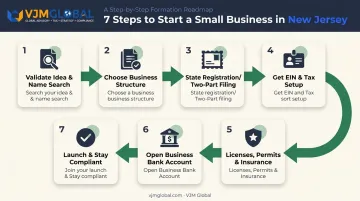
Step 1 – Validate Your Idea and Choose a Compliant Name
Before touching any paperwork, confirm real demand exists. Talk to potential customers. Pre-sell if you can.
Once you're confident, run your proposed name through the NJ Business Name Search tool to confirm it's 'distinguishable' from existing registrations. If you're not ready to file immediately, reserve the name for 120 days using Form UNRR-1 for a small fee.
Step 2 – Choose Your Business Structure
Compare liability exposure and tax treatment across sole proprietorship, general partnership, LLC, and corporation (see the table above). LLCs remain the default choice for most small business owners: liability protection, pass-through taxation, and far fewer ongoing formalities than a corporation.
Step 3 – Register With the State of New Jersey (Two-Part Filing)
This is where most founders get tripped up, because it's genuinely two separate filings:
- File the Public Records Filing/Certificate of Formation with the NJ Division of Revenue and Enterprise Services. The current fee is $100 for domestic formation or foreign authorization, per the current DORES fee schedule.
- File Form NJ-REG separately for state tax registration. This step is required to bid on public contracts, apply for state grants, or claim NJ tax credits, and it's due at least 15 business days before you start doing business.
Step 4 – Get an EIN and Understand Core Tax Obligations
Apply for a free EIN directly through the IRS, but only after your state formation is approved. Domestic applicants can typically get one instantly online; applicants whose principal business is outside the US need to apply by phone, fax, or mail.
Core tax duties to plan for:
- File state income tax returns
- Register for sales tax, if you sell taxable goods or services
- Register for payroll tax, once you hire employees
- File your annual report (more on this below)
Step 5 – Obtain Required Licenses, Permits, and Insurance
Apply for a general business license or tax certificate through your city or township. You may also need industry-specific permits, such as health department approval for food service or Division of Consumer Affairs registration for home improvement contractors. Requirements vary heavily by municipality.
If you plan to hire, secure general liability insurance and workers' compensation coverage before your first employee starts.
Step 6 – Open a Business Bank Account
Keep business and personal finances separate to protect your limited liability status. Gather these documents before applying:
- EIN confirmation letter
- Certificate of Formation
- Ownership or partnership agreements
Step 7 – Launch and Stay Compliant
Set up basic tracking early so you know which marketing channels actually bring in paying customers. Mark your annual report deadline on the calendar; it's due by the last day of your formation-anniversary month, and missing it puts your business out of good standing.
Costs, Ongoing Compliance, and Getting It Right
Here's a realistic cost summary for budgeting purposes:
| Item | Amount |
|---|---|
| Formation or foreign authorization | $100 |
| Optional name reservation (120 days) | $50 |
| Annual report | $75 |
| Licenses and permits | Varies by activity and municipality |
| Registered agent service | Varies by provider |
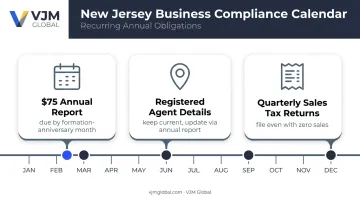
Ongoing compliance calendar:
- File your $75 annual report every year by your formation-anniversary month
- Keep registered agent details current (update via the annual report if it changes)
- File sales tax returns quarterly if you're a registered seller, even when reporting zero sales
Starting a small business in New Jersey comes down to sequencing: validate, register, license, then launch. Rushing any one step tends to create rework later.
This kind of multi-step compliance can be especially tricky for multinational companies and first-time foreign business owners setting up their first US entity. VJM Global supports entity formation, registered agent services, and ongoing tax and accounting compliance, so the paperwork doesn't compete with actually running the business.
Frequently Asked Questions
How much does it cost to start a small business in NJ?
The state filing fee is $100 for formation. Add optional costs like a $50 name reservation, municipal licenses, and registered agent service, and most founders spend $150-$400 total after those extras.
What qualifies as a small business in NJ?
There's no single NJ definition. Federal SBA size standards apply, based on your industry's NAICS code and either employee count or annual receipts, which vary widely by sector.
What is a good business to start in NJ?
Consulting, food service, retail, trucking/logistics, and professional services all show strong demand, largely thanks to NJ's access to the NYC and Philadelphia metro markets.
How long does it take to start a business in New Jersey?
State formation processing plus NJ-REG registration typically takes several weeks. Licensing requirements, especially industry-specific ones, can extend that timeline further.
Do I need a registered agent for my New Jersey business?
Yes. Every NJ entity must maintain a registered agent with a physical New Jersey street address. Many founders, especially those out of state, use a professional registered agent service.
Can I start a business in New Jersey if I live in another state or country?
Yes. You'll need a New Jersey-based registered agent regardless of where you live. If your business is already formed elsewhere, you'll file for foreign qualification instead of new formation.