The total cost of a Delaware LLC swings widely based on your filing method, registered agent choice, compliance needs, and whether you're a US resident or an international founder. A DIY filer pays far less than someone building a full compliance package for a fintech startup with multi-state operations.
This guide breaks down state fees, annual costs, hidden charges, and how to budget correctly for a Delaware LLC going into 2026.
Key Takeaways
- Setup costs range from $110 for DIY filing to $1,000+ for full-service packages with expedited processing.
- Annual maintenance runs roughly $300-$400 in franchise tax plus a registered agent fee.
- Non-resident founders typically pay more due to EIN delays, apostille needs, and foreign qualification fees.
- Ongoing compliance costs often exceed your initial setup cost within the first two years.
How Much Does It Cost to Start a Delaware LLC? (Pricing Overview)
Delaware LLC costs aren't fixed. They depend on your filing method, which add-on services you choose, and whether your business is US-based or foreign-owned. A US-resident founder acting as their own registered agent pays a fraction of what a non-resident founder with cross-border operations will spend.
Three budgeting mistakes trip up new founders repeatedly:
- Franchise tax is often underestimated: Delaware charges this fee annually regardless of revenue, even if your LLC never earned a dollar.
- Registered agent pricing varies widely — skipping a comparison can cost you more than expected.
- Post-formation accounting often surprises founders because bookkeeping and tax filing become the largest recurring expense.
Typical Cost Range
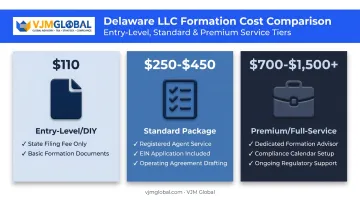
The Delaware Division of Corporations' current fee schedule lists the Certificate of Formation filing fee at $110. That's your absolute floor cost. Everything above that reflects the services you layer on top.
| Tier | Starting Cost | What's Included | Best For |
|---|---|---|---|
| Entry-level/DIY | $110 | State filing fee only, self-filed Certificate of Formation | US-resident founders comfortable serving as their own registered agent |
| Standard package | $250-$450 | Filing fee + first-year registered agent + EIN assistance + operating agreement template | Startups, SaaS founders, small business owners wanting guided setup |
| Premium/full-service | $700-$1,500+ | Expedited filing, foreign qualification, compliance monitoring, virtual office, accounting add-ons | Non-resident founders, fintech/high-risk businesses, multi-state operators |
These ranges typically cover filing and basic registered agent service. They usually exclude ongoing franchise tax, accounting support, and business banking setup. These costs show up later and catch new founders off guard.
Basic DIY formation works well if you're a Delaware resident (or comfortable acting as your own registered agent from a US address) and don't mind handling compliance calendars yourself.
Standard formation packages bundle the essentials most founders actually need: filing, a year of registered agent service, EIN help, and a template operating agreement.
Premium packages make sense for non-resident founders navigating EIN processing without a Social Security Number, businesses planning to register in multiple states, or fintech companies facing heavier compliance scrutiny.
Key Factors That Affect Delaware LLC Formation Costs
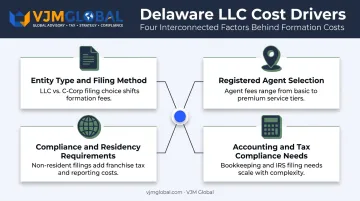
Delaware LLC pricing hinges on several factors: the filing choices you make, your registered agent setup, your compliance and residency obligations, and how you handle bookkeeping afterward. Here's how each one affects your total cost.
Entity Type and Filing Method
Standard processing is baked into your $110 filing fee. Need it faster? Delaware charges separately for speed:
- 24-hour processing: $50 additional
- Same-day processing: $100 additional
- Two-hour processing: $500 per document
- One-hour processing: $1,000 per document
Online filing is standard practice now, though Delaware doesn't publish a stated price difference between online and mail submission.
Your entity structure affects costs too. Single-member LLCs generally need simpler operating agreements than multi-member entities, where ownership splits, voting rights, and profit distribution require more detailed (and often pricier) drafting.
Registered Agent Selection
Delaware law requires every LLC to maintain a registered agent with a physical Delaware address, regardless of who forms the entity. This isn't optional, and failing to maintain one risks administrative dissolution of your LLC. Basic agent services typically run $50 to $150 per year, depending on whether you're buying a bare-bones address service or a premium package with mail forwarding and compliance reminders. Many founders bundle this service with their initial formation package, then switch to a standalone provider for lower renewal costs.
Compliance and Residency Requirements
Non-resident and international founders face costs that US-based owners rarely encounter:
- AML/KYC document preparation for banking and compliance verification
- Apostille services for authenticating documents abroad
- EIN processing delays since the IRS requires extra verification steps for applicants without a US Social Security Number
If your business operates outside Delaware, you'll also need to budget for foreign qualification fees, charged per additional state where you register to do business.
Accounting, Bookkeeping, and Tax Compliance Needs
This is where costs add up fastest. Ongoing bookkeeping, US federal tax filing, and financial reporting usually become the largest recurring expense after your LLC is formed, larger than the franchise tax itself for many founders.
Founders managing both US and Indian financial ties, including NRIs and OCIs, often outsource this work to specialized cross-border accounting firms. VJM Global, for instance, works with founders navigating US-facing compliance alongside Indian tax obligations, offering DTAA advisory, cross-border bookkeeping, and financial reporting support so founders aren't juggling two regulatory systems alone.
Full Cost Breakdown: One-Time vs Recurring Delaware LLC Fees
The total cost of a Delaware LLC extends well beyond that initial filing fee. Here's the complete picture, split by one-time versus recurring obligations.
| Fee | Type | Amount | Notes |
|---|---|---|---|
| Certificate of Formation | One-time | $110 | Paid at filing |
| Registered agent service | Recurring (annual) | $50-$150 | Bundles mail forwarding, compliance alerts |
| Delaware franchise tax | Recurring (annual, due June 1) | $300-$400 | Flat fee regardless of revenue |
| EIN registration | One-time | $0 from IRS | Third-party services charge for faster processing |
| Operating agreement | One-time | Free-$500+ | Self-drafted, template, or attorney-drafted |
| Certified copy | One-time/periodic | $50 + $2/page | Needed for banking, licensing |
| Good standing certificate | One-time/periodic | $50 (short-form) / $175 (long-form) | Required for foreign registration |
| Apostille | One-time/periodic | $30 each | For documents used abroad |
| Accounting/tax filing support | Recurring | Varies by complexity | Often the biggest ongoing cost |
Franchise Tax: The Recurring Cost Every LLC Owes
Every LLC owes an annual franchise tax whether or not the business generated revenue. Under Delaware's official annual tax instructions, the tax due June 1, 2026, covered calendar year 2025 at $300. Missing that deadline triggers a $200 penalty plus 1.5% monthly interest on both the tax and penalty combined.
That flat rate is changing. House Bill 400 raises the annual tax to $400 for calendar year 2026, payable by June 1, 2027. Budget for the higher figure going forward, not the legacy $300 rate.
One-Time Setup Costs and Ongoing Support
EIN registration is free directly through the IRS. Non-resident founders without an SSN, however, often pay a third-party service to speed up processing and avoid application errors.
Operating agreements vary more widely: a free downloadable template covers simple single-member LLCs, while attorney-drafted documents for multi-member structures with complex ownership can run several hundred dollars.
Beyond initial filing, a few additional documents come into play later. Certified copies, good standing certificates, and apostilles aren't needed at formation, but you'll typically order them when opening a US bank account, applying for a foreign business license, or changing your LLC's name.
DIY Formation vs Using a Formation/Registered Agent Service
Self-filing and hiring a formation service lead to very different cost and risk profiles. Here's the comparison founders actually need.
| Factor | DIY | Formation Service |
|---|---|---|
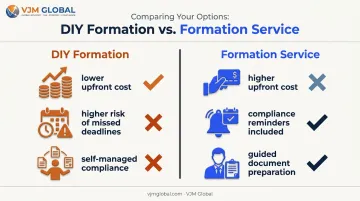
| Upfront cost | Lower: just the $110 state fee | Higher: bundles registered agent, EIN help, templates |
| Risk of errors/missed deadlines | Higher: incomplete filings, missed franchise tax dates, weak operating agreements | Lower: compliance reminders and guided document prep |
| Long-term value | May require corrective filings or legal help later | Often includes ongoing compliance support |
DIY makes sense when:
- You're organized and comfortable tracking your own June 1 franchise tax deadline
- Filings stay simple, with no unusual ownership structure or multi-state tax issues
- Time exists to research requirements instead of paying someone else to
A missed deadline costs $200 plus monthly interest, quickly erasing whatever you saved by skipping a formation service.
Formation services fit founders who'd rather not manage compliance calendars themselves:
- Compliance reminders flag deadlines before they turn into penalties
- Guided document prep reduces errors in operating agreements and initial filings
- The upfront premium buys ongoing support, not just a one-time filing
How to Budget Correctly for Your Delaware LLC (and Mistakes to Avoid)
There's no single "right" Delaware LLC budget. The correct number depends on your business activity, residency status, and long-term compliance needs.
Factors to weigh before you commit to a budget:
- Whether you'll operate in states beyond Delaware (triggers foreign qualification fees)
- Your residency status and banking requirements
- Needing professional accounting or tax support from day one
- Long-term franchise tax and registered agent renewal obligations
Mistakes that cost founders the most:
- Focusing only on the initial filing fee while ignoring annual franchise tax and agent renewal costs
- Underestimating EIN and banking onboarding delays for non-resident founders
- Skipping professional bookkeeping support until compliance issues force the issue
Avoiding these mistakes often comes down to bringing in professional support early rather than after problems surface. VJM Global's back-office and tax compliance services help founders manage both US entity obligations and Indian financial ties. This keeps records accurate as the business scales, rather than scrambling to fix gaps later.
Frequently Asked Questions
How much does it cost to start an LLC in Delaware?
The state filing fee is $110. Once you add a registered agent and EIN assistance, total setup costs typically land between $250 and $450 for a standard package.
What is the Delaware LLC annual franchise tax?
The flat annual tax is $300 for calendar year 2025, rising to $400 for calendar year 2026. It's due every June 1, and late payments trigger a $200 penalty plus 1.5% monthly interest.
Do I need a registered agent for a Delaware LLC?
Yes, it's a legal requirement for every Delaware LLC, and annual fees typically range from $50 to $150 depending on the service level you choose.
How much does an EIN cost for a Delaware LLC?
An EIN is free directly from the IRS, though non-US founders without a Social Security Number often pay a third-party service for faster, error-free processing.
Can a non-US resident form a Delaware LLC?
Yes, international founders can form and manage a Delaware LLC entirely remotely, though they should budget extra for apostille services, AML/KYC documentation, and potential EIN delays.
What happens if I don't pay my Delaware franchise tax on time?
You'll face a $200 penalty plus 1.5% monthly interest on the outstanding balance, and prolonged non-payment risks losing your LLC's good standing status with the state.