Introduction
Delaware is home to more than 2.28 million active business entities. Over two-thirds of Fortune 500 companies are incorporated there, according to the Delaware Division of Corporations' 2025 annual statistics.
Indian founders are taking notice. SaaS companies, export businesses, and consulting practices are increasingly forming Delaware LLCs. The draw includes reaching US customers, tapping payment gateways such as Stripe and PayPal, and attracting investors who prefer familiar US structures.
The formation process itself is genuinely simple. What most generic guides skip is everything that follows. Think EIN applications with no SSN, RBI and FEMA reporting back home, dual tax filings, and opening a bank account without ever visiting a branch.
This guide covers the benefits, what you need before filing, the exact formation steps, the tax and compliance obligations specific to Indian owners, and the mistakes that trip up first-time founders.
Key Takeaways
- Indian residents and companies can own 100% of a Delaware LLC with no US visit, Green Card, or SSN
- Formation requires a registered agent, a Certificate of Formation, and an EIN via a special IRS process
- Indian owners must handle RBI/FEMA reporting when funding or holding the LLC
- Missing Form 5472 can trigger a $25,000 penalty, even with zero revenue
- Delaware costs stay low, but compliance gaps on either side risk good standing
Why Indian Entrepreneurs Choose Delaware
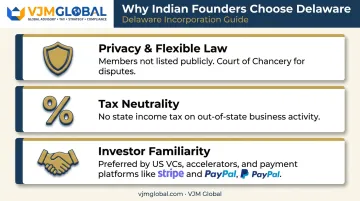
Delaware built its reputation on flexible LLC statutes and a specialised Court of Chancery that resolves business disputes through judges experienced in corporate law, not juries. Members and managers aren't listed on the public Certificate of Formation either, which gives Indian owners a layer of privacy most home states don't offer.
There's also a tax angle. Delaware doesn't impose state income tax on an LLC that doesn't conduct business within the state, which suits Indian founders selling internationally through e-commerce, SaaS, or consulting models. Indian founders are taxed where their business actually operates, not where it's registered.
Investor and platform expectations matter too. A Delaware entity is frequently a baseline requirement for:
- US venture capital firms doing due diligence
- Startup accelerators structuring cap tables
- Payment platforms like Stripe, PayPal, and Amazon US that expect a recognisable US legal structure
Founders from India and other countries have consistently chosen Delaware when raising sizable growth capital, since American investors are more comfortable with the entity type they already know. That familiarity, rather than any single tax break, is often the deciding factor for Indian export and tech founders weighing where to incorporate.
What You Need Before Forming a Delaware LLC From India
Gathering the right documents and understanding your India-side obligations upfront prevents delays on both the US filing and the RBI reporting that follows.
Business & Personal Documents
Keep these ready before you start:
- Passport copy for each member or owner
- Proof of Indian residential address
- Two to three proposed LLC name options (in case your first choice is taken)
- Full legal names and ownership percentages for every member
Registered Agent Requirement
Since Indian founders don't reside in Delaware, state law requires you to appoint a commercial registered agent with a physical Delaware street address. This agent receives legal and state correspondence on your behalf.
Typical annual fees range from $50 to $125, depending on the provider. Look for one that offers mail scanning and forwarding — a small feature that matters a lot when you're managing everything from India.
RBI/FEMA Readiness
This is the piece most US-focused guides never mention:
- Individuals funding the LLC personally must stay within Liberalised Remittance Scheme (LRS) limits when remitting funds abroad
- Indian companies investing in the LLC typically use the Overseas Investment (ODI) route through an Authorized Dealer bank
- Ongoing compliance, including the Annual Performance Report (APR) filed with the RBI each year for ODI-route investments, keeps your structure in good standing
Sorting this out before you file saves you from scrambling once the Certificate of Formation is already approved. Advisory teams like VJM Global's FEMA specialists routinely help founders pick the correct remittance route before any paperwork reaches the RBI.
Step-by-Step Guide to Forming a Delaware LLC From India
These are the core state-level steps, sequenced for someone filing entirely remotely from India.
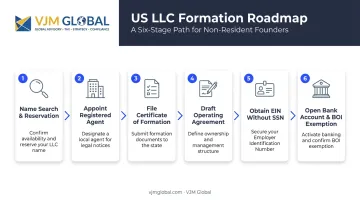
Step 1: Choose and Check Your LLC Name
Search the Delaware Division of Corporations' name database to confirm your chosen name is distinguishable from existing entities. It must include "LLC" or "L.L.C." at the end.
If you're not filing immediately, you can reserve the name for 120 days for a $75 fee, useful if you're still finalising documents or waiting on funds.
Step 2: Appoint a Delaware Registered Agent
Select a commercial registered agent service (physical presence in Delaware isn't possible for you). Confirm upfront that they:
- Forward legal notices and state mail promptly
- Offer digital mail scanning for overseas owners
- Provide renewal reminders so you don't miss annual fees
Step 3: File the Certificate of Formation
File online or by mail with the Delaware Division of Corporations. The form requires your LLC name, registered agent details, and an organiser's signature. The standard filing fee is $110, with an optional certified copy available for an extra $50.
Step 4: Draft an Operating Agreement
Delaware doesn't legally require an operating agreement, but skipping it is a mistake for foreign-owned LLCs. It formally defines:
- Ownership percentages among Indian co-founders or investors
- Profit and loss distribution
- Management rights and decision-making authority
Without one, disputes between co-founders have no documented framework to fall back on.
Step 5: Obtain an EIN Without an SSN
Founders without an SSN or ITIN enter "Foreign" on Form SS-4 and apply through an alternate channel instead of the IRS's online portal:
| Method | How It Works | Typical Timing |
|---|---|---|
| Phone | Call the IRS international line (267-941-1099) | Same call, if approved |
| Fax | Send SS-4 with a return fax number | Around 4 business days |
| Send to IRS EIN International Operation, Cincinnati | Roughly 4 weeks |
Budget for this delay. It's the single biggest timing difference between a US-resident founder and an Indian one.
Step 6: Open a US Business Bank Account and File BOI
Traditional banks often expect an in-person visit, which isn't practical from India. Most Indian founders instead use remote-friendly fintech options like Mercury or Wise, which accept EIN and formation documents digitally.
One piece of good news: under FinCEN's March 2025 rule change, a Delaware-created LLC is exempt from Beneficial Ownership Information (BOI) reporting, even if it's 100% Indian-owned. The exemption is based on where the entity was created, not who owns it.
Tax and RBI/FEMA Compliance for Indian-Owned Delaware LLCs
Forming the LLC is step one. Indian owners carry dual compliance obligations across both countries, and this is where most generic guides stop short.
US Federal and State Tax Obligations
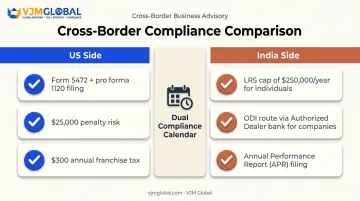
A foreign-owned single-member LLC is a "disregarded entity" for tax purposes, but that doesn't mean you skip filing. You must still submit Form 5472 with a pro forma Form 1120 every year, even with zero revenue.
Miss this filing and the IRS can impose an initial penalty of $25,000, with an additional $25,000 for every 30-day period the failure continues after notice, according to IRS instructions for Form 5472.
A few more specifics:
- Multi-member LLCs default to partnership taxation, requiring Form 1065 plus a K-1 for each member
- Delaware charges a flat $300 annual franchise tax, due each June 1
- Unlike corporations, Delaware LLCs don't file an annual report, just the tax payment
RBI/FEMA Reporting From the India Side
Indian companies investing in the LLC must route funds through an Authorized Dealer bank under RBI's Overseas Investment framework, then file an Annual Performance Report (APR) for that entity each year.
Individual investors face a different rule. Resident individuals funding a Delaware LLC personally must stay within the LRS cap of USD 250,000 per financial year, as confirmed by the Reserve Bank of India's LRS FAQs. They must also report the investment as required under FEMA.
How Professional Guidance Helps Avoid Penalties
Running two compliance calendars (US filings like the EIN and Form 5472, alongside India-side RBI and FEMA reporting) is genuinely difficult without someone who's handled both. Missed deadlines on either side can mean penalties, frozen bank relationships, or an LLC that falls out of good standing.
VJM Global's team of Chartered Accountants works with founders on exactly this kind of cross-border complexity, from FEMA and RBI advisory to international tax planning for entities operating across the US and India. Having one team track both jurisdictions removes the guesswork of figuring out which deadline applies where.
Common Mistakes Indian Founders Make
A few errors show up repeatedly among first-time filers:
- Treating formation as purely a US matter and skipping RBI/FEMA reporting until a compliance review flags the gap
- Underestimating ongoing costs like registered agent renewals, franchise tax, and US tax prep fees, which can push an LLC out of good standing
- Delaying the EIN application, which stalls bank account setup and blocks access to payment gateways like Stripe or PayPal for weeks
- Mixing personal and business funds across accounts, which risks piercing the LLC's liability protection entirely
None of these mistakes are complicated to avoid, but they do require treating the LLC as an ongoing obligation rather than a one-time filing. Working with advisors familiar with both US requirements and Indian RBI/FEMA rules, such as VJM Global, catches these issues before they become compliance headaches.
Frequently Asked Questions
Can a non-US citizen open an LLC in Delaware?
Yes. Delaware allows full foreign ownership with no residency, visa, or SSN (Social Security Number) requirement, as long as you appoint a registered agent with a Delaware address.
What is required to form an LLC in Delaware?
You need a unique LLC name, a Delaware registered agent, and a filed Certificate of Formation along with the $110 state filing fee.
Do Indian founders need to visit the US to form a Delaware LLC?
No. The entire process, from name reservation to filing, can be completed remotely through a registered agent and Delaware's online filing system.
Is RBI approval required for Indian residents to set up a Delaware LLC?
There's no blanket "approval" process, but individuals must follow LRS remittance rules and companies must use the Overseas Investment (ODI) route with proper reporting.
How is a Delaware LLC taxed if owned by an Indian company or resident?
Single-member LLCs are typically disregarded entities requiring Form 5472 and a pro forma 1120. Profits may also be taxable in India depending on residency status and the India-US tax treaty.
Can I open a US business bank account for my Delaware LLC without an SSN?
Yes, once you have an EIN (Employer Identification Number). Fintech providers like Mercury and Wise are commonly used by Indian founders, though requirements vary by provider.